Profile of an occupation – saddler
Saddlers manufacture individual, artistic and robust craft trades products such as hoods for vintage convertibles, made-to-measure riding saddles and elegant luggage items. This profile describes the three specialisms of vehicle upholstery, riding saddlery and luxury bags and presents figures relating to training.

From horse-drawn carriages to convertibles
The craft trade of saddlery was once mainly connected with horse husbandry. Today’s occupational profile has developed and expanded from the manufacture and repair of bridles and saddles and later of carriage hoods and upholstery. Carriage hoods have now become convertible soft tops. Seat cushions and covers are needed for boats, and people like to take elegant travelling bags on aeroplanes. Saddlers must be in a position to execute their customers’ wishes and produce appealing designs without losing sight of the functionality of the item in question. Knowledge of different leather types, their properties and how to properly care for them is crucial. Mastery of techniques such as sewing, gluing and dyeing is likewise very important. This is an occupation in which quality assurance and meeting high customer expectations play a key role, regardless of whether a job comprises the complete re-equipping of a vintage car or the creation of a one-off saddle. Saddlery products are individual constructions which are readily repairable and thus sustainable. The predominant part of the company-based element of training takes place at small craft trade firms in one of the occupation’s three specialisms. There are ten vocational school locations where teaching is usually conducted in blocks, i.e. on several days in a row. Two of these locations also offer courses leading to a master craftsman qualification in saddlery and luxury bag manufacture. Once they have completed training, saddlers often develop an individual repertoire of skills which allows them to provide cross-cutting services.
Vehicle upholstery
The specialism of vehicle upholstery involves the manufacture and repair of interior fittings for vehicles. Saddlers in this area are responsible for the production of seats, door panels, roof linings, cushions and hoods. They use various materials including leather, artificial leather, soft-top fabrics, cover fabrics and carpets in order to fulfil both aesthetic and functional requirements. Knowledge of different vehicle models and of their specific demands is an important aspect of vehicle upholstery. Saddlers need to be able to read and interpret technical drawings so that they can produce accurately fitting parts.
Riding saddlery
Riding saddlery focuses on the manufacture and repair of saddles, harnesses and of other horse accessories such as bridles and reins. Saddlers working in this specialism require a deep understanding of the needs of horses and their riders so that they can craft ergonomically designed products which provide comfort, robustness and safety. This necessitates extensive knowledge of the various sorts of saddle and how they are used. Examples include jumping saddles, dressage saddles, western saddles and Spanish saddles. The repair, maintenance and care of existing equipment also form an essential component of the work.
Luxury bags
The focus in the specialism of luxury bags is on the manufacture of high-quality leather goods. These include products such as handbags, luggage, purses and wallets, belts and other accessories. Products for use in sport are also manufactured. These items range from leather balls to gymnastics apparatus and even extend to include full sets of hang-gliding equipment. Saddlers specialising in luxury bags frequently work with very high-end materials and set great store by attention to detail and precise processing. Creativity and an understanding of design are particularly important in this specialism because most products are customised.
Digital technologies
Although saddlers work with a plethora of traditional craft trade techniques, they also use modern machines and new and innovative technologies. 3D laser scanning, for instance, is deployed to measure the interior of vehicles and to determine correct material quantities. 3D printing facilitates the production of lettering and functional components when working with leather and fabrics. Riding saddles may feature sensors to monitor the vital functions of the horse.
High proportion of women in riding saddlery
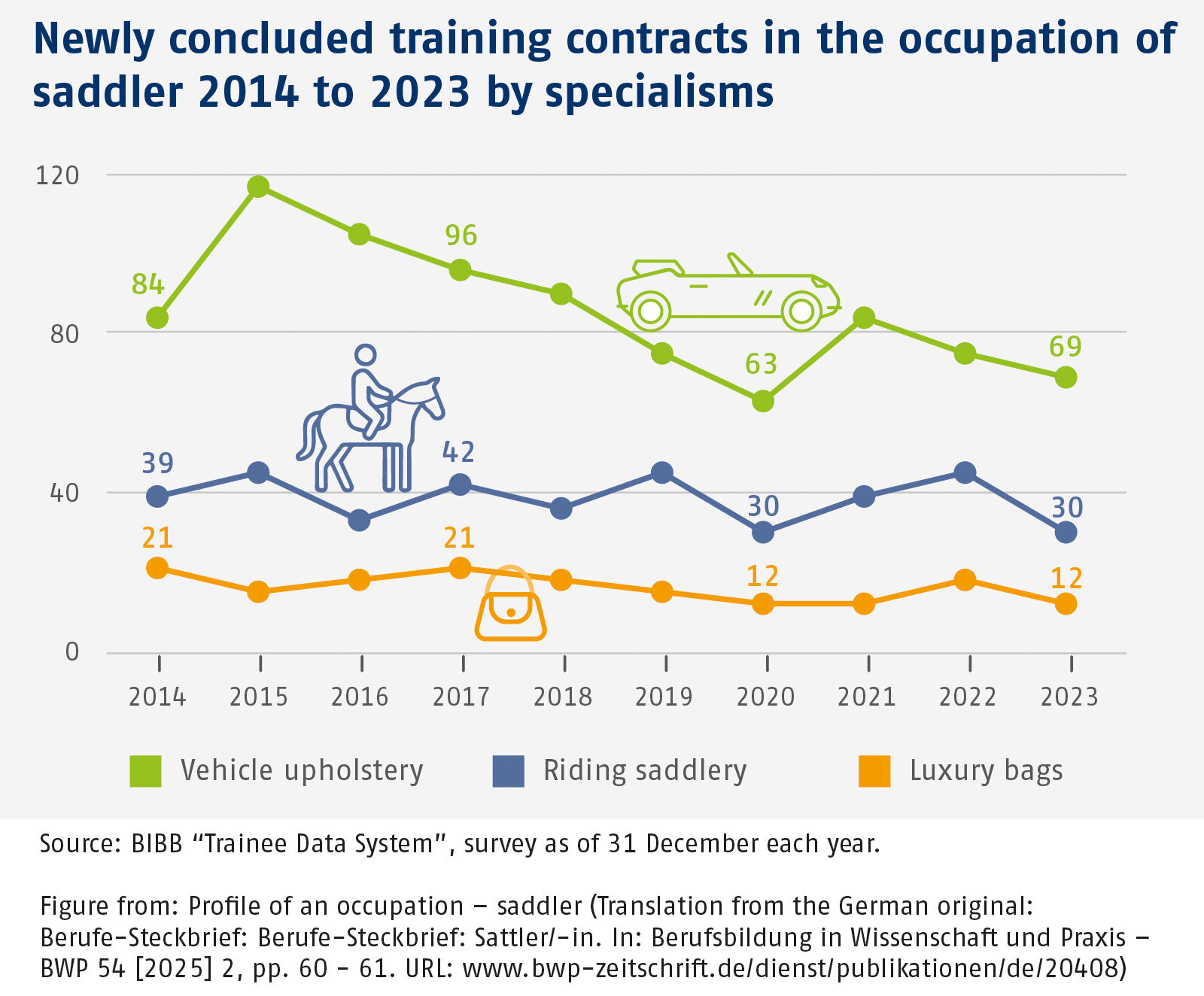
Foto-Download (Bild, 246 KB)
Saddlery is a small and specialised trade. In 2023, 111 men and women concluded new training contracts across all three specialisms. The number of newly concluded contracts in vehicle upholstery has fallen over the past ten years, whereas the popularity of the other two specialisms has remained approximately the same (see Figure). In the case of the specialism of riding saddlery, this is due to young women in particular. The average female intake over the period from 2014 to 2023 was 86 percent. Not a single man commenced training in this specialism in 2023.
At a glance
- Last update: 2005
- Duration of training: 3 years
- Area of responsibility: craft trades/trade and industry
- Training structure: training occupation with three specialisms
- Vehicle upholstery
- Riding saddlery
- Luxury bags
- DQR reference level: 4
- Advanced vocational training: master craftsman qualification in saddlery and luxury bag manufacture; certified industrial foreman (Bachelor Professional) in the specialism of leather production
Further links (in German)
BIBB website page on the occupation
BIBB “Structuring training” guide
Bundesverband Fahrzeugausstattung und Reitsportausrüstung e. V.
Podcast on the profile of the occupation featuring two trainees
(All links: status 19/05/2025) (Compiled by Arne Schambeck, BWP)
Translation from the German original (published in BWP 2/2025): Martin Kelsey, GlobalSprachTeam, Berlin