Profile of an occupation – gardener
Climate change is leading young people increasingly to seek out occupational prospects in the green economy. Gardeners make an important contribution to the environment by growing fruit and vegetables, by laying out and caring for gardens and parks, and even by tending to graveyards. Gardening is an occupation which combines craft trade skills with specialist knowledge of plants, soils, nutrients and near-natural design. This profile sets out the tasks involved in the occupation’s seven specialisms and presents figures relating to training.

Green is always good
According to a survey conducted by Harvard University, Americans experience the highest levels of professional satisfaction in the occupation of gardener (including florists). 87 percent of respondents stated that they were happy in their job. During training and whilst exercising the occupation itself, gardeners are always moving between places such as nurseries, parks, orchards and cemeteries. They may find themselves out in the fresh air, in a greenhouse or in the sales area of a garden centre. Physical work is part of the everyday routine, and sometimes this can also involve kneeling down to set plants in soil. However, even though much manual labour is required, there is also a multitude of machines and devices which can provide support. These also include new technologies such as drones, which are used to monitor the status of plants in open cultivation areas. Other examples are networked sensors to measure temperature and soil moisture, sensor-controlled irrigation systems, and 3D laser scanners that survey sites to permit the virtual planning of gardens and green spaces.
Seven specialisms
A gardener’s selected specialism also determines where he or she will be working at which times of the year. All seven specialisms have different deployment profiles.
Arboriculture: Deciduous, coniferous and fruit trees are grown in nurseries. They subsequently appear in all areas of our living environment as roadside greenery, for example, and may also be found in parks and private gardens. This specialism also encompasses the propagation and cultivation of young plants.
Cemetery gardening: Cemeteries form part of the green lungs of our cities and provide valuable habitats for plants and animals. Cemetery gardeners specialise in the professional laying out and planting of burial grounds, in the upkeep of graves and in funeral floristry.
Horticulture and landscape gardening: Task areas in the specialism of horticulture and landscape gardening include the preparation and management of private domestic gardens and of the external areas of public and commercial buildings, as well as of apartment blocks and housing estates. Horticulture and landscape gardeners carry out additional activities in the form of construction and maintenance works in green spaces, on sports fields and in playgrounds, and also undertake other measures relating to nature and environmental protection and to landscape management.
Vegetable growing: Vegetable companies supply consumers with a wide selection of vegetables grown outdoors or in greenhouses on a year-round basis. Vegetable gardeners are responsible for crop planning, for timely plant propagation, and for the necessary cultivation and maintenance works.
Fruit growing: Fruit growers produce pip fruits, stone fruits and berries. Cultivation systems, the characteristics of various varieties, the demands of the location, soil management, plant protection measures, fertilisation methods, and targeted pruning are all areas in which knowledge is required.
Herbaceous plants: Gardeners specialising in herbaceous plants possess expert knowledge on the propagation and use of perennials. They address the various needs of the plants with regard to light, water and soil, and are familiar with their multifarious possible purposes.
Ornamental plant culture: More than half of all ornamental plant companies in Germany are retail garden centres with a strong degree of customer orientation. Gardeners specialising in ornamental plant culture have detailed knowledge of the cultivation and propagation of decorative plants. They are also able to provide important information in response to any questions relating to plants, gardens, and the environment.
Women account for just under a quarter of trainees
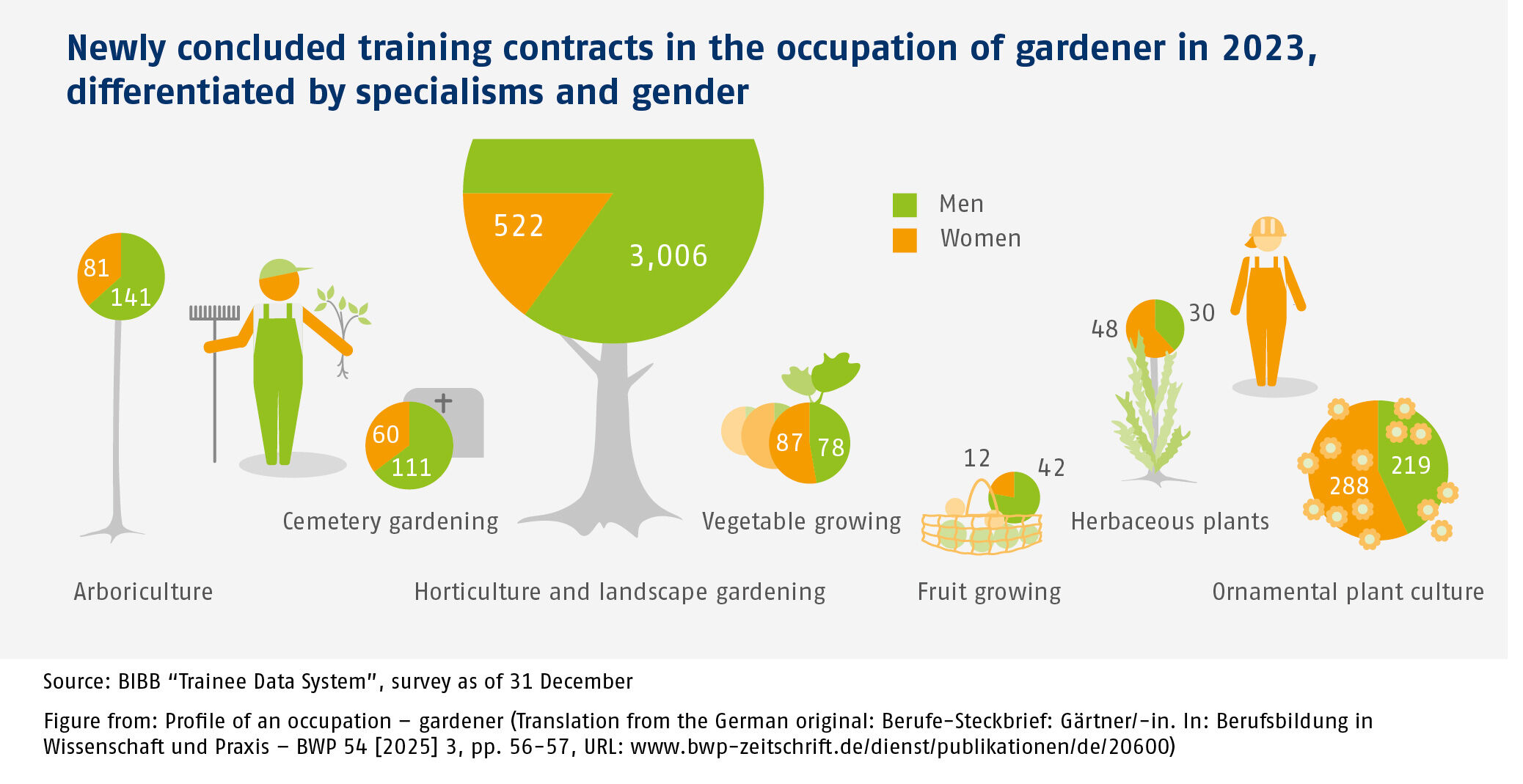
Horticulture is a major area of training in Germany. As of the cut-off date of 31/12/2023, there were 13,080 trainees at around 6,000 companies providing training. There were a total of 4,728 new training contracts in 2023. 1,101 of these (23.3 percent) were concluded with women. Horticulture and landscape gardening is the most popular training specialism by some distance. This option was chosen by 3,528 (74.6 percent) of new trainees in the occupation of gardener. Fruit growing, in which a total of 54 new training contracts were concluded, is the specialism with the least demand. Female trainees are in the majority in the specialisms of vegetable growing, herbaceous plants, and ornamental plant culture (cf. Figure).
Multivarious advanced training opportunities
Master gardener is just one of the many possible further qualifications that can be pursued upon completion of training. Other options include advanced training programmes leading to the qualifications of certified nature and landscape conservation specialist, qualified customer advisor in horticulture, and agrarian specialist/Bachelor Professional in tree management and maintenance.
At a glance
- Last update: 1996
- Duration of training: 3 years
- Area of responsibility: Agriculture
- Training structure: Training occupation with seven specialisms
- DQR reference level: 4
- Advanced vocational training: Master gardener, agrarian specialist
(All links: status 16/07/2025) (Compiled by Arne Schambeck, BWP)
Translation from the German original (published in BWP 3/2025): Neil Bristow, GlobalSprachTeam, Berlin