Profile of an occupation – electronics technician
Training to become an electronics technician is a future-proof option. Nowadays, everything which functions in a technological, electronic and automatic way contains a contribution from the skilled electrical trades. Electronics technicians are professionals in electrical appliances, in energy and building technology and in automation solutions. Trainees in this occupation can choose between two specialisms. This occupational profile describes the key tasks and presents current training figures.

Programming, control systems and installations
Rising requirements in respect of energy-efficient buildings and smart technologies mean that electronics technicians are skilled workers who are much in demand. Their spectrum of tasks is broad and combines the conventional electrical trades with the latest technologies. These tasks range from the installation of electrical devices, plants and communication technology to the fitting of photovoltaic systems and also extend to include activities such as electromobility connections and the set-up and maintenance of industrial equipment. The training occupation of electronics technician comprises the two specialisms of “energy and building technology” and “automation and system technology”. It forms part of the group of electrical and information technology occupations in the craft trades, which was redefined and updated in 2021.
Energy and building technology
Electronics technicians in this specialism plan and implement electrical systems for buildings. The broad range of tasks encompasses everything from sockets to light switches to entire energy supply systems, smart home elements and data connections. Electronics technicians connect ovens and plan and install building management systems and data networks. They also programme and configure the control and regulation equipment for heating, ventilation and air conditioning systems. They identify the causes of any malfunctions and repair systems and plants. This sort of work continues right up until the point when machines and equipment are commissioned. It involves a high level of technical knowledge which needs to be continuously adapted to new developments and standards. Electronics technicians in this specialism generally work for craft trade companies in the electrical sector.
Automation and system technology
The specialism of automation and system technology was revamped when training was modernised in 2021. Nevertheless, it has played a subordinate role in the training of electronics technicians thus far and accounts for only 2.5 percent of newly concluded training contracts. Electronics technicians in this specialism ensure the error-free execution of automated processes, for example production lines. They design, programme and install complex automation systems. They may, for instance, work for companies which offer automation solutions.
New technologies – new tasks
The occupation is constantly changing as a result of advancing digitalisation. This opens up opportunities for electronics technicians to learn new technologies. In the specialism of energy and building technology, these may include the installation of “smart” systems such as smart metering (for the measurement of electricity consumption) or smart grid sensors, i.e. control software and real-time data systems for the smart generation, storage and distribution of electricity. Many innovations are taking place in the area of networked building technology in particular, such as systems which use artificial intelligence. Real-time data systems allowing the predictive maintenance of energy supply systems and drones for the inspection of solar plants are also being deployed. The area of electromobility offers further future-oriented task fields. Electronics technicians participate, for example, in the establishment of the charging infrastructure systems which are necessary to supply energy to vehicles.
The specialism of automation and system technology also covers Industry 4.0 technologies and IoT (Internet of Things) applications. One example in this regard is the use of augmented reality in the form of smart glasses to facilitate the installation and maintenance of automated plants.
Small proportion of women
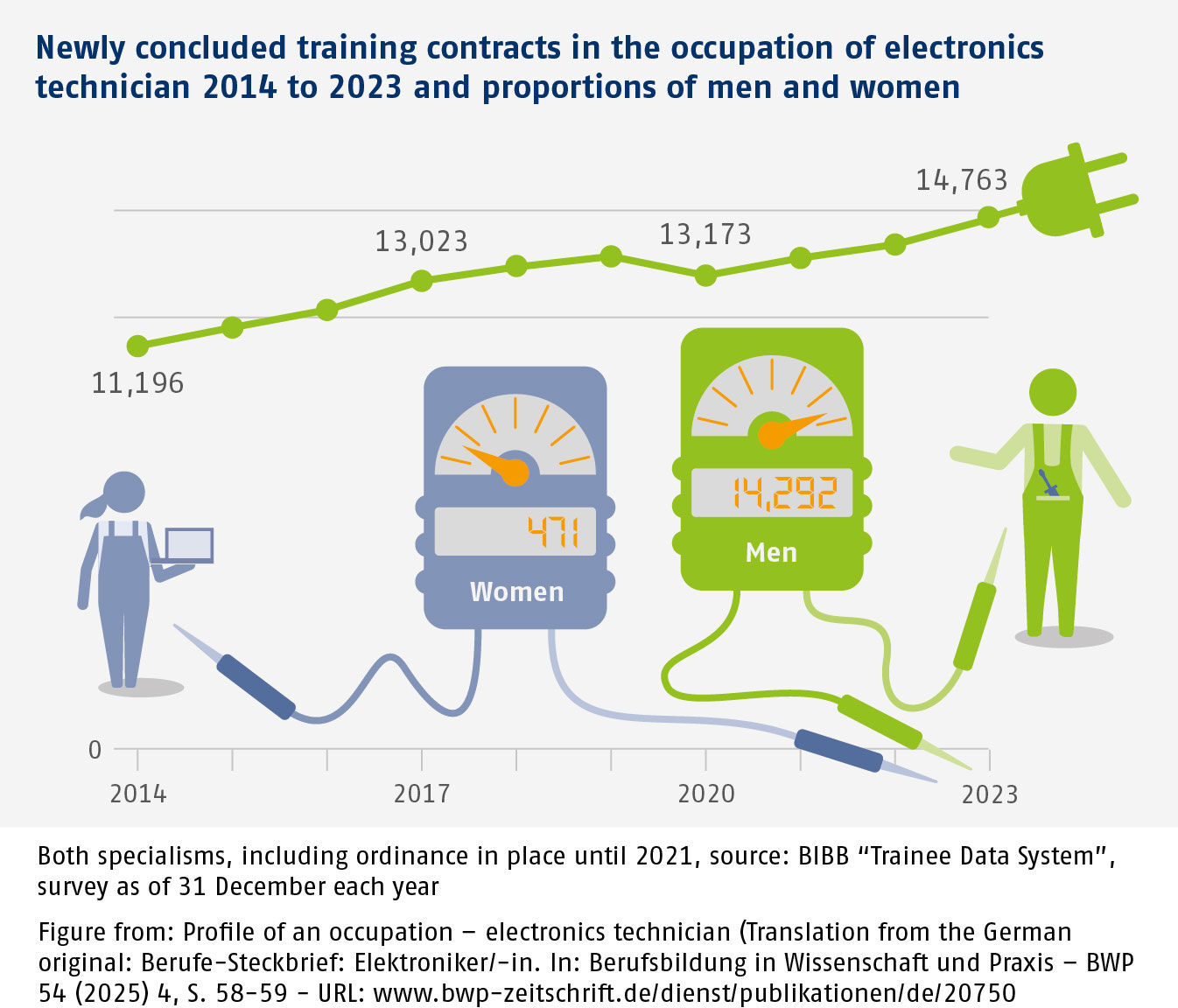
A total of 14,763 new training contracts were concluded in 2023. This makes electronics technician the ninth most popular training occupation in the ranking list of newly concluded contracts. The proportion of women (471 newly concluded contracts, 3.2 percent) remains very small (cf. Figure). This figure was, however, even lower ten years ago. The proportion of women entering the occupation in 2014 was two percent (219 of a total of 11,196 newly concluded training contracts).
Career, advanced and continuing training
Many advanced vocational education and training and continuing training pathways are open upon successful completion of the final examination in the occupation of electronics technician. These include a master craftsman qualification in the electrical trades, an advanced training qualification as state-certified technician in the specialism of electrical engineering or a course of higher education study leading to the qualification of Bachelor or Master of Engineering.
Training allowance
According to the BIBB “Training allowances based on collective wage agreements” database, average training allowances in the occupation of electronics technician are €939 per month in the first year of training, €1,007 in the second year, €1,089 in the third year and €1,158 in the fourth year. The average training allowance received over the entire duration of training is €1,037. This is slightly below the overall average in the area of training of the craft trades, which stands at €1,046 (as of 01.10.2024).
At a glance
- Last update: 2021
- Duration of training: 3½ years
- Area of responsibility: craft trades
- Training structure: occupation with two specialisms
- DQR reference level: 4
- Advanced vocational training: master craftsman in electrical engineering
- Occupational information from BIBB: www.bibb.de/dienst/berufesuche/de/index_berufesuche.php/profile/apprenticeship/xsw478
- Central Association of German Electrical and Information Technology Crafts (ZVEH): www.zveh.de
- Information chart to download: www.bwp-zeitschrift.de/g12341
- Podcast on the description of the occupation featuring two trainees: www.bwp-zeitschrift.de/p212425
(All links: status 15/10/2025) (Compiled by Arne Schambeck, BWP)
Translation from the German original (published in BWP 4/2025): Kirsty Dwyer, GlobalSprachTeam, Berlin