Profile of an occupation – qualified tax assistant
The decision to pursue training in this occupation lays the foundation for a wide range of career pathways, including progression towards qualification as a tax consultant. An affinity for digital working methods is becoming increasingly important alongside an excellent understanding of numbers and attention to detail. The profile describes the key tasks, presents current training figures, and arrives at the conclusion that qualified tax assistants are often very satisfied with their training.

A person of trust with a clear overview
Tax clerks are organisational talents who keep track of figures, deadlines and legislation whist also serving as trusted contacts for companies, the self-employed, and private individuals. They are primarily employed by tax consultancy and accountancy firms. Qualified tax assistants help with day-to-day accounting tasks at the firm. They analyse current financial results in the financial accounting department and draw up annual financial statements. They help the tax consultants to prepare tax declarations for companies and private individuals and also check tax office assessment notices for clients, bearing confidentiality requirements and professional regulations in mind. Although these tasks have changed very little over the years, there has been a shift in the way they are executed. Most business and accountancy firm processes are now performed digitally. Qualified tax assistants maintain a clear overview of data flows and interfaces. Their work also involves searching for occupationally specific information in specialist databases and dealing with the company’s document management system. Qualified tax assistants communicate with tax authorities, with social insurance and pension insurance providers, with banks and with insurance companies. For this reason, training contents relating to information, communication and presentation technology were added on the most recent occasion when the training regulations were updated in 2022. This new aspect is also addressed in the final examination, which includes a simulated discussion focused on helping to advise clients. Candidates are thus involved in a role-play situation which relates to their future professional function.
High degree of satisfaction with training
The tax sector is perceived by many as a somewhat mundane occupational field. For this reason, it is not easy to ignite young people’s enthusiasm for this training occupation. However, those who do opt to enter training as a qualified tax assistant show that they are very satisfied with this choice.
According to a survey conducted by the youth branch of the German Confederation of Trade Unions (DGB-JUGEND, 2025), trainee qualified tax assistants feel that they are in good hands. 82.4 per cent of respondents stated that they were “very satisfied” with their training (p. 54). This is the best such response of all dual training occupations for which surveys were carried out. Trainee qualified tax assistants also perform the lowest amount of overtime on average, 1.8 hours per week (cf. ibid. p. 41). The occupation is in the top 5 in the “Personal assessment of training quality” ranking (p.51). Factors such as proper and correct treatment by trainers, a good work-life balance and not being either over-worked or under-challenged all play a key role in this respect. This impression is confirmed by the two trainees who talk about their everyday experiences in the “AzubiView” podcast episode accompanying this occupational profile. They stress how important it is for them to work in an environment where they are appreciated and supported by their boss and colleagues.
Female proportion of two thirds
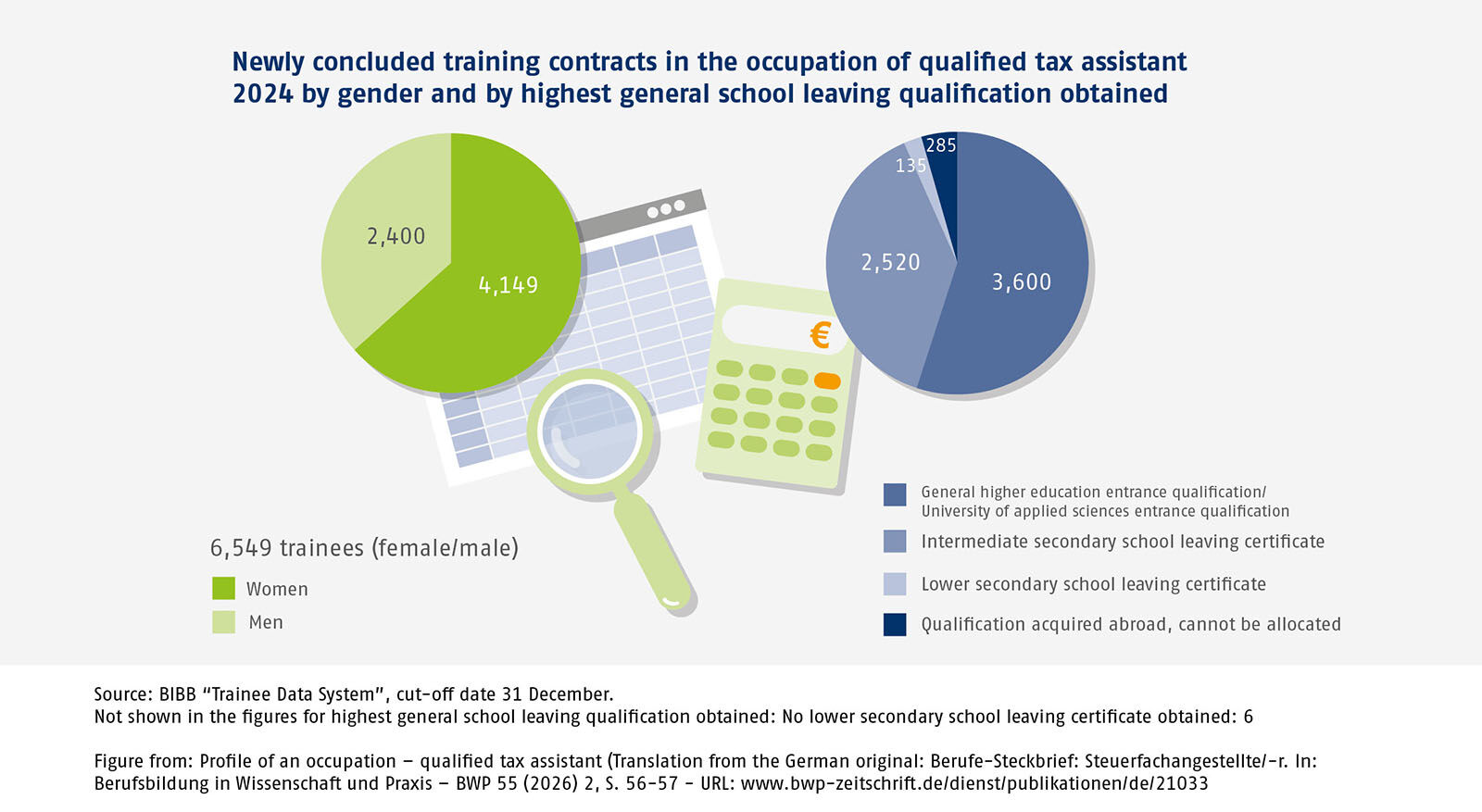
There were a total of 17,394 trainee qualified tax assistants as of the cut-off date of 31 December 2024. The number of trainees has remained at a constantly high level for over 15 years. 4,149 of 6,549 new training contracts were concluded with women. This represents a proportion of 63 per cent. The most common highest general school leaving qualification of training entrants is a general higher education entrance qualification/university of applied sciences entrance qualification (55 per cent, 3,600 trainees).
Requirements and career
Tax law is constantly in flux. The digitalisation of processes, changes to notification and reporting duties and a large number of statutory reforms such as property tax declarations and e-invoices are all leading to a high level of demand for advice from both companies and private individuals. As a consequence, tax consultancy firms and companies are facing a heavy workload.
Despite the large number of training contracts in force, demand for young skilled staff remains high. According to a business survey by the Institute for Economic Research (ifo) on 21 August 2025, 72 percent of legal, tax and accountancy firms are experiencing difficulties in finding qualified employees.[1]
There are numerous advanced training programmes for qualified tax assistants. These include Senior tax assistant, Senior Auditing assistant, Bachelor Professional in Management Accountancy, Senior assistant in Agriculture and Forestry and Senior assistant in Digitalisation and IT Processes. They may be admitted to the tax consultant examination after eight years of professional experience.
At a glance
- Last update: 2022
- Duration of training: 3 years
- Area of responsibility: Liberal profession
- Training structure: Mono-occupation
- DQR reference level: 4
Literature
DGB-Jugend: Ausbildungsreport 2025. Berlin 2025.
Further links (in German)
BIBB – website page on the occupation
BIBB – Designing Vocational Training
German Federal Chamber of Tax Advisors
German Tax Consultants Association (registered association)
Federal Association of Liberal Professions (registered association)
Podcast on the description of the occupation featuring two trainees
(All links: status 22/04/2026) (Compiled by Arne Schambeck, BWP)
Translation from the German original (published in BWP 2/2026): Martin Kelsey, GST GlobalSprachTeam ‒ Sassenberg e.K., Berlin