The healthcare system – a world of work in which numerous occupations are shifting
Julia Jörgens, Thomas Borowiec
The German healthcare system is experiencing a shift and faces major challenges, particularly as a result of demographic development, a shortage of qualified skilled workers, and economic and technological changes. This has an impact on a number of non-academic healthcare professions. Which professions are affected, and what vocational education and training pathways are required for their training? This article provides an overview of the heterogeneous training landscape in the healthcare system and outlines some reforms which have already been instigated.
Healthcare system under pressure
The healthcare system is a human resources-intensive sector which employed just under 6.2 million people in 2024. This figure represented a growth of 1.7 per cent compared to the previous year (cf. Destatis 2026). Qualified skilled workers in numerous professions make a key contribution to maintaining the health of the population. Nevertheless, structural deficits in the German healthcare system have been in evidence for years. According to the Advisory Council on Health and Nursing, current structures will not be able to cover future care requirements even with an above-average increase in staffing. The further development of coordinated occupational profiles, the allocation of competencies, and training for increasingly complex tasks are viewed as being some of the areas of potential improvement with regard to the quality and efficiency of medical provision. Strengthening inter-professional collaboration so as to deploy and link the competencies of different professional groups in the best possible manner is also stated as being a core building block for the recommended further development of primary care (cf. Deutscher Bundestag 2024).
Before the present article moves on to discuss selected reforms in specialist healthcare professions, we would like to begin by more closely outlining the object of investigation – the multivarious professions and training opportunities.
Three areas of training lead to a joint world of work
Vocational education and training in Germany may be pursued via three different pathways, which can be differentiated on the basis of their legal foundations (for a more detailed description cf. Zöller/Jörgens 2025). Two types of training programmes exist under federal law – programmes which are subject to the Vocational Training Act (BBiG) and Crafts and Trades Regulation Code (HwO) on the one hand, specialist healthcare professions governed by their own specific individual laws, on the other hand. There are also training programmes governed by federal state law (cf. Figure). Healthcare professions may be found in all three regulatory areas, and these are outlined below.
Training programmes in specialist healthcare professions
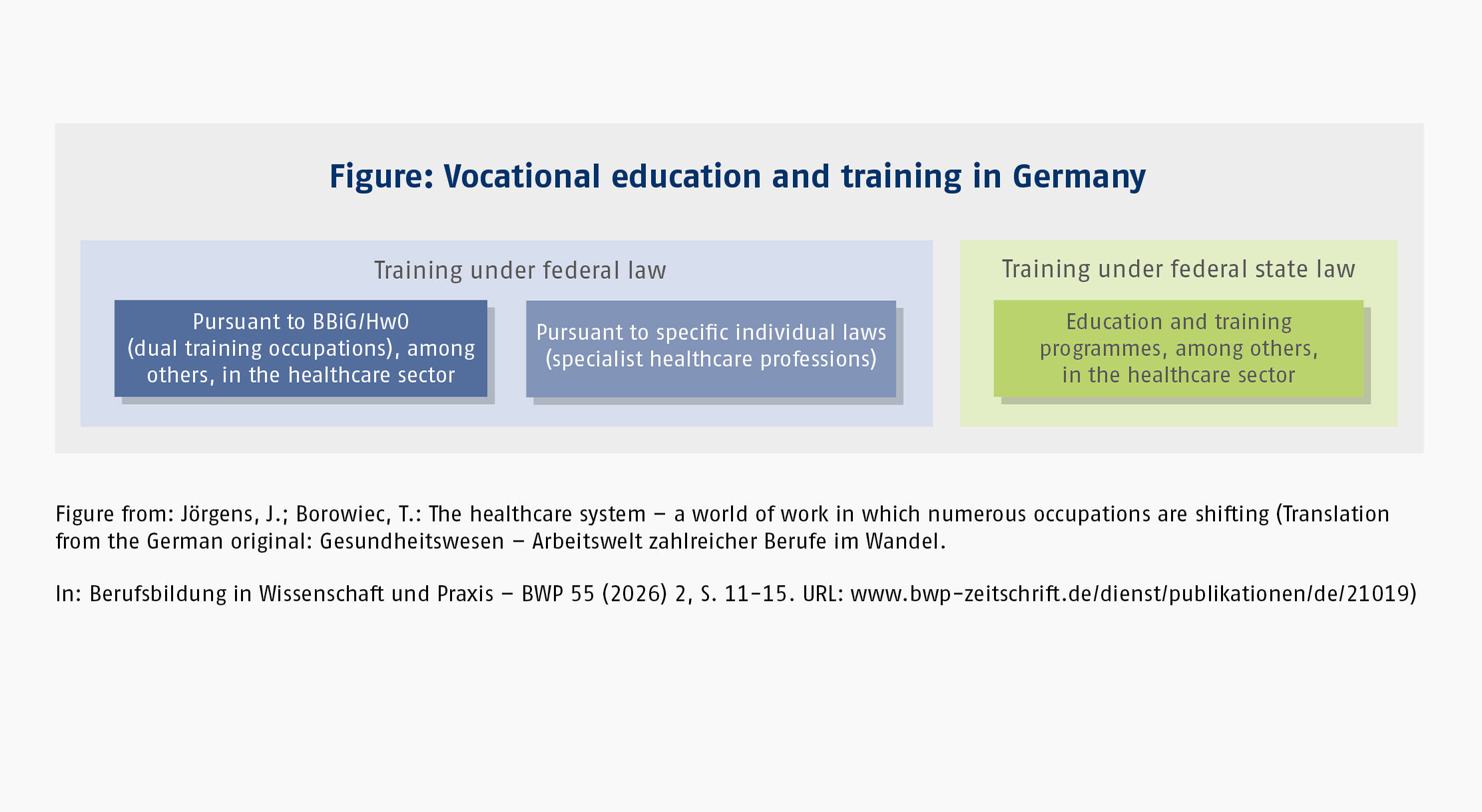
Most qualified skilled workers in the healthcare system are trained in the specialist healthcare professions which are governed by federal law (cf. Table 1, p. 12). These should be understood as professions which encompass the task of “the curing of diseases and the provision of medical care and support to patients” (Federal Ministry of Health 2025).
The legal foundations of these professions are specific individual laws containing training and examination regulations, which are adopted by the Bundestag and the Federal Council and apply nationwide. Modernised or new training regulations thus constitute legislative procedures.
Training takes place both at schools and at a practical learning venue. There was a total of around 230,000 trainees in specialist healthcare professions in the 2024/2025 school year (cf. Table 1). The highest numbers of trainees, around 147,000, were recorded in the general nursing professions. This represents a proportion of 63.7 percent.
| Training programme | Trainees 2024/2025 |
| Nurse (general, geriatric or paediatric) | 146,685* |
| Physiotherapist | 26,518 |
| Occupational therapist | 13,073 |
| Paramedic | 12,295 |
| Dispensing assistant | 7,424 |
| Technical surgery assistant | 7,398 |
| Speech therapist | 3,686 |
| Anaesthesia assistant | 3,196 |
| Medical technologist – radiology | 2,631 |
| Medical technologist – laboratory analysis | 2,329 |
| Podiatrist | 1,184 |
| Dietary assistant | 1,071 |
| Massage therapist and medically qualified lifeguard | 919 |
| Orthoptist | 145 |
| Medical technologist – functional diagnostics | 118 |
| Medical technologist – veterinary medicine | 15 |
| Expiring training programmes | |
| Medical laboratory assistant | 786 |
| Medical laboratory assistant in radiology | 743 |
| Medical laboratory assistant in functional diagnostics | 86 |
| Children’s nurse | 29 |
| Geriatric nurse | 7 |
| Veterinary laboratory assistant | - |
| Total number of trainees | 230,338 |
* Information regarding nurses (general, geriatric or paediatric) is taken from statistics pursuant to the Ordinance on the financing of training in the nursing professions and maps the total number of trainees (general nursing, geriatric nursing and children’s nursing).
Training programmes in the healthcare sector pursuant to BBiG/HwO
Training programmes on the basis of the BBiG and HwO also lead to a qualification to perform professional tasks in the healthcare system. Although these programmes make up only a small proportion of the total of 327 training programmes governed by the BBiG/HwO (2025), they represent a significant aspect by dint of the fact that around 116,000 training contracts are in force. Training is organised by the Federal Government, the federal states and the social partners, who develop occupationally specific regulatory instruments via a process of consensus. The essential characteristic of these training programmes is the duality of learning venues. The company and the vocational school work together to fulfil the education and training remit.
Training programmes pursuant to the BBiG include medical assistant, qualified dental employee and commercial employee in the pharmaceutical sector, with the last not being aligned to the specialist healthcare professions because most tasks performed are of a commercial nature.
There are also the “craft trade occupations” in the healthcare sector, which are governed by the Crafts and Trades Regulation Code (cf. Table 2).
| Training programme | Trainees 2024/2025 |
| Medical assistant | 43,977 |
| Qualified dental employee | 32,076 |
| Specialist veterinary employee | 6,978 |
| Social insurance clerk | 6,798 |
| Optician | 6,444 |
| Health services officer | 5,952 |
| Dental technician | 5,148 |
| Commercial employee in the pharmaceutical sector | 3,513 |
| Hearing aid audiologist | 2,559 |
| Orthopaedic technician | 1,440 |
| Pharmaceutical technician | 840 |
| Maker of orthopaedic footwear | 621 |
| Surgical instrument maker | 114 |
| Total number of trainees | 116,460 |
Source: BIBB “Trainee Database” based on data from the Vocational Education and Training Statistics provided by the Federal Statistical Office and the statistical offices of the federal states (survey as of 31 December)
Training programmes in the healthcare system pursuant to federal state law
There are also qualified skilled workers in the healthcare system whose training is entirely governed by federal state law. The legal basis in this case is provided by the education laws of the federal states and by federal state ordinances relating to types of schools and training programmes. Framework agreements of the Conference of the Ministers of Education and Cultural Affairs (KMK) also serve as guidance. The modernisation of existing training programmes or the creation of new programmes take place in the form of legislative procedures at federal state level.
KMK documentation contains 54 training programmes governed by federal state law and taught at full-time vocational schools. Eight of these may be allocated to the healthcare system (cf. Table 3), although other alignments may also be conceivable because of overlaps with social occupations. The alignment selected here incorporates around 90,000 trainees in the year 2024/2025. The training programmes include a large school-based element, and classroom teaching extends over a minimum of 30 hours per week. A company-based practical placement is scheduled, the duration of which differs widely depending on the federal state (cf. Zöller/Jörgens 2025, p. 272).
The diverse range of training programmes frequently involve assistant and auxiliary occupations. Duration of training varies between one and three years. Some occupational profiles can be aligned to the area of nursing in terms of their content. As of 2027, nationally standardised generalist training in the occupation of nursing assistant will be provided pursuant to the Nursing Assistant Act, which replaces previous federal state law ordinances.
| Training programme | Trainees in 2024/2025 |
| Social education assistant/Childcare assistant | 34,668 |
| Social assistant | 26,293 |
| Care assistant for the elderly | 10,795 |
| Nursing assistant | 8,473 |
| Healthcare assistant |
7,834 |
| Special needs care auxiliary/special needs care assistant | 1,859 |
| Breathing, speech and voice coach | 131 |
| Medical documentation assistant | 65 |
| Total number of trainees | 90,118 |
Source: Federal Statistical Office: Statistical Report – Vocational schools and healthcare sector schools – occupational titles
Changing healthcare provision
The care landscape and care structures in the healthcare system have undergone rapid change in recent years, notable factors being the effects of the demographic shift, skilled worker shortages, the consequences of technological change and the increasing complexity of care services. This means that the requirements made of skilled workers are also altering.
The specialist healthcare professions governed by federal law constitute the largest group of qualified skilled workers in the healthcare system and are severely affected by the developments. For this reason, the second part of our article will focus on selected reforms in this area.
The coalition agreement between the CDU/CSU and the SPD (2018) stipulated the realignment of training in the specialist healthcare professions within the scope of an overall concept. The main topics addressed by a benchmark paper drawn up by a Federal Government-Federal State Working Group included the abolition of school fees, the introduction of a training allowance, a revision of the specific individual laws governing the professions, the permeability of training programmes, examination remits with regard to academisation and direct access, professions to be updated and the associated financing issues (cf. Blag 2020).
Incentives to access training – abolition of school fees and introduction of a training allowance
In light of increasing skilled worker shortages, incentives to access training are key parameters of the “Overall concept for specialist healthcare professions”. In 2023, the Conference of Ministers of Health set the short-term goal of abolishing school fees and paying a training allowance nationwide in all specialist healthcare professions for which training takes place at full-time vocational schools (cf. GMK 2023).
The abolition of school fees has been enshrined in the modernised and new specific individual laws governing nurses (general, geriatric or paediatric), medical technologists, anaesthesia assistants, technical surgery assistant and paramedics. This objective has not yet been fulfilled in eight specialist healthcare professions. Exemption from school fees applies in eleven federal states (cf. Deutscher Bundestag 2024a, p. 9).
The introduction of a training allowance has also not yet taken place nationwide. Up until now, it has been firmly established in the aforementioned modernised and new training programmes contained in the specific individual laws governing the professions. Trainee technical pharmaceutical assistants also have the right to receive a training allowance, although this is limited to the six-month practical element of the training. So far there is no corresponding statutory entitlement in the specific individual laws governing training in the areas of dietary assistance, occupational therapy, speech therapy, physiotherapy, podiatry and orthoptics (cf. Zöller/Jörgens 2025, p. 60 ff.).
Inter-professional collaboration – a key factor in the change process
The intention is for individual specific laws governing the professions and training and examination regulations to pursue the objective of competency-oriented training in future. Particular emphasis is placed on inter-professional collaboration (cf. BLAG 2020, p. 4).
Inter-professional collaboration may be defined as cooperation between various occupational groups which aims to achieve high-quality patient-centred care and makes optimum use of resources by pooling complementary competencies (cf. Eberle 2025, p. 81). Avoiding breaks in care and increased quality and efficiency of healthcare provision are considered the greatest benefits of such an approach. This is of increasing relevance given the growing complexity of care tasks in with a higher need for coordination. Inter-professional collaboration is thus perceived to be an essential building block for modernisation of the healthcare system (cf. inter alia BLAG 2020; Deutscher Bundestag 2024).
In its report, the Advisory Council on Health and Nursing proposes the establishment of new primary care multi-professional institutions with inter-professional care teams (cf. Deutscher BUndestag 2024, p. 130). The Federal Government and the federal states are providing financial support for the piloting of relevant innovative care concepts. One case in point is the HÄPPI concept, which plans the creation of a general practitioner primary care centre at which inter-professional teams comprising non-medical staff at the surgery will work together under medical supervision (cf. HÄV 2024). A further objective is to make greater use of digitalisation in future. The aims behind the expansion of joint digital patient records and communication platforms are to facilitate the exchange of data between occupational groups and to make cooperation in everyday working life more practicable.
One other key point of approach is the adaptation of general statutory and structural conditions. In the wake of the reforms which have taken place in the specialist healthcare professions, inter-professional collaboration was enshrined as a training goal in some specific individual laws governing the professions and, in some training, and examination ordinances (cf. Zöller/Jörgens 2025, pp. 88 ff.). Inter-professional learning is also being fostered at a number of full-time vocational schools and institutes of higher education (cf. e.g. von Gahlen-Hoops/Busch/Tolskdorf in this issue). Joint teaching programmes are increasingly being held for medical students, trainee nurses and therapists.
The 2024 report of the Advisory Council on Health and Nursing pays tribute to highly promising approaches to inter-professional collaboration and recommends further actions in order to achieve goals such as an inter-professional understanding of care. The report points to the importance of multi-professional and inter-professional healthcare planning which takes account of all relevant occupational groups, of their interaction and of potential areas of substitution. It states that major endeavours are still needed in overall terms for widespread adoption of inter-professional collaboration and that there are areas of potential that remain untapped hitherto (cf. Deutscher Bundestag 2024, pp. 169 ff.).
Growth in complexity – academisation and competency expansion as a possible solution
Given the growing complexity of care tasks, higher education qualifications may assist in the realisation of high-quality patient treatment (cf. BLAG 2020, p. 6). The Advisory Council even views the academisation of nursing as a prerequisite for dealing with complex care needs more effectively when human resources are limited (cf. Deutscher Bundestag 2024, p. 171).
A distinction must be drawn in this regard between partial and full academisation. As early as 2012, the German Science and Humanities Council pointed to the foreseeable demand for care and to increasing complexity in recommending partial academisation for nursing and therapist professions and for the area of midwifery and midwifery assistance in the form of an academisation rate of between ten and 20 percent (cf. Wissenschaftsrat 2012, p. 85). The decision was made to introduce full academisation of midwife training with effect from 1 January 2020. All midwives are now trained at institutes of higher education. The crucial factors informing this choice were the small size of the occupational and trainee group, the increased demands facing the profession, and the necessity to achieve mastery of the whole task spectrum. There was no division into different levels (cf. BLAG 2020, p.6).
By way of contrast, partial academisation is taking place in nursing training. Both vocational and higher education training are possible. The key reasons why partial academisation was chosen were the size of the occupational and trainee group and the opportunity for and sensibleness of a graduation of competencies (cf. BLAG 2020, p. 6). The possibility of direct authorisation to practise via a primary qualifying Bachelor’s degree in nursing was created in 2020. Since December 2023, the federal states have also been afforded permission to institute primary qualifying courses of study running parallel to VET in the areas of physiotherapy, occupational therapy and speech therapy.
In overall terms, it is possible to ascertain that academisation is being driven forward. However, rapid and widespread implementation is still pending. In 2024, for example, the academisation rate in the nursing professions was 0.83 percent (calculation on the basis of Destatis 2024). The provision of degree level programmes is not being fully utilised (cf. Deutscher Bundestag 2024, p. 27).
Alongside higher education, initial and continuing vocational education and training also offer suitable pathways and responses to meet the current challenges. Competency expansions are just one of many approaches. From 2026, for example, a new law relating to the extension of authorisation and reduction of bureaucracy in nursing will transfer more powers previously reserved for doctors to nurses.
Course set – work still in progress
As is evident based on the reform processes selected, the healthcare system is undergoing an extensive process of change. The structures and content of vocational education and training are therefore also being rethought and remodelled. Isolated solutions will not be sufficient. A whole raft of interlinked measures will be required in order to train and deploy healthcare staff efficiently and sustainably. As well as the approaches already set out above, these include the efficient use of digital opportunities, data-driven strategic planning of healthcare resources, the management of patient pathways in line with needs, the prioritisation of outpatient care and treatment services and the improvement of the population’s health literacy (cf. Deutscher Bundestag 2024, pp. 4–5). Possible solutions and key levers have thus been identified, and the first steps towards achieving a sustainable world of work have been taken. Given the large number and urgency of potential and existing challenges in the healthcare system, the focus must now be on the robust and timely implementation of reforms that have already been initiated whilst actively tackling further processes of change at the same time. In the area of training, this requires more of a cross-system approach in order to coordinate concepts across different policy areas and to make the most of the available potential.
Literature
Bundesministerium für Gesundheit (BMG) (Hrsg.): Gesundheitsberufe –Allgemein. Berlin 2025.
(All links: status 22/04/2026)
Julia Jörgens
Dr. Research fellow at BIBB
Thomas Borowiec
Research fellow at BIBB
Translation from the German original (published in BWP 2/2026): Martin Kelsey, GST GlobalSprachTeam, Berlin