When companies fund continuing training for professional recognition
What is the significance of regulation and adherence to a collective wage agreement?
Jessica Erbe
To use their qualification to work in Germany, skilled workers trained abroad frequently need to undergo continuing training as part of the recognition process. This is particularly the case if an equivalence assessment procedure makes this a prerequisite for full recognition. This article takes data from the BIBB Training Panel to investigate how and to which extent companies support their employees in this and to examine which reasons speak against it.
Full recognition frequently only obtained after further training – demand is growing
Skilled workers wishing to work in Germany in a profession or occupation in which they trained abroad are able to seek recognition of the equivalence of their vocational qualification with a German reference occupation. In order to work in a regulated profession, such as in the field of medicine or teaching, attestation of full equivalence is even a prerequisite under employment law. Recognition is not required to work in a non-regulated occupation, but may prove worthwhile (cf. inter alia Brücker 2021), for example in terms of obtaining employment or remuneration that is commensurate with qualifications, access to higher levels of training, better legal residency status, or social acknowledgement.
Within the scope of the recognition procedures under federal or state law, competent bodies – usually government authorities or chambers – frequently identify differences between a profession or occupation in which training has taken place abroad and the German reference occupation. They then derive further training requirements on the basis of these differences. Certification of full equivalence is the second stage of the process, and this can only take place once these requirements have been fulfilled. In 2024, for example, a compensation measure was “imposed” in more than half (57 %) of some 53,300 procedures relating to regulated professions governed by federal law in which a decision was reached. In addition, a compensation measure had already been completed in two thirds of cases where a decision was made to award full equivalence. Partial equivalence was also attested in one in two (49 %) of around 13,500 procedures relating to non-regulated occupations under federal law (cf. Böse/Schmitz/Zorner 2025). The resulting need for training has risen significantly over recent years.
To compensate for the differences identified between a profession or occupation in which training has taken place abroad and the German reference occupation, measures must be completed. For the sake of simplicity, such measures will be referred to here as continuing training for recognition. In the case of non-regulated occupations, they take the form of refresher training. In regulated professions, there are conditions which need to be met, such as examinations.[1] Some differences must explicitly be offset via practical phases at a company, such as employment or an internship. In other instances, extra-company courses or examinations involving relevant preparation courses are mandatory or recommended. Companies thus play a key role in achieving full recognition. They may, for example, offer training provision directly. Equally, they may also cover the costs of continuing training measures or release their employees from work duties to enable them to participate in such measures.
This article uses the BIBB Training Panel to investigate the extent to which companies in Germany support employees with a foreign professional or vocational qualification (cf. Information box, p. 40).
Reality check – limited funding of continuing training for recognition
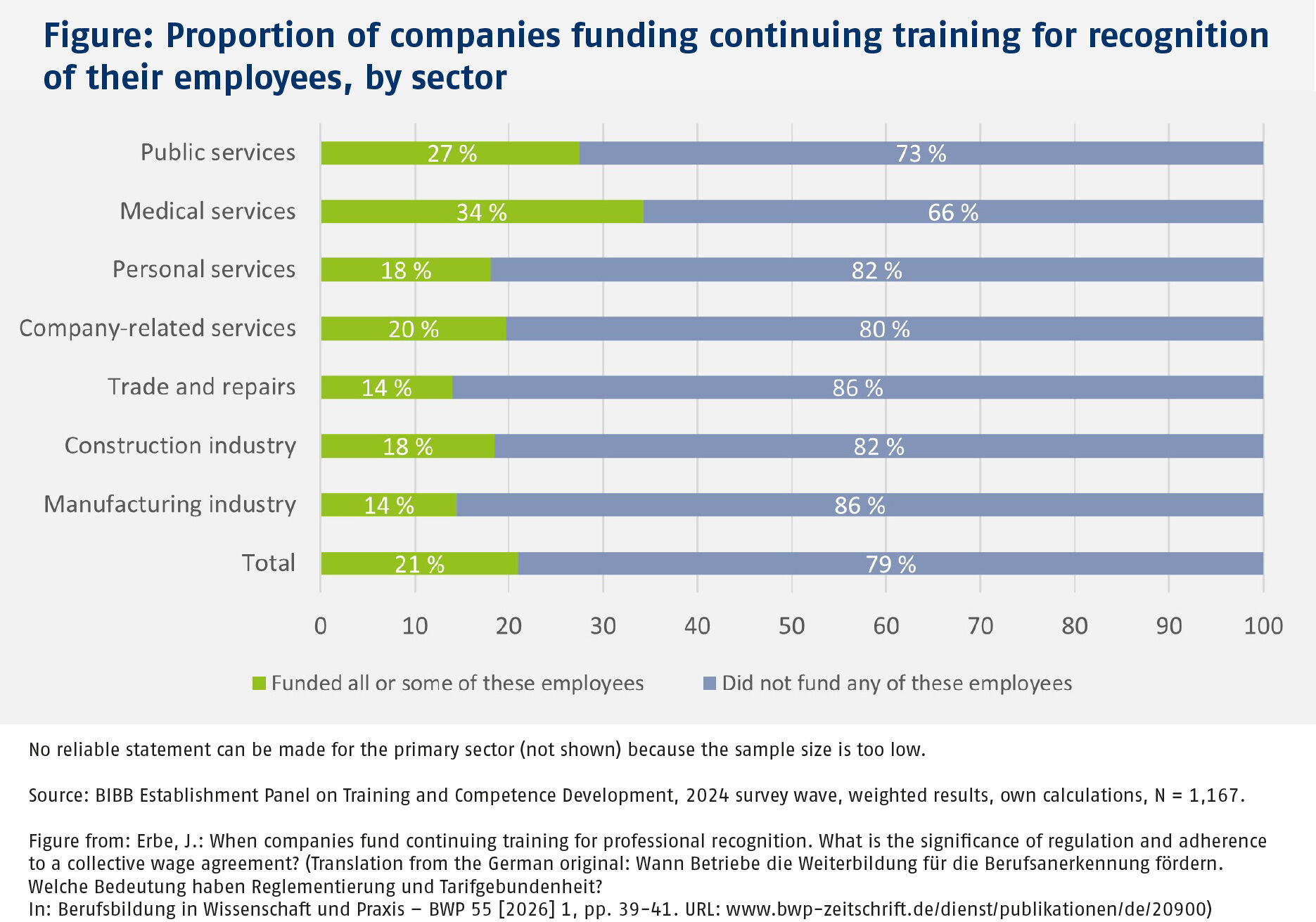
One in five companies employs at least one person with a professional or vocational qualification acquired abroad (subsequently referred to as “international skilled workers”). If such companies were fundamentally active in continuing training – i.e. they facilitated participation in continuing training measures for their employees – they were also asked whether they had specifically funded participation in advanced or continuing training for the recognition of a foreign professional or vocational qualification. This again proved to be the case for one in five of the companies in question (21 %, cf. Figure). Half of these companies stated that they had funded such training for all employees (10 %). The other half had done so for some employees (11 %).
It must be assumed that achievement of full equivalence was not relevant for all international skilled workers. They may, for example, have already obtained full equivalence because a different procedure[2] is applicable to their qualification. De facto recognition by their employer by dint of entering into an employment relationship with them may also have been sufficient. Nevertheless, 79 percent of the companies had failed to fund even a single one of their international skilled workers, and this seems to be quite a high figure. This evaluation is supported by reports from practice on the difficulties of finding training provision (cf. F-BB 2025; Atanassov et al. 2022).
BIBB Training Panel
The BIBB Establishment Panel on Qualification and Competence Development is a regular annual representative survey of companies in Germany.
This article uses data from the 2024 survey wave (around 3,600 companies), which also includes questions on persons trained abroad and on recognition. The evaluations presented here relate to the 1,167 companies which, in the previous year (i.e. 2023), had funded the participation of their employees in upgrading or continuing training and employed persons with foreign qualifications. The analysis also included data from the same survey wave relating to company size category, sector, the funding of upgrading training programmes or other continuing training measures, and the application of a collective wage agreement.
Further information: www.qualifizierungspanel.de und www.bibb.de/bereaqin
Which companies pursue this strategy, and which do not?
Generally speaking, larger companies are more likely than smaller companies to fund the continuing training of their employees.[1] The same applies to continuing training as part of recognition procedures. In the two smaller size categories (one to 19 and 20 to 99 employees), funding was provided by 19 and 22 percent of companies respectively. The corresponding figures for the two larger company size categories (100 to 199 employees and 200 employees and more) are 32 and 34 percent, i.e. around every third company. The differences between sectors are considerably larger (cf. Figure). As would be expected, an above-average number of companies fund continuing training for recognition in sectors where regulated tasks feature strongly. This is the case with around a third (34 %) of medical services, which are provided by hospitals, clinics, doctors’ surgeries, physiotherapy and alternative medicine practices, homes and outpatient social services. The public sector, which encompasses amongst others education and teaching –areas characterised by regulated occupations –, also displays an above-average level of continuing training funding within the scope of recognition of 27 percent. In contrast, companies operating in the sectors of manufacturing industry and trade and repairs are less likely to provide funding (14 % in each case).
Because medical services and the public sector including education and teaching are amongst the sectors with an above-average application of collective wage agreements, willingness to fund recognition-related continuing training could also be influenced by issues relating to these agreements as well as by regulation. This is also reinforced by the fact that, in the manufacturing industry, the companies most likely to fund their employees within the context of recognition are from the chemical and pharmaceutical branches, where there is an above-average likelihood that collective wage agreements will be in force.
If a collective wage agreement stipulates a specific employee qualification for a certain job description, then a recognition notice can prove that an international skilled worker has the required qualification. The bivariate comparison confirms that companies with a sectoral, in-house or company collective wage agreement are more likely to fund continuing training for full recognition than companies at which no agreements of this kind are in force (25 % as opposed to 18 %).
Reasons for not funding continuing training for recognition
Given the major significance of recognition-related continuing training when it comes to fully using the potential offered by international skilled workers, a further point of interest is why four in five companies did not fund it. These 79 percent were asked to specify the main reason for this.
Almost three quarters (72 %) stated that there were no further qualification needs. 15 percent of the remaining 28 percent gave a specific reason. The most common responses were that employees’ knowledge of German was not yet sufficient, or that they organised their own training alongside the job, or that operational issues were to blame (above all a lack of capacities, resources or information that would be necessary for recognition). A further 13 percent did not provide any more precise information and merely stated “another reason”. Qualitative methods would need to be deployed to research whether this is mainly due to practical reasons or to cost-benefits considerations.
Continuing to explore commitment and reluctance
Potential will remain unused if companies do not fund continuing training for recognition in accordance with needs. In order to tap into this potential more effectively, consideration must be given to the complexity of the reasons why companies are reluctant. Just over a quarter of companies not providing funding cited a specific obstacle, and this is where the greatest potential might be found. In order to obtain more specific indications for policy making and practice, the recommendation would be to deepen the present analysis by multivariate methods and to include further company and industry characteristics which have been shown by VET research to influence investments in initial and continuing training.
-
1
For an overview of the heterogeneous measures, cf. Atanassov et al. (2022).
-
2
No comparable requirements for further training exist in respect of the Statement of Comparability for Foreign University Degrees or the digital Statement on a Foreign Vocational Qualification (DAB), which was introduced in 2024.
-
3
Own calculation on the basis of the same data source (cf. Information box)
Literature
Atanassov, R.; Best, U.; Bushanska, V.; Gilljohann, K.: Wege zur Gleichwertigkeit: anerkennungsbezogene Qualifizierungen in Heilberufen und dualen Berufen. Ergebnisse des BIBB-Anerkennungsmonitorings. Bonn 2022. URL: www.bibb.de/dienst/publikationen/de/17796
Böse, C.; Schmitz, N.; Zorner, J.: Auswertung der amtlichen Statistik zum Anerkennungsgesetz des Bundes für 2024. Ergebnisse des BIBB-Anerkennungsmonitorings. Bonn 2025. URL: https://datapool-bibb.bibb.de/pdfs/Boese_et-al_Anerkennung.pdf
Brücker, H.; Glitz, A.; Lerche, A.; Romiti, A.: Anerkennung ausländischer Berufsabschlüsse hat positive Arbeitsmarkteffekte. IAB-Kurzbericht No. 2. Nuremberg 2021. URL: https://doku.iab.de/kurzber/2021/kb2021-02.pdf
Forschungsinstitut Betriebliche Bildung (f-bb) (Hrsg.): Arbeitshilfe: Quali gesucht!? Das Angebot von Qualifizierungen im Kontext der Anerkennung ausländischer Berufsabschlüsse. Nuremberg 2025. URL: www.netzwerk-iq.de/fileadmin/Redaktion/Downloads/FSAQ/FSAQ_Arbeitshilfe_QualiGesucht_barr.pdf
(All links: status 21/01/2026)
Jessica Erbe
Academic researcher at BIBB
Translation from the German original (published in BWP 1/2026): Martin Kelsey, GlobalSprachTeam, Berlin