Taking different routes – gender-atypical vocational education and training in the course of employment
Pia Wagner, Lisa Fournier, Ralf Dorau
Gender-atypical VET could have the potential to reduce gender segregation on the labour market and to lessen gender-specific inequalities. Nevertheless, studies indicate poorer utilisation prospects of such training qualifications. In order to examine these more closely, this article identifies challenges people face in their later employment trajectory if they opted for training in an occupation dominated by the other gender. The basis is provided by interviews with people who have left their gender-atypical training occupation and on expert interviews.
Occupationally atypical – still the exception
Both the training and labour markets in Germany are highly segregated along gender-specific lines (cf. Hamjediers/Peters 2024; Achatz 2018). Occupational gender segregation, i.e. the uneven distribution of women and men in different occupations, significantly contributes to the reproduction of inequality and disadvantage. Whereas female-dominated occupations are often associated with lower incomes, with lesser professional prestige and with limited opportunities for development (cf. Hünfeld/Dötsch 2023; Boll et al. 2016), occupations which are mostly exercised by men are more likely to exhibit poorer chances in terms of work-life balance (cf. Beblo/Schäfer/Hermann 2025).
Gender-atypical VET (cf. Information box) could help to reduce gender segregation on the labour market, but only if opting for such an occupation exerts a long-term impact on a person’s employment trajectory. Nevertheless, studies indicate worse utilisation prospects for gender-atypical education and training qualifications. For example, this is reflected in higher likelihoods of changing occupations, and an increased risks of unemployment (cf. Hamjediers/Peters 2024; Madsen/Brekke/Feklaer 2023; Busch 2013).
Studies relating to the career entry and further employment trajectory of people who have completed gender-atypical training are, however, scarce. The few studies which are available focus on academic employment trajectories (cf. Jeanrenaud 2020; Imdorf et al. 2015). The aims of our study are to discover more about the challenges of working in a gender-atypical occupation after completing the requisite training and to investigate the reasons why people leave these occupations.
Gender-atypical and gender-typical occupations – use of the term
The designations “gender-typical” and “gender-atypical” relate exclusively to the numerically unequal distribution of women and men in certain (training) occupations. Different delineations for this exist in the relevant literature. The German Federal Anti-Discrimination Agency, for example, deems occupations to be segregated if the proportion of one gender is 70 percent or more. The use of the term in the present article relates to statistically unequal distribution of the genders to occupations.
For further information, see: www.antidiskriminierungsstelle.de/SharedDocs/Glossar_Entgeltgleichheit/DE/13_Frauenberufe.html?nn=304718
(status: 21/01/2026)
Mechanisms which reproduce segregation – theoretical framework
Our study addresses the phenomenon of the “leaky pipeline” (cf. Solga/Pfahl 2009), which [describes] occupational gender segregation as “‘a problem’ for the education system and, to a very significant extent, for the labour market too” (ibid., p. 1).
Various mechanisms which reproduce segregation are used to explain why people drop out at different stages of a gender-atypical educational and employment trajectory. Three theoretical approaches are predominantly deployed to explore these. The first is based on an institutional argument and describes occupational structures which have developed alongside the traditional gender-specific division of labour (paid employment and care work) and which are still apparent in different work and employment conditions (e.g. with regard to flexible working (time) models, income levels and opportunities for advancement) in female- and male-dominated occupations (cf. Betzelt/Bothfel 2021; Busch 2013). These occupational conditions create barriers to career entry and to professional development for the underrepresented gender in an occupation.
The second is the “doing gender” approach (cf. West/Zimmermann 1987). This describes prejudiced expectations of competency and performance vis-à-vis occupational minorities on the part of managers, colleagues or customers, and differentiation and self-preservation strategies of the gender which is dominant in the occupational field. Gender stereotypes lead to discrimination against the minority gender in the workplace, e.g. exclusion from decision-making processes, and to disadvantages in the distribution of tasks or in professional development opportunities. Sexist comments directed at the minority gender are also collated under this approach in our analysis. Existing structural barriers and gender stereotypes may be reasons why people turn away from the occupations in which they have trained. Such a decision is, however, not solely determined by external factors. It also needs to be understood as a process via which a person recognises and comes to terms with a discrepancy between their own professional orientations and the working and employment conditions in the respective occupation. The “cooling-out” approach (cf. Matthies 2021) encapsulates this process by viewing a career exit as an individual decision caused by alienation of the affected individual from the occupation in which training has taken place and from the general prevailing conditions in this occupation.
Interview data and empirical approach
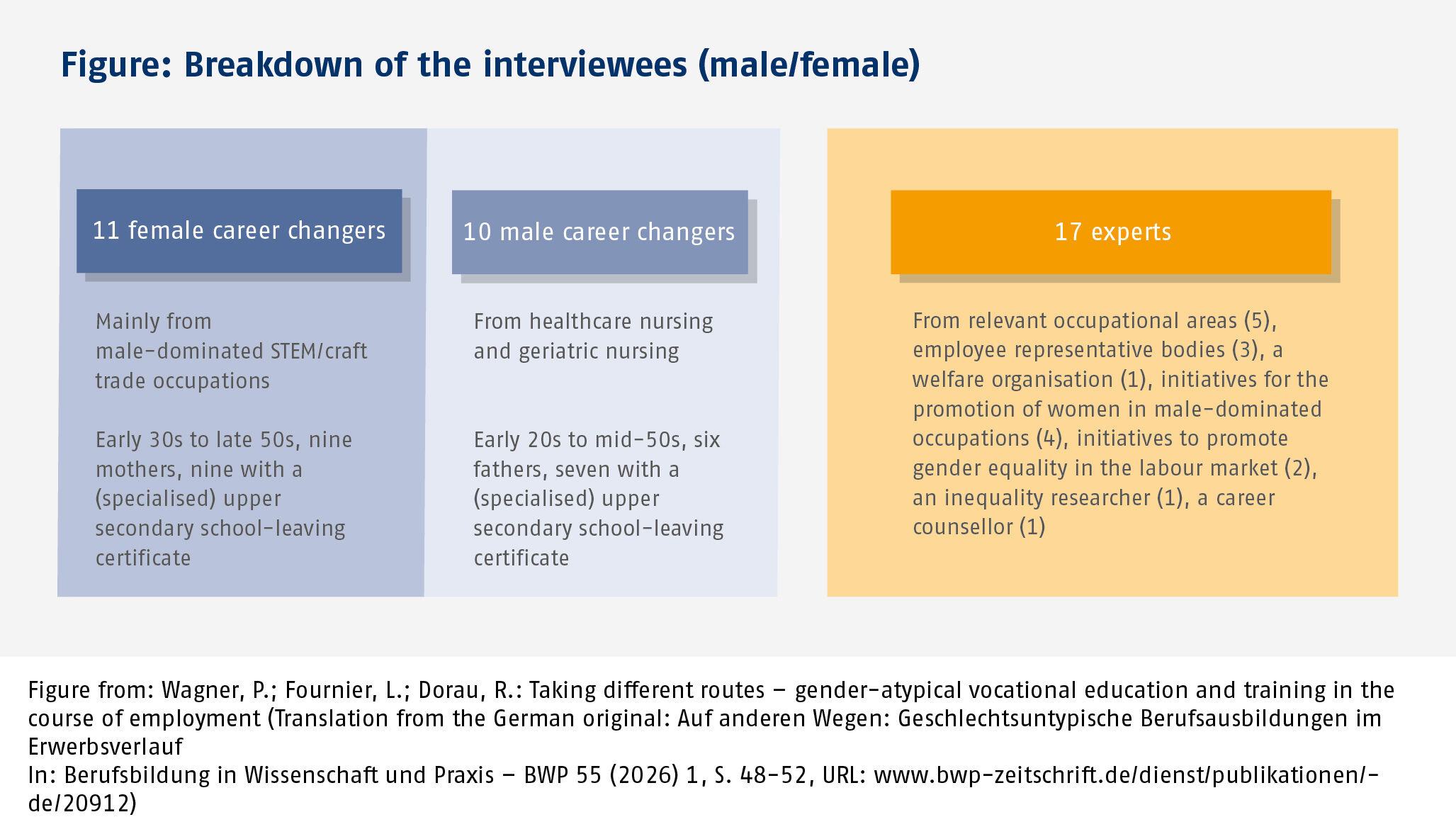
The study pursues a qualitative research design and is based on eleven biographical narrative interviews with female career changers from male-dominated occupations, on ten biographical narrative interviews with male career changers from nursing, and on 17 guided expert interviews (cf. Figure). When selecting respondents, attention was paid to ensuring that the career changers were representative of a diverse range of occupations, companies, educational backgrounds, and socio-demographic profiles. The objective was to gain the most comprehensive picture possible of the professional situation of people in gender-atypical occupations and of their lived environments. Nevertheless, career changers with an upper secondary school-leaving qualification are overrepresented in our sample. Reference to this bias is made in the interpretation of the results. The experts recruited were chosen in accordance with their knowledge of relevant sectoral and occupational cultures and of general conditions relating to employment, human resources and anti-discrimination law (further information on the respondents and the anonymisation abbreviation may be found in the electronic supplement). Interviews were conducted between July 2024 and June 2025. They were then transcribed and evaluated on the basis of qualitative content analysis in accordance with Gläser/Laudel (2006).
Exit motivations of people in gender-atypical occupations
The perspective of male career changers
The evaluation of the interviews with former male nurses identified unfavourable working conditions in nursing as the main exit motivation: “The problem primarily lies in the working conditions.” (M_BW_2). Particular reference is made to the tight staffing situation, to the high workload associated with this, and to shift work. In conjunction with the individual stress involved, these working conditions resulted in an inability on the part of some of the career changers to exercise a profession, which they actually valued highly, in the way they wished. Limited opportunities for advancement – “Where do I want to go in nursing?” (M_BW_1) – and the low level of prestige associated with nursing – “Because I can’t see that the view of society is going to change in the next few years either.” (M_BW_3) – were further reasons for leaving the care sector. The decision by the former male nurses to exit the profession may therefore be viewed as the result of a “cooling-out” towards the occupation in which they had trained, a process involving recognition of the discrepancy between their own professional orientations and conditions in the nursing sector and their alienation from nursing as a career. In many cases, the experts use an institutional argumentation to explain the absence of professional development opportunities and the low prestige of the profession by pointing out that nursing has always been a female-dominated occupation: “The question of the gender ratios [has], of course, something to do with the reputation and status of these occupations in society. It is therefore also connected with retention, benefits and career options.” (EXP_3). Nursing traditionally tended to be seen as a transition or supplement to women’s private care-giving responsibilities rather than as a long-term fully fledged career. This has led to employment characteristics which men, and increasingly women too, now perceive as unattractive and incompatible with their professional goals. Like the men interviewed, the experts emphasise that the unfavourable working conditions in nursing are a material exit motivation. One view is that the profession of nursing “cannot be exercised full-time for the rest of your life under the current conditions.” (EXP_5). On the other hand, neither the former male nurses nor the experts cite experiences of discrimination in the work context as a reason for leaving the nursing profession. The career changers assess situations of this kind as one-off cases and even tend to be more likely to speak of “positive” stereotypisation, for example: “What I often noticed was that men simply brought a bit of calmness to the work.” (M_BW_8). Although patients occasionally displayed irritation at male nurses, it proved possible to mitigate this by addressing patients in an appropriate manner. The experts arrive at a similar assessment and also refer to the benefits of gender-diverse nursing teams for patient care: “We should reach a point where we ask patients ‘Would you prefer to be washed by a man or a woman?’ This should become standard practice.” (EXP_4).
With regard to the further employment trajectory of the former male nurses interviewed, it is evident that most of them are now working in occupations which enjoy higher social prestige, having completed further academic education. Interestingly, such new task areas often have links with nursing and include research and teaching jobs in nursing itself or (administrative) roles in the healthcare sector. This further career development appears to correlate closely with the fact that the male career changers mainly have higher level school-leaving qualifications as well as with the exit motivations caused by limited opportunities for professional development within nursing and by the perception that professional prestige is low.
The perspective of female career changers
In contrast to the male career changers, the exit of the women interviewed from the gender-atypical occupations in which they have completed training tend to be determined by structural barriers rather than a sense of alienation from the occupation. In particular, the limited opportunities for part-time work in the occupations in which they have trained make it more difficult for the women, especially the respondents who are mothers, to reconcile their personal and professional lives: “Part-time is the problem. Skilled workers are being sought, but they are saying that they only want full-time staff.” (W_BW_5). Experts also identify these working conditions in male-dominated occupations, particularly in manufacturing and in the craft trades, as one of the main reasons for the exit of women from these occupations. They also point to institutionalised male-led workplace structures such as an absence of toilets for women – “They need to go somewhere else in order to go to the toilet.” (EXP_10) or changing rooms: “Women are usually assigned a storage room somewhere.” (EXP_9). Additional aspects are a lack of procedures for appropriately dealing with parental leave and difficulties in “re-entry following parental leave” (EXP_7). Most of the women interviewed also report situations in which they have experienced stereotypisation and discrimination in the workplace. Some of the ways in which these were expressed include doubts regarding their professional competence – “Women are more likely to be queried.” (W_BW_1) –, sexist comments – “Sweetheart, grab the notepad.” (W_BW_2) – or the allocation of gender-stereotyped work tasks: “That will suit you as a woman.” (W_BW_9). The experts are also of the view that stereotypisation and discrimination are an everyday occurrence for women in male-dominated occupations. “What we are still hearing is shocking.” (EXP_8). They feel that this is a contributory factor as to why many women abandon these occupations during the course of their working lives. The experts further point to limited career opportunities for women and to unjustified gender-specific income differences. They believe these are due to the exclusion of women from informal networks and to prejudices faced by women, and mothers in particular, in the workplace. The female career changers themselves report restrictions on their career development opportunities only sporadically. When they mention this aspect, they believe it to be caused by the disadvantages ensuing from their-part-time employment status, something which is frequently associated with motherhood. Notwithstanding the structural challenges and the experiences of discrimination, the women interviewed describe the occupations in which they have trained in predominantly positive terms. “This is my passion (...) and I enjoyed it immensely.” (W_BW_5). Moreover, they often view the incompatibility of prevailing working conditions with their private commitments as a consequence of occupational requirements which are difficult to alter: “With electrical work, you can't just leave the job half done. That’s the way it is, it simply doesn’t work.” (W_BW_11). The experts, on the other hand, adopt a more critical stance in this regard. Although they also attribute inflexible working (time) models to the demands of the respective occupations and to operational circumstances (e.g. limited predictability of installation orders, tight production cycle times, restricted flexibility for smaller craft trade firms), they also refer to a low degree of willingness on the part of employers to make changes in respect of work organisation: “[Employers] are simply not flexible enough when it comes to working hours or things like mobile working.” (EXP_7)
With regard to the further employment trajectory of the female career changers interviewed, it is revealed that the occupational switch is usually associated with professional advancement in the form of better employment and working conditions in very different occupational fields. This step is frequently preceded by a further phase of vocational training or (in the majority of cases) by a further period of academic training. This has been rendered possible by dint of the fact that the women interviewed are predominantly in possession of higher level school-leaving qualifications.
Occupational structure adjustments – a win for everyone
The results of our study indicate gender-specific patterns in respect of the challenges with which individuals are confronted after completing gender-atypical VET. As far as company and sector-specific endeavours to improve the retention and career development of women in male-dominated occupations are concerned, the indication is that further efforts will be necessary in order to create more flexible working (time) models and to establish a work culture in which discrimination is not accepted. On the other hand, better working conditions, clear professional development paths and associated career opportunities could motivate men to remain in the nursing sector. Even though these improvements have been formulated from a gender-specific perspective, it is clear that they will benefit all employees regardless of their gender.
As well as revealing these necessary adjustments, the results also indicate a correlation with the persistence of the traditional gender model in society. In this model, men continue to play the role of full-time breadwinners, whereas women assume the main responsibility for private commitments which must be reconciled with their professional activities. Its endurance is significantly reinforced by the German social welfare system, which, for example, provides insufficient childcare for working parents, whilst at the same time offering financial incentives for a family model in which one partner does not work full-time.
The professional advancement observed after leaving a gender-atypical occupation must be viewed against the background of the predominantly high level of school-leaving qualifications among the men and women interviewed. It would be interesting to examine the further employment trajectories of individuals with lower school leaving qualifications. Statistical studies could deliver further findings here due to the challenging recruitment of interviewees.
In overall terms, our results reinforce the observation formulated by Rohrbach-Schmidt/Uhly (2015, p. 132): “If we wish to break down gender-specific occupational structures, improving access to the respective gender-atypical training occupations is not sufficient in itself.” Because this very area has formed the focus of gender-sensitive education policy and career counselling initiatives of recent years, more intensive measures targeting later stages of the career path are needed. The assumption is that improvements in the utilisation prospects of gender-atypical VET programmes will in turn have a positive impact on the decision of young men and women to choose such a training pathway.
Literature
Achatz, J.: Berufliche Geschlechtersegregation. Probleme, Theorien, empirische Befunde. In: Abraham, M.; Hinz, T. (Hrsg.): Arbeitsmarktsoziologie. 3rd edition. Wiesbaden 2018, pp. 389–435
Beblo, M.; Schäfer, M.; Hermann, M.: So vereinbarkeitstauglich ist der deutsche Stellenmarkt. Zeitsouveränität und Familienfreundlichkeit in Online-Stellenanzeigen. Gütersloh 2025
Betzelt, S.; Bothfeld, S.: Die Krankenpflege im deutschen Genderregime. Woran scheitert die berufliche Gleichstellung? In: Scherger, S.; Abramowski, R.; Dingeldey, I.; Hokema, A.; Schäfer, A. (Hrsg.): Geschlechterungleichheiten in Arbeit, Wohlfahrtsstaat und Familie. Frankfurt a. M./New York 2021, pp. 249–278
Boll, C.; Jahn, M.; Lagemann, A.; Puckelwald, J.: Dauerhaft ungleich – berufsspezifische Lebenserwerbseinkommen von Frauen und Männern in Deutschland. In: HWWI Policy Paper No. 98 (2016)
Busch, A.: Die berufliche Geschlechtersegregation in Deutschland. Wiesbaden 2013
Gläser, J.; Laudel, G.: Experteninterviews und qualitative Inhaltsanalyse. 4th edition. Wiesbaden 2006
Hamjediers, M.; Peters, E.: Gender compositions of occupations and firms jointly shape switches from gender-atypical towards more gender-typical positions. In: European Societies 26 (2024) 4, pp. 1170– 1194
Hünefeld, L.; Dötsch, M.: Berufliche Geschlechtersegregation. Die Arbeits- und Gesundheitssituation von Frauen und Männern in geschlechtersegregierten und -integrierten Berufen. Dortmund 2023
Imdorf, C.; Hegna, K.; Eberhard, V.; Doray, P.: Educational systems and gender segregation in education – A three-country comparison of Germany, Norway & Canada. In: Imdorf, C.; Hegna, K.; Reisel, L. (Hrsg.): Gender Segregation in Vocational Education. Bingley 2015, pp. 83–122
Jeanrenaud, Y.: MINT. Warum nicht? Zur Unterrepräsentation von Frauen in MINT, speziell IKT, deren Ursachen, Wirksamkeit bestehender Maßnahmen und Handlungsempfehlungen. Ulm 2020
Madsen, A. Å.; Brekke, I.; Fekjær, S. B.: Women’s Attrition from Male-Dominated Workplaces in Norway: The Importance of Numerical Minority Status, Motherhood and Class. In: Work, Employment and Society 37 (2023) 2, pp. 333–351
Matthies, H.: Cooling out in der Arbeitswelt: Berufswechsel als Folge eines Mismatch von Habitus und Feld. In: Berliner Journal für Soziologie 31 (2021) 3–4, pp. 415–443
Rohrbach-Schmidt, D.; Uhly, A.: Determinanten vorzeitiger Lösungen von Ausbildungsverträgen und berufliche Segmentierung im dualen System. Eine Mehrebenenanalyse auf Basis der Berufsbildungsstatistik. In: Kölner Zeitschrift für Soziologie und Sozialpsychologie 67 (2015) 1, pp. 105– 135
Solga, H.; Pfahl, L.: Doing Gender im technisch-naturwissenschaftlichen Bereich. Berlin 2009
West, C.; Zimmerman, D. H.: Doing Gender. In: Gender and Society 2 (1987) 1, pp. 125–151
Further links
Details on the list of interview partners (career changers and experts) can be found in the electronic supplement at www.bwp-zeitschrift.de/dienst/publikationen/de/material/12527
(All links: status 21/01/2026)
Pia Wagner, Lisa Fournier, Ralf Dorau
Academic researchers at BIBB
Translation from the German original (published in BWP 1/2026): Martin Kelsey, GlobalSprachTeam, Berlin