Profile of an occupation – carpenter
Carpenters play an indispensable role in the construction industry. They combine traditional craft trade skills with advanced high-tech in order to make the best possible use of the versatility and sustainability of wood as a building material. This profile describes the entire scope of the modernisation of 2026 and shows the development of trainee figures in the largest training occupation in the construction industry.
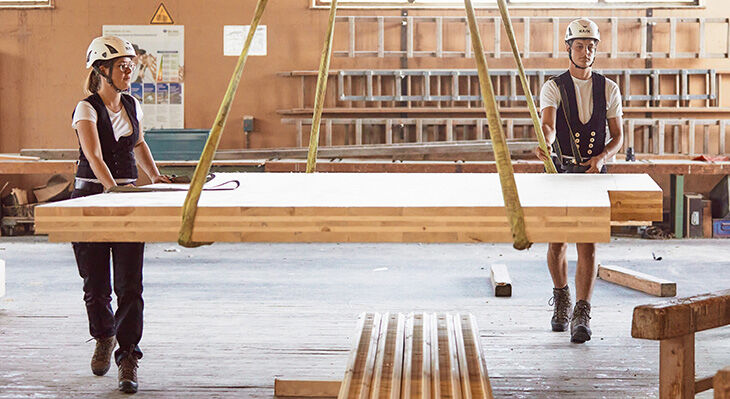
Timber construction on the rise
In Germany, the number of planning permissions for newly built properties where timber is the predominant construction material (for both residential and non-residential buildings) increased from around 21 percent in 2020 to about 25 percent in 2024 (cf. HOLZBAU DEUTSCHLAND 2025). The carpentry trade is the most important occupation involved in carrying out these timber construction projects.
Carpenters specialise in the processing and treatment of complex timber constructions. Their field of work ranges from the preparation of wooden surfaces to the erection of new timber structures. They prepare and treat wooden surfaces in order to provide protection against external factors and to lend them an attractive appearance. Carpenters also plan and execute measures for structural timber preservation. They are familiar with the various methods of protecting wood against damp, insect infestation and other forms of damage. The use of woodworking machinery to prepare, process and assemble timber structures constitutes a further key aspect of their work. Energy efficiency measures are also playing an increasingly important role in their day-to-day work alongside the erection of new timber structures. Carpenters need to be able to identify, preserve and protect historic building structures too.
Support from digital technologies
Timber construction is constantly evolving, both in terms of building physics and energy-efficient refurbishment and with respect to the deployment of digital tools. The carpentry trade is increasingly making use of new technologies alongside the traditional craft techniques that are still required. Carpenters work with a combination of digital planning (CAD/BIM), computer-controlled machining equipment (CNC) and high-precision measuring and assembly tools. The use of these technologies makes it possible to prepare a large proportion of components in the workshop. This improves efficiency, fit accuracy and sustainability on the construction site. Surveys are carried out with a 3D laser scanner. Complex roof trusses, half-timbered structures or entire timber-framed houses are designed in 3D on a computer. The precise cutting of timber joints is performed by computer-aided sawing and milling centres. Work orders, plans, materials lists and site diaries are accessed and edited directly on site via mobile apps and tablets.
Training figures growing constantly
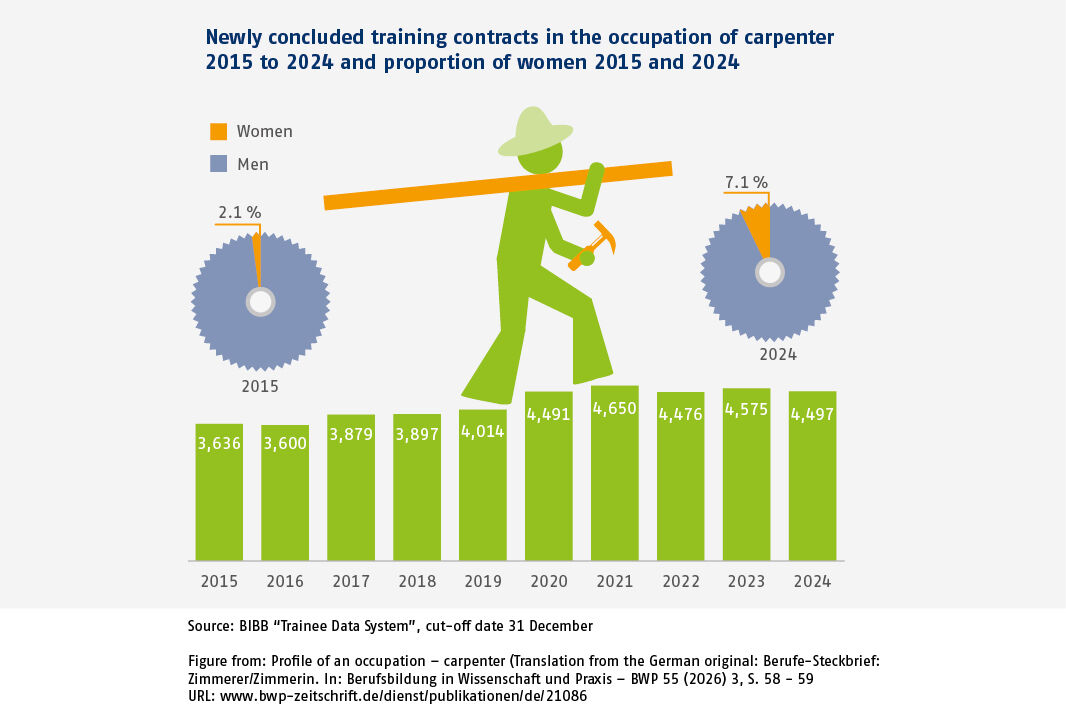
The increasing significance of timber construction is also reflected in the training figures. The carpentry trade is strongly represented amongst construction occupations. It boasts 10,000 trainees across all years of training (as of 31/12/2024) and is now the largest training group in the building sector. The popularity of the occupation has been underlined by training figures which have been either constant or increasing over many years. The number of newly concluded training contracts rose over ten years from 3,636 (2015) to 4,497 in 2024. The proportion of women grew from 2.1 percent to 7.1 percent over the same period (cf. Figure).
Career
A multitude of career pathways are open following successful completion of the journeyman examination in the craft trade occupation of carpenter. These range from traditional hands-on management roles to specialist areas and also extend to encompass academic routes. Master craftsman training leads to the entitlement to train the next generation of skilled workers and is a prerequisite for self-employment. The title of master carpenter is aligned to Bachelor degree level within the German Qualifications Framework (DQR). Examples of specialisations include certified restorer in carpentry, building energy advisor or timber construction technician specialising in design, structural analysis and work planning.
Upon completion of training, and frequently after having achieved a master craftsman qualification too, higher education programmes such as architecture, civil engineering or timber technology may be accessed at universities of applied sciences without any need for an upper secondary school leaving certificate.
High training allowance
Carpenters receive an average training allowance of €1,343 per month across the entire duration of training. This is the highest average monthly training allowance based on collective wage agreements within the craft trades area of training (average €1,093). According to the BIBB “Training allowances based on collective wage agreements” database, average allowances are €1,070 per month in the first year of training, €1,281 in the second year and €1,527 in the third year. (Status 01/10/2025)
At a glance
- Last update: 2026
- Duration of training: 3 years
- Area of responsibility: Crafts
- Training structure: Mono-occupation
- DQR reference level: 4
Literature
Holzbau Deutschland – Bund Deutscher Zimmermeister (Ed.): Lageberichte. Berlin 2025
Further links (in German)
BIBB website page on the occupation
Designing Vocational Training
Timber Construction Germany – Association of German Master Carpenters
Podcast on the description of the occupation featuring two trainees
(All links: status 15/07/2026) (Compiled by Arne Schambeck, BWP)
Translation from the German original (published in BWP 3/2026): Martin Kelsey, GST GlobalSprachTeam ‒ Sassenberg e.K., Berlin