Profile of an occupation – orthopaedic technician
Orthopaedic technicians working in the craft trades support people with physical disabilities by providing customised aids such as prostheses, insoles and wheelchairs. This profile offers an insight into the tasks and activities which are typical of the occupation. It also states figures relating to training and presents a project showing how the sector is helping war invalids in Ukraine.
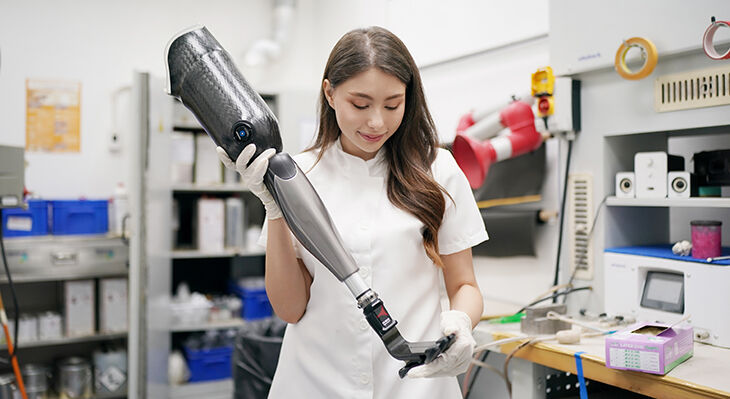
A fusion of technology, craftsmanship and medicine
The work of orthopaedic technicians can significantly improve the quality of life of people with physical disabilities. Requirements are complex, and bespoke solutions are always necessary. The scope of tasks covered by this craft trade occupation in the healthcare sector is consequently highly varied. Orthopaedic technicians construct and assemble orthopaedic aids which they then adjust to suit the needs of patients. They use various materials such as metals, plastics, casting resins, carbon, silicone, leather and fabrics. Processing these requires a whole range of manufacturing techniques including moulding, milling, drilling, cutting, bonding, upholstering and thermoplastic and casting procedures. Knowledge of anatomy, pathology and applied biomechanics forms part of the training alongside technical craft trade skills. In addition, sensitivity, empathy, discretion and a respectful approach to different cultural identities are key requirements within this occupational profile, as acceptance of orthopaedic care also depends on how well professionals are able to respect the dignity of those affected. Patients must receive personalised advice and be encouraged to become actively involved within the limits of their abilities. Interdisciplinary collaboration is also important for ensuring optimum care and the success of rehabilitation measures.
Main focuses
Training takes place in one of the three specialisms of prosthetics, individual orthotics or individual rehabilitation technology. Orthopaedic technicians specialise in different types of medical device engineering in accordance with the main focus they have chosen.
Prosthetics, for example, covers artificial limbs (arm and leg prostheses) and the replacement of body parts following amputations or as a result of congenital malformations.
Individual orthotics, for example, encompasses orthoses, devices designed to support or guide the trunk and limbs, and specialised trusses.
Individual rehabilitation technology, for example, includes the fitting of technical aids such as wheelchairs, reclining and seating shells, walking and standing aids, care beds, and the customisation of rehabilitation equipment.
Support for Ukraine
As a result of the ongoing war, there is an extremely high demand in Ukraine for prosthetic limbs to assist people who have been maimed in the conflict. Several initiatives, such as the “Life Bridge Ukraine” project, have been launched in order to offer support. As part of this project, young Ukrainian skilled workers are undergoing training in the manufacturing of prostheses at German orthopaedic engineering companies. German trainees and journeymen/journeywomen are passing on the knowledge they have acquired via dual training, while their Ukrainian colleagues are able to contribute valuable experience of improvisation and practical insights gained in a crisis-hit region. Initiatives instigated by teachers and trainee classes are also taking place at some vocational schools and orthopaedic engineering training centres. One such scheme involves collecting prosthetic components which are no longer in use but still intact. These are then passed onto people in Ukraine.
Support via digital technologies
The work of an orthopaedic technician requires finesse and manual dexterity. Modern technologies are on hand to assist. Measurements can be taken using a 3D laser, 3D printers are able to produce foot models, and robot-assisted technology can be deployed for the manufacture of prostheses. Innovations are constantly expanding the functions of orthopaedic aids. Electronically controlled prostheses are now available, and exoskeletons fitted with sensors are also being produced to support the musculoskeletal system.
Women have overtaken men
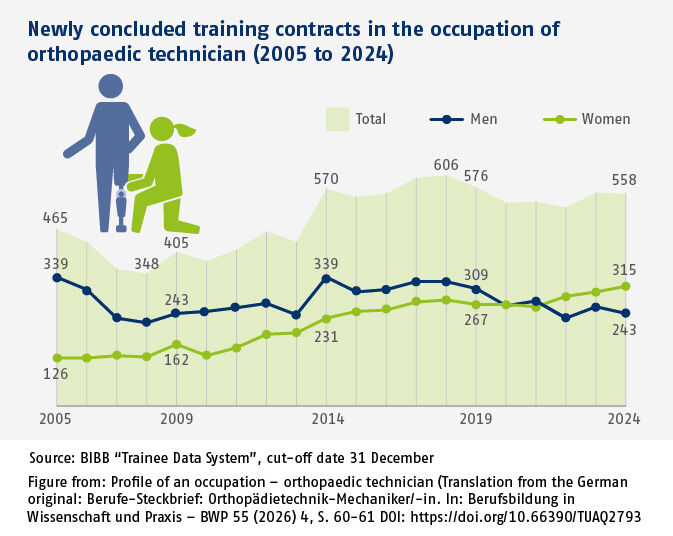
Total training numbers in the occupation of orthopaedic technician have been at a high level for many years. As of the cut-off point of 31/12/2024, there were 1,440 trainees across all three years of training. The number of newly concluded training contracts has risen over the past 20 years from 465 (2005) to 558 (2024). Despite individual outliers (2008: 348, 2018: 606), figures have remained generally stable in overall terms. One striking aspect has been the steady increase in the proportion of women, from 27.1 percent in 2005 to 56.5 percent in 2024. In 2022, women accounted for more than half of all trainees for the first time (see Figure).
Career
Numerous opportunities are available on the labour market following successful completion of training. Orthopaedic engineering and rehabilitation centres offer particularly good prospects, but a career in sales at a manufacturer of medical aids is, for example, a further option. Holders of the qualification of Master Professional in Orthopaedic Technology are able to establish their own orthopaedic engineering business or medical supplies store and can also assume a senior managerial role at a company.
At a glance
- Last update: 2013
- Duration of training: 3 years
- Area of responsibility: Crafts
- Structure: Training occupation with the three specialisms of prosthetics, individual orthotics and individual rehabilitation technology
- DQR reference level: 4
Further links (in German)
BIBB website page on the occupation
Designing Vocational Training
Federal Guild Association for Orthopaedic Technology
Podcast on the description of the occupation featuring two trainees
(All links: status 14/10/2026) (Compiled by Arne Schambeck, BWP)
Translation from the German original (published in BWP 4/2026): Martin Kelsey, GST GlobalSprachTeam ‒ Sassenberg e.K., Berlin