Systematic competence management in the company
Consequences for the participation of low-skilled employees in continuing vocational education and training
Mortimer Schlieker, Agnes Dietzen
This article examines the prevalence of systematic competence management in German companies and investigates whether it influences the participation of low-skilled employees in non-formal continuing vocational education and training (CVET). Analyses of the BIBB Training Panel show that highly systematised forms of competence management are established in around a quarter of large companies and that these contribute to an increase in employees’ participation in CVET, whereby highly systematised competence management has a more positive effect for high-skilled employees.
The relevance of non-formal CVET for low-skilled employees
Due to technological and ecological changes in the world of work, continuous competence development is becoming increasingly important for both employees and companies. On the one hand, it is an important basis for the professional and personal development of employees and ensures their labour market participation. For companies, on the other hand, continuously developing the competences of their workforce is an important way of countering skills shortages and maintaining competitiveness.
Non-formal training is particularly important in this regard. In contrast to formal training (e.g. formal upgrading to become a master craftsperson), access for employees is significantly easier, partly because the mostly course-based non-formal measures focus more on specific qualification and learning needs from the work and organisational processes, often take place in companies or training institutions associated with the company, and can be designed more flexibly (see European Union 2016). This low-threshold form of training can be a significant opportunity to participate in lifelong learning, especially for low-skilled employees, who have been significantly underrepresented in in-company competence development (see Mohr/Troltsch/Gerhards 2016). This is all the more relevant as non-formal training can prevent people from dropping out of the labour market and thus establish a safety net function for employment biographies (Ebner/Ehlert 2018).
In addition, non-formal training offers low-skilled employees the opportunity to demonstrate the development of their competences and abilities with certificates of participation. In the best case, this can lead to higher wages or the transfer to higher quality jobs.
Participation in CVET through systematic competence management
We assume that the participation of low-skilled employees in continuing vocational education and training will improve if companies are aware of the competence development potential of this part of their workforce. This is based on the assumption that companies will primarily invest in the CVET of previously underrepresented groups if the uncertainties regarding the returns (e.g. productivity gains) associated with these investments are reduced (Williamson 1985). According to this assumption, which is also known as the “transaction cost problem”, it can be expected that company investments in CVET for low-skilled employees will increase if the respective company personnel strategy includes a systematic and long-term approach to the workforce’s competence potential. This reduces uncertainties for both company decision-makers and for employees.
Systematic competence management (SCM) could be an important prerequisite for this. Characteristic elements of SCM are
- the systematic recording of competence development and qualification needs,
- the customised organisation of CVET and competence development measures,
- the rewarding of learning and participation in CVET, and
- the documentation and certification of acquired competences so that employees can utilise them (Paulsen/Kauffeld 2019).
Ideally, employees benefit from SCM if they can further develop in their tasks, are promoted to better-paid positions, or have access to CVET and further qualification measures.
Generally, SCM can be defined as an overarching concept for planning, realising and managing the acquisition and development of employees’ competences. It encompasses recruitment, formal, non-formal and informal training, as well as workplace organisation that promotes learning (North/Reinhardt/Sieber-Suter 2018). It is based on company-specific competence models that enable (software-supported) measurements and target/actual comparisons to synchronise employees’ competences with the company’s strategic goals (Knackstedt et al. 2020a). Thus, SCM can be understood as an overarching organisational logic of action that places the lifelong acquisition and development of employee competences at the centre of operational decision-making processes (Truschkat 2010; Knackstedt et al. 2020b; Dietzen et al. 2023).
Despite increasing empirical evidence of the relevance of SCM, there is still a lack of knowledge regarding its prevalence and consequences for different groups of employees. This is because SCM has primarily been analysed from a business administration perspective that focuses on internal efficiency processes. The empirical findings in the literature are primarily based on qualitative expert interviews or case studies in large and medium-sized companies (see Dörsam/Körfer 2022), which do not allow any representative statements to be made about the prevalence and impact of SCM in the German company landscape. Accordingly, little is known to date about how the systematisation of company competence development affects the participation of low-skilled employees in CVET.
This is particularly relevant in light of the high proportion of small and medium-sized enterprises (SMEs) in Germany. Although practices of CVET organisation exist here, there are generally no systematised forms of competence management (Kauffeld/Frerichs 2018). This article therefore examines the following questions.
- How prevalent are various forms of systematic competence management in German companies?
- Do they have an influence on the CVET participation of low-skilled employees compared to (high-)skilled employees?
The first research hypothesis is that participation in CVET among both low-skilled and high-skilled employees rises with an increasing degree of systematic competence management. The second hypothesis is that the more transparent and structured the company’s competence development is organised, the greater the increase in CVET participation among low-skilled employees, because uncertainties about the costs and benefits of training are reduced.
BIBB Training Panel
The BIBB Establishment Panel on Qualification and Competence Development is a representative recurring survey on the qualification behaviour of companies with at least one employee subject to social security contributions in Germany that has been conducted annually since 2011. The survey is conducted by BIBB in cooperation with the infas Institute for Applied Social Science and is carried out using computer-assisted personal interviews (CAPI). This article draws on data from the 2018 survey wave, in which around 4,000 companies were surveyed.
Further information: www.qualifizierungspanel.de
The operationalisation of systematic competence management
To analyse these questions and hypotheses, the article draws on data from the BIBB Training Panel (see info box).
This dataset contains information on the extent to which companies (systematically) address the competences of their employees (see Table 1 in the electronic supplement). Based on this information, three company groups with different degrees of systematisation of competence management are examined (see Table 2 in the electronic supplement).
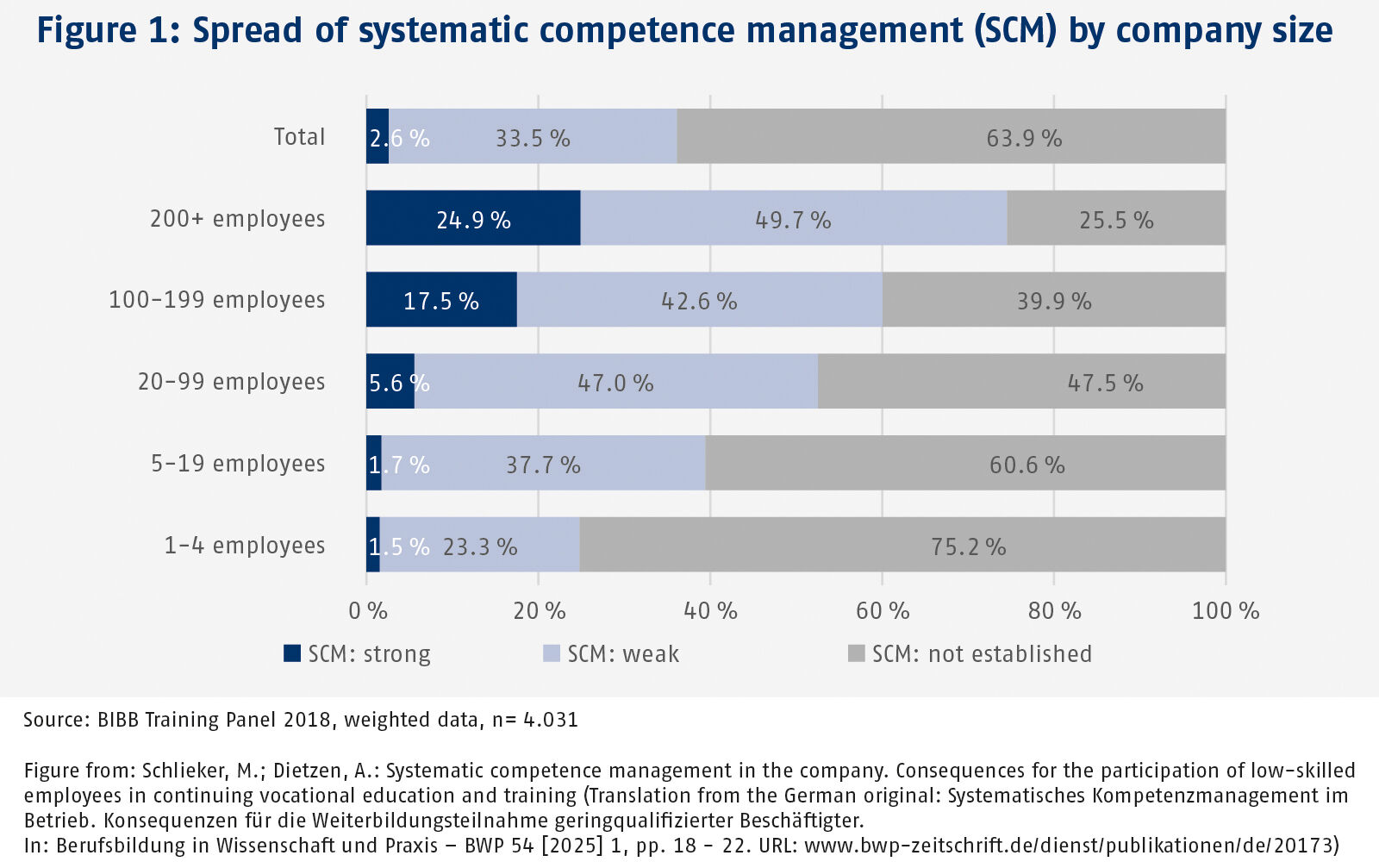
The first group are companies that have no established SCM. These are companies that do not systematically record, compare or document the competences of their employees and do not have a systematic personnel development system or written promotion criteria. This applies to around 64 per cent of German companies (see Fig. 1). The second group are companies where SCM is weakly developed, which means that they compare existing and required employee competences, use target agreements and take social, personal and methodological competences into account. However, this type, which occurs in around one in three companies, does not follow a specific systematic management approach. This is only the case in the third type of company with a strong SCM (in addition to the other criteria, competences are systematically recorded and there is systematic personnel development or written promotion criteria), which is found in 2.6 per cent of German companies.
A look at the distribution by company size (see Fig. 1) shows that this distribution is primarily related to the large number of small and micro-companies. As expected, the vast majority of these companies do not use systematic approaches to record and promote competences. In the larger companies, however, the situation is different: In the group with 20 to 99 employees, almost half of the companies have the resources to manage their employees’ competences at least weakly systematically. In companies with more than 100 employees, the prevalence of highly systematised competence management is increasing significantly.

Sector-specific differences in the prevalence of are also striking (see Fig. 2): Forms of systematic competence management are particularly widespread in the medical, public and business-related services sectors. In agriculture, mining and the energy industry, on the other hand, around 86 per cent of companies do not use any form of SCM at all.
This can partly be explained by the smaller average company size in this sector. In contrast, a weak use of SCM is more prevalent in the construction industry, in other (mainly personal) services and in the trade and repair sector. This also applies to the manufacturing industry. What is notable here, however, is the significantly above-average prevalence of highly systematised competence management (4.3%). This could indicate that increasing digitalisation in the manufacturing sector is leading to a growing need for structured competence management. The results show that the implementation of SCM depends not only on the size of the company, but also on the specific requirements and developments of the sectors. The use of systematic competence management is widespread, particularly in sectors with a high demand for CVET, such as healthcare and public administration.
In addition to these descriptive results, a multivariate regression model provides indications of possible underlying influencing factors behind these differences by sector and company size. The model is based on an ordinal logistic regression, which can be used to identify factors that influence the probability of a higher level of SCM being established in companies (from non-existent to weakly systematised, from weakly to strongly systematised). Various influences such as organisational structure, collective bargaining commitment or decline in demand in the market segment were considered (see descriptive statistics of the analysis variables in Table 3 in the electronic supplement).
This shows that an increasing degree of digitalisation, a divisional formal company structure (i.e. subdivided by product group) as well as consultation during the implementation of SCM have a positive influence on the extent of SCM (see Table 4 in the electronic supplement). Interestingly, while the sector differences described above can be fully explained by the included control variables, the significant effect of company size remains, at least in the group of large companies with more than 200 employees.
Higher participation in CVET at companies with systematic competence management
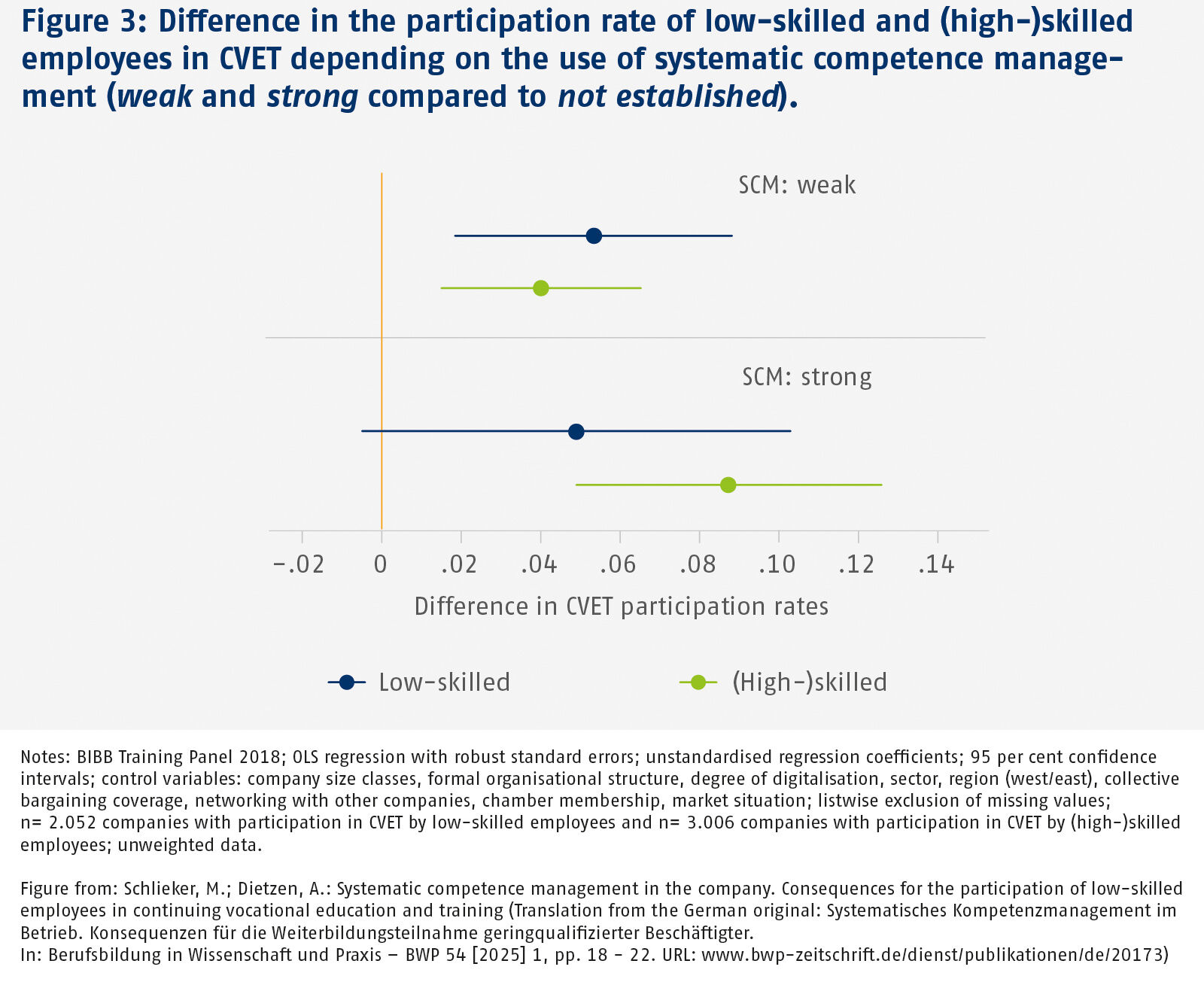
In addition to information on the degree of systematisation of company competence development, the BIBB Training Panel also contains information on the CVET behaviour of employees. This information is used in the following to investigate the influence of SCM on the participation rates of employees with different qualification levels1 (for details on operationalisation, see Table 5 in the electronic supplement). For this purpose, two further (linear) regression models were estimated, which analyse the influence of weak and strong SCM on the CVET participation rates in of a) low-skilled and b) (high-)skilled employees2 (see Table 6 in the electronic supplement).
Holding relevant control variables constant, the models confirm the initial research assumption that both low-skilled and (high-)skilled employees benefit from a higher degree of systematic competence management in terms of their participation in continuing vocational education and training: As Figure 3 shows, the training participation rate of both groups is on average around four to nine percentage points higher in companies with SCM. Interestingly, the participation rates of the low-skilled tend to be more pronounced in companies with weak SCM, while the group of (high-)skilled employees is more influenced by strongly systematised competence management. The second assumption, that the more transparent and structured the company’s competence development is organised, the greater the benefit to the low-skilled, can therefore only be confirmed to a limited extent.
Discussion: Why are the participation rates of (high-)skilled employees increasing most in companies with strong SCM?
This result, that the training participation rate of (high-)skilled employees is particularly high in companies with strong SCM, can be plausibly explained within the framework of the Relational Inequality Theory (Tomaskovic-Devey/Avent- Holt 2019).
According to this theory, company resources can be claimed primarily by those groups of employees that have a good social bargaining potential within the company. These groups usually have higher formal qualifications and more professional expertise. Corresponding experiences of self-efficacy and the required knowledge of company rules and practices enhance their social bargaining ability. This could explain why formalised systems such as the SCM do not eliminate existing social differences between groups of employees, but rather perpetuate them, albeit to a lesser extent.
In this respect, more intensive support with regard to recognising and strengthening one’s own skill and performance potential, as well as an improved understanding of how SCM works in the company, could be necessary in order to also include the group of low-skilled employees in the process of highly systematised competence development. To ensure that the different requirements of employee groups are considered, it is important to have a working environment that promotes learning and skills and a management culture that supports this (cf. Böse/Dietzen 2017). This can help to ensure that all employees, regardless of their level of qualification, have the same opportunities for continuing professional development and thus for long-term employability.
-
1
In the BIBB Training Panel, the qualification level refers to the requirement level of the tasks carried out by the respective employee groups (see Table 5 in the electronic supplement).
-
2
The group of qualified employees (performing activities, which usually require completed vocational training) was summarised here with the group of highly qualified employees (jobs that usually require a university, master craftsperson or technician qualification).
Literature
Böse, C.; Dietzen, A.: Kompetenzfeststellung und Anerkennung im Betrieb. Die Bedeutung von Kompetenzmanagement aus Sicht der psychologischen Vertragsbeziehung. In: BWP 46 (2017) 6, pp. 36–39. URL: www.bwp-zeitschrift.de/dienst/publikationen/de/8519
Dietzen, A.; Gerhards, C.; Schlieker, M.; Troltsch, K.: Handlungslogiken in der betrieblichen Qualifikationsbedarfsdeckung. Entwicklung eines organisations- und institutionssoziologischen Theorierahmens und empirische Exploration von Einflussfaktoren. Bonn 2023
Dörsam, M.; Körfer, A.: Skill-Management in Unternehmen der Industrie 4.0. Gute Beispiele aus der Praxis. Leverkusen 2022
Ebner, C.; Ehlert, M.: Weiterbilden und Weiterkommen? Non-formale berufliche Weiterbildung und Arbeitsmarktmobilität in Deutschland. In: Kölner Zeitschrift für Soziologie und Sozialpsychologie 70 (2018) 2, pp. 213–235
European Union (Ed.): Classification of learning activities. Luxembourg 2016
Kauffeld, S.; Frerichs, F.: Kompetenzmanagement in kleinen und mittelständischen Unternehmen. Berlin, Heidelberg 2018
Knackstedt, R.; Kutzner, K.; Sitter, M.; Truschkat, I. (Ed.): Grenzüberschreitungen im Kompetenzmanagement. Trends und Entwicklungsperspektiven. Berlin, Heidelberg 2020a
Knackstedt, R.; Truschkat, I.; Häussling, R.; Zweck, A. (Ed.): Betriebliches Kompetenzmanagement im demografischen Wandel. Orientierung für Wissenschaft und Praxis. Berlin, Heidelberg 2020b
Mohr, S.; Troltsch, K.; Gerhards, C.: Job tasks and the participation of low-skilled employees in employer-provided continuing training in Germany. In: Journal of Education and Work 29 (2016) 5, pp. 562–583
North, K.; Reinhardt, K.; Sieber-Suter, B.: Kompetenzmanagement in der Praxis. Mitarbeiterkompetenzen systematisch identifizieren, nutzen und entwickeln. Mit vielen Praxisbeispielen. Wiesbaden 2018
Paulsen, H. F. K.; Kauffeld, S.: Kompetenzmanagement in Organisationen: Ein Beitrag zur Laufbahnentwicklung. In: Kauffeld, S.; Spurk, D. (Ed.): Handbuch Karriere und Laufbahnmanagement. Berlin 2019, pp. 511–542
Tomaskovic-Devey, D.; Avent-Holt, D. R.: Relational inequalities. An organizational approach. New York 2019
Truschkat, I.: Kompetenz – Eine neue Rationalität sozialer Differenzierung? In: Kurtz, T.; Pfadenhauer, M. (Ed.): Soziologie der Kompetenz. Wiesbaden 2010, pp. 69–84
Williamson, O. E.: The Economic Institutions of Capitalism. New York 1985
Further links
Detailed information on operationalisation and multivariate analyses can be found in the electronic supplement.
(All links: status 17/03/2025)
Mortimer Schlieker
Researcher at BIBB
Agnes Dietzen
Prof. Dr. Head of the “Competence Development” Division at BIBB
Translation from the German original (published in BWP 1/2025)