Young adults without a vocational qualification – unused skilled worker potential?
Michael Kalinowski
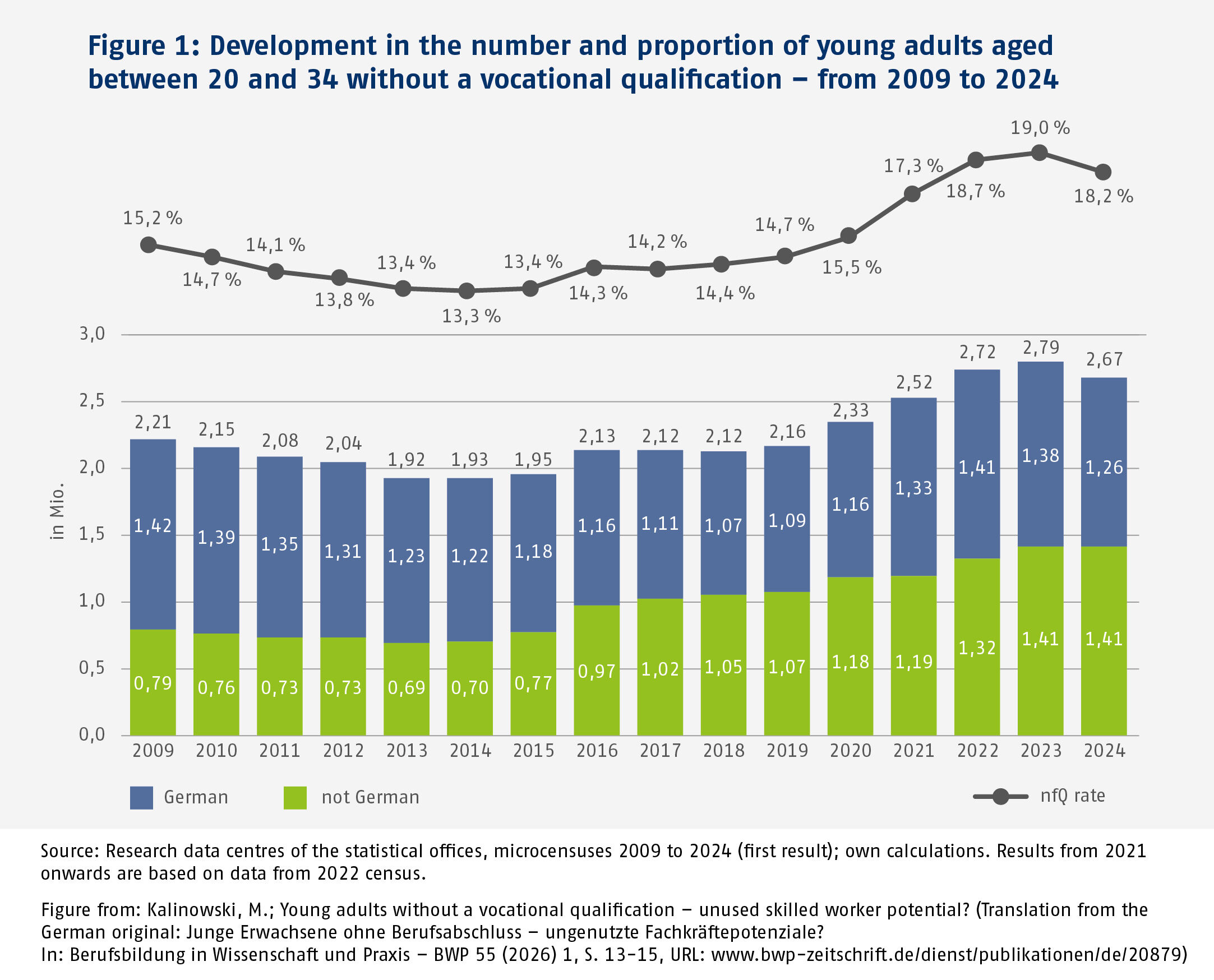
In 2023, the number of young adults aged from 20 to 34 without a vocational qualification reached a new record high of 2.79 million people. In 2024, the figure decreased for the first time in nine years. This development is presented below, and the explanation of the results is differentiated according to school and vocational qualifications. It is also worth looking at the labour market situation of young adults in order to identify skilled worker potential.
Lack of a qualification limits opportunities in the labour market
The lack of a vocational qualification represents a significant labour market policy indicator since people who have not completed vocational education and training (VET) are at higher risk of unemployment, even during economically favourable times. In 2024, the unemployment rate amongst people without a vocational qualification was 20.9 percent. This contrasts with a figure of only six percent for unemployment across Germany as a whole (cf. Federal Employment Agency 2025a). Unqualified workers also earn significantly less on average than their counterparts who have completed a qualification. Those without a vocational qualification earn a gross monthly income of €2,987. The comparable figures for people who have completed VET and for people with an academic qualification are €3,870 and €5,916 respectively (cf. Federal Employment Agency 2025b). Using targeted higher level training to reduce the number of people without a formal qualification (see Information box for definition of this term) would thus considerably improve their chances in the labour market and allow a significant pool of skilled worker potential to be tapped into.
Development in the number of young adults without a vocational qualification since 2009
Although both the number of young adults aged 20 to 34 without a vocational qualification and the proportion of such people within the relevant age cohort (nfQ rate) fell from 2009 to 2014, both these figures have been rising continually since 2015 (cf. Figure 1, p.14). In 2023, the number of people without a formal qualification reached a record high of around 2.79 million. This represented an nfQ rate of 19 percent. In 2024, the proportion of young adults aged 20 to 34 without a vocational qualification was 18.2 percent. The extrapolated national figure was 2.67 million young adults without a formal qualification. This was thus the first time for nearly ten years that a discernible decrease had been recorded. However, the fall was entirely due to a decline in the number of German nationals (not including dual nationals) without a formal qualification. Figure 1 shows that the number of non-German young adults without a vocational qualification rose steadily from 2015 onwards as a result of increased refugee migration. The next occasion on which there was no year-on-year increase in the number of non-Germans without a vocational qualification was 2024. In 2024, the number of non-Germans without a formal qualification was, for the first time, significantly higher than the corresponding figure for Germans, by 150,000.
Persons without a formal qualification (nfQ)
The term non-formally qualified persons or persons without a vocational qualification is used to describe all persons who are unable to demonstrate “successful certified participation in formal (standardised, state regulated or recognised) education and training courses” (Gottsleben 1987), i.e. persons who have not completed dual or school-based VET or a course of study at a university of applied sciences or institute of higher education (or achieved an equivalent qualification). Persons who have undergone semi-skilled training or who have completed an internship or practical placement are not considered to be formally qualified.
Because non-formally qualified persons include a considerable number of those who have not yet completed their VET or else who are engaged in voluntary military service, in the Federal Voluntary Service or in a voluntary social or ecological year, especially in the age cohort forming the object of investigation, persons who had attended an education and training facility within the past twelve months (students, trainees) or persons performing voluntary service were not counted as persons who had failed to complete VET in the evaluation of the microcensus data. The nfQ rate relates to the total number of persons in the respective age cohort (cf. Kalinowski 2024).
Situation of young adults in the labour market
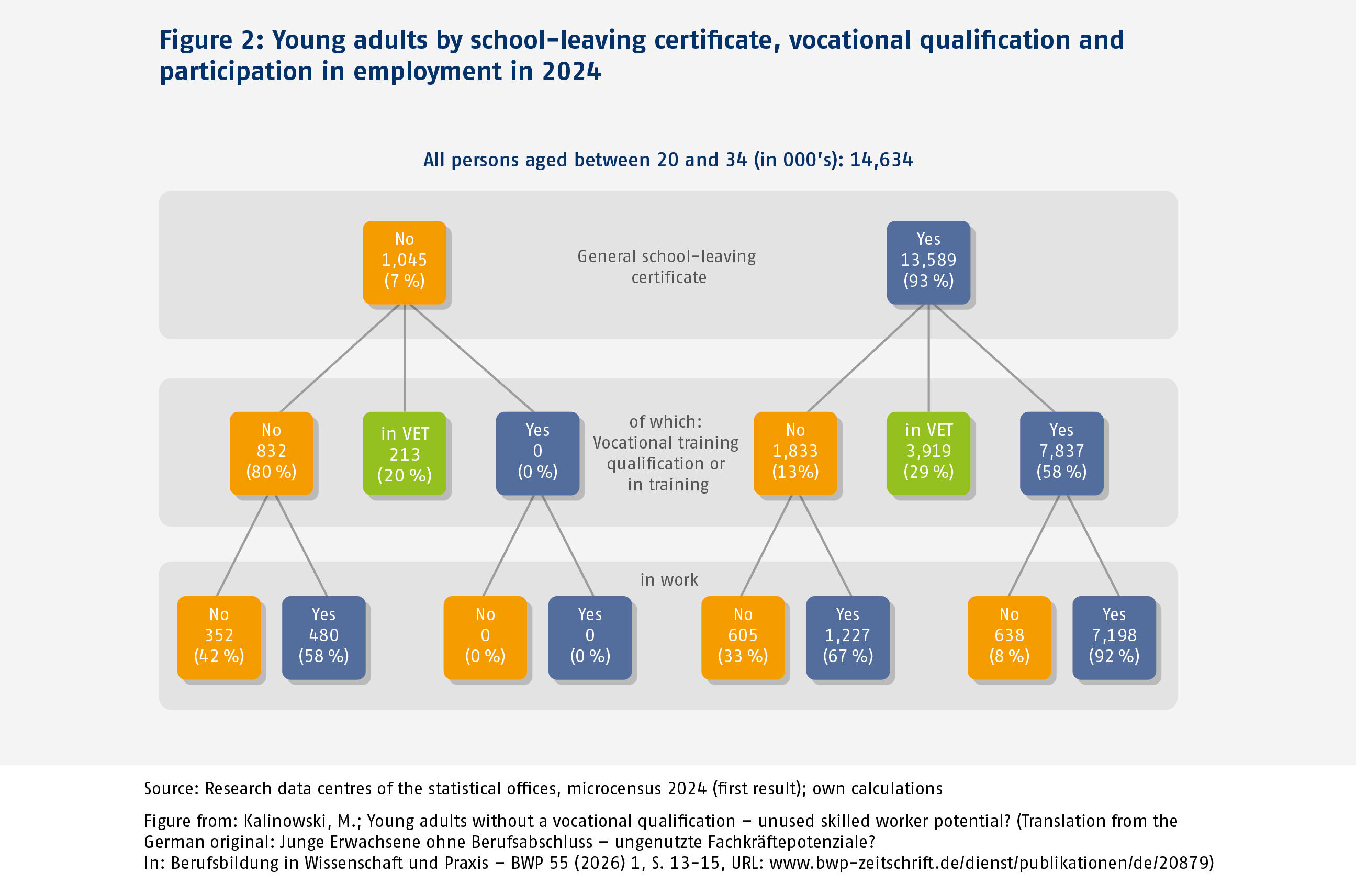
With regard to employment opportunities, it is sufficient to describe labour market participation for young people up until the age of 34 since the expectation is that no further formal higher level qualifications will be achieved to any significant extent after this point. Around 1.71 million of the 2.67 million people without a vocational qualification are in work (480,000 from the group without a school leaving certificate and 1.23 million from the group with a school leaving certificate) (cf. Figure 2, total of the blue fields in the bottom line of persons without a vocational qualification). This corresponds to a proportion of 64 percent. By way of contrast, there are around 7.84 million people with a formal vocational qualification, of whom around 7.20 million (92 %) are in work.
NEETs (Not in Education, Employment or Training) are a further important indicator to describe the labour market situation of young adults. NEETs are people who are inactive in all the three areas to which the acronym refers. There were around 1.60 million NEETs aged between 20 and 34 in 2024. 957,000 (60 %) of these did not have a vocational qualification.
80 percent of the 1.05 million people without a school-leaving certificate do not have a vocational qualification either. 42 percent of those are not in work. Only 13 percent of people with a school leaving certificate do not have a vocational qualification. 33 percent of those are not in work. This highlights the fact that a school-leaving certificate is an important prerequisite for achieving a vocational qualification and for higher employment opportunities.
The key to tapping into skilled worker potential
The group without a formal qualification exhibits a high degree of heterogeneity and is composed of people with various prior qualifications. The proportion of people without a formal qualification varies widely depending on their school-leaving qualifications. An improvement in general school education should be viewed as a key measure in terms of decreasing the nfQ rate and increasing labour market opportunities. A higher general school-leaving certificate exerts a positive impact on training success and fosters the acquisition of a formal vocational qualification (cf. Kalinowski/Pfeifer 2023). The high number of NEETs is worrying from a labour market policy perspective because it indicates a large unused resource of skilled worker potential. As well as being excluded from employment, this group also has restricted access to training and qualification opportunities which could exacerbate the skilled worker shortage in the long term. This potential will remain unexploited if targeted funding measures and integration strategies are not in place, and both individual chances and overall economic development will be hindered.
Literature
Bundesagentur für Arbeit (Hrsg.): Statistik: Qualifikationsspezifische Arbeitslosenquoten (Jahreszahlen). Nuremberg 2025a
Bundesagentur für Arbeit (Hrsg.): Statistik: Sozialversicherungspflichtige Bruttomonatsentgelte (Jahreszahlen). Reference date: 31 December 2024. Nuremberg 2025b
Gottsleben, V.: Randgruppe in der zertifizierten Arbeitsgesellschaft? In: Institut für Arbeitsmarkt- und Berufsforschung der Bundesanstalt für Arbeit (Hrsg.): Sonderdruck aus: Mitteilungen aus der Arbeitsmarkt- und Berufsforschung (MittAB) 20 (1987) 1, pp. 1–14
Kalinowski, M.; Pfeifer, H.: Junge Menschen ohne Berufsabschluss – durch Stärkung der Ausbildungsbeteiligung zu mehr Fachkräften. In: ifo Schnelldienst 76 (2023) 12, pp. 3–6. URL: www.ifo.de/DocDL/sd-2023-12-ZDG-berufseinstieg-wachstumsfaktor.pdf
Kalinowski, M.: Indikatoren zur Reichweite der Berufsausbildung. In: Dionisius, R.; Niemann, M. (Hrsg.): Beteiligung an beruflicher Bildung – Indikatoren und Quoten im Überblick – 2024. 2nd edition. Bonn 2024, pp. 89–92. URL: www.bibb.de/dienst/publikationen/de/19712
(All links: status 21/01/2026)
Michael Kalinowski
Academic researcher at BIBB
Translation from the German original (published in BWP 1/2026): Martin Kelsey, GlobalSprachTeam, Berlin