Can education for democratic citizenship be a task for company-based training?
Monika Hackel
According to the Vocational Training Act, a holistic educational remit forms a core element of training in the dual system. In light of increasing political disenchantment and popularism, more and more companies providing training are wondering which aspects of civic education they can impart without running the risk of being perceived by the trainees as ideologically biased or manipulative. This article illustrates the points of reference offered in this regard by the standards in all occupational profile positions, which have been applicable since 2021. One of the aims is to foster cross-cutting competencies, which also form part of the employability skills set in the modern world of work, over the entire apprenticeship. These also include societal and democratic competencies and values such as participation, the ability to enter into discourse, solidarity and tolerance.
Key aspects of education for democratic citizenship at work
The terms “education for democratic citizenship” and “civic education” are frequently used synonymously. In the past, civic education in vocational education and training was chiefly reflected in the political teaching provided at vocational schools. The current popular debate centring on education for democratic citizenship is being conducted in a wide range of societal contexts in connection with the perception of anti-democratic tendencies. There is no exact delineation between the two terms. The three principles of the Beutelsbach Consensus of 1976 may be viewed as central tenets of civic education in the didactic discussion of general political education. The main focus here is on guiding pupils towards the formation of a political opinion in an impartial and non-indoctrinational manner on the basis of comprehensive information which also takes account of controversial views. A contribution is thus made to young people’s political and social development. This objective appears to be more important than ever in an age of (dis)information campaigns conducted via social media, even though the multiplicity of non-quality assured information channels makes such an aim significantly more difficult to achieve. Against this background, the key educational goal is to strengthen information competence and power of judgement in an increasingly digitalised environment. Further political competencies and attitudes are also essential to successful education for democratic citizenship. These include the ability to engage in discourse and debate and to adopt an open and respectful attitude to all people.
Hamm et al. (2023) recently addressed the topic of education for democratic citizenship in schools in greater detail and have developed four dimensions of “learning about democracy”. These are participation, debate, encounter and commitment.
These dimensions also relate to the structuring of school life rather than merely to the organisation of teaching. The fostering of social competence and the imparting of democratic values form a further aspect of education for democratic citizenship. This is particularly expressed in a respectful culture of debate and in the ability to assume the perspective of various social groups (cf. Education Action Council of the Bavarian Association of Trade and Industry 2024). The report cited here is also specifically focused on the company as a learning venue in VET. Finally, the German UNESCO Commission also gives advice for the development of political competency in a global world: “The aims are to enable learners to develop a sense of belonging to the world community, to become involved and to take on an active role in society and to make a contribution towards a peaceful and just world in which ecological resources are preserved.”1
The company as a learning space for education for democratic citizenship?
This leads to the question of which tasks and strengths the company as a learning venue has within the context of imparting education for democratic citizenship. According to the ifo Institute (cf. Dörr et al. 2024), democratic structures and the rule of law are two essential factors alongside the level of education and training which make Germany attractive as an economic location. For this reason, supporting and consolidating these via broadly based education for democratic citizenship is a central objective. Political and societal competencies also largely coincide with the prior learning which future-oriented companies require of their new skilled workers. Companies providing training assist with the personal development of trainees and indeed are also urged to do so by the Vocational Training Act (BBiG). According to § 14 Paragraph 1 No. 5 of the BBiG, the relationship between companies and their trainees encompasses the declared aim of “character advancement”.
The contribution made by VET to the personal development of young people is also a topic which is addressed in vocational pedagogy literature. The keywords in this regard are vocational socialisation, identity formation at work, and social learning (cf. Lempert 2006; Pukas 2022). The particular combined way in which the company acts as a learning venue whilst also constituting an occupational and societal experiential space facilitates the imparting of practical civic and societal competencies and renders these tangible. Nevertheless, the status of research explicitly directed towards the topic of education for democratic citizenship remains relatively thin (cf. also Busse/Brodsky/Krebs in this issue). Investigations hitherto have looked at the role played by the company as a learning venue in the development of political and societal competencies and at which influencing factors have been identified in the academic research treatment of the topic (cf. Brodsky et al. 2023). Studies have been conducted of the influences on political and societal action competence exerted by aspects such as company size, the behaviour of training staff, perceived quality of training and the role of opportunities for participation at the company. The term “political and societal action competence” is, however, defined very differently in terms of its competency dimensions. Further and more detailed research is needed in this regard.
It is clear that the company, in its capacity as a societal space, offers a plethora of learning opportunities for democratic cohesion, both of a formal nature (e.g. company representative bodies) and of an informal type (within the context of work processes which are increasingly being designed in a project-based and communicative manner). If they are reflected upon as such and therefore also made visible, these opportunities may change views of democracy and of the values, rights and duties associated with it. New contents do not need to be created in every case. A consideration of the standard occupational profile positions2, which today are already being applied in all training regulations, shows that the interlinking of the company, societal institutions and policy objectives within the context of the democratic constitution of our economic system is having an impact on companies, where it is also being implicitly conveyed. In times when esteem for democracy as a form of government is threatening to dwindle and when it needs to be strengthened for the forthcoming generations in particular, the indication is that this interlinking should be made clear and that the benefits and opportunities arising for the individual and for society should be worked out.
Binding minimum requirement set by nationwide standards
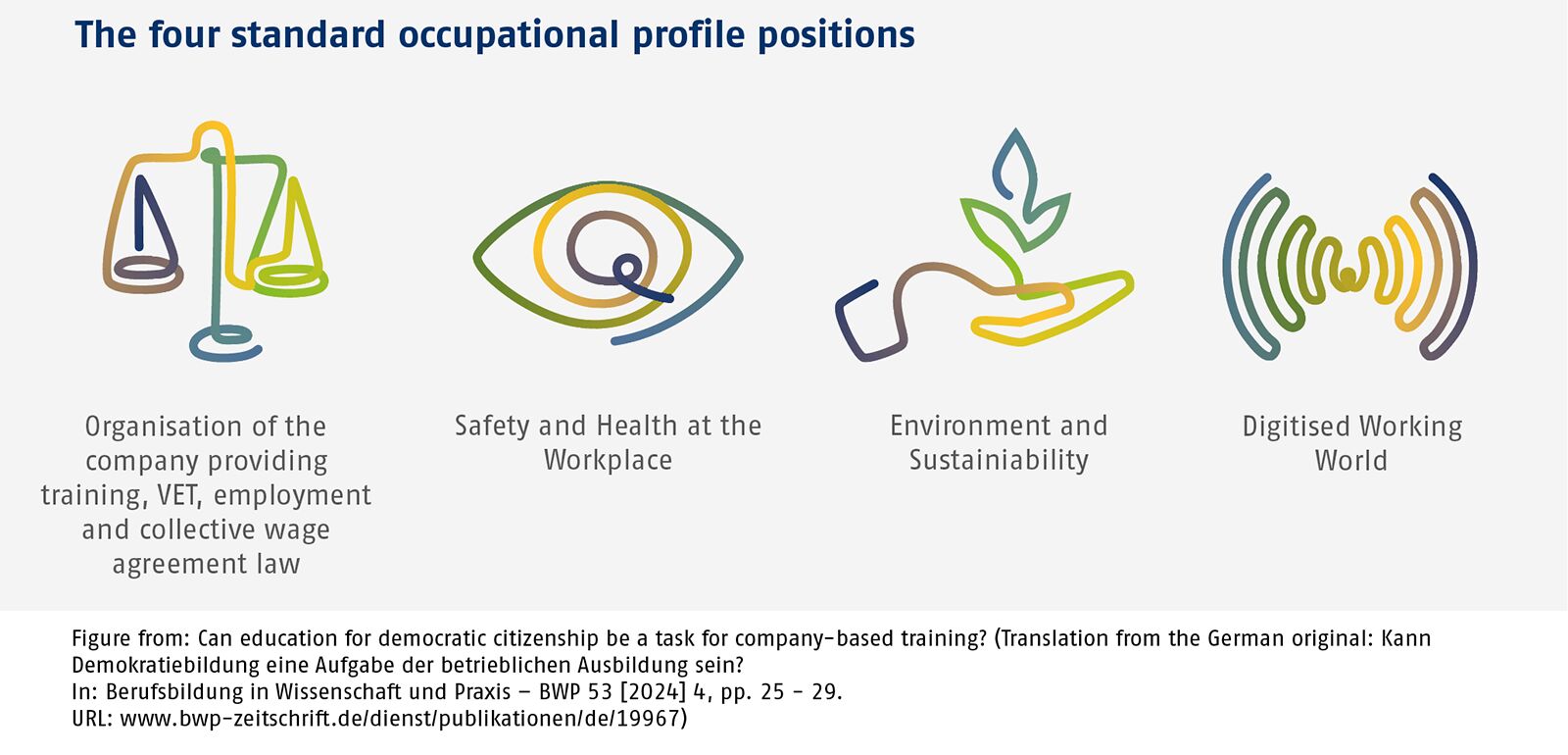
The so called standard occupational profile positions are mandatory stipulations for all company-based training programmes pursuant to the Vocational Training Act (BBiG) and the Crafts and Trades Regulation Code (HwO). The intention is for them be imparted integratively over the entire period of training. They were drawn up by the Working Group of the BIBB Board with the participation of representatives from employer associations, chamber organisations, trade unions and federal and federal state ministries. One important criterion was for the requirements to be capable of actual implementation at every company. For this reason, they need to be formulated as feasible minimum demands to be fulfilled in every training programme. There are also explanations which provide assistance with interpretation and with regard to practical realisation (cf. BIBB 2021). The facets of political and societal competencies to be addressed and imparted are presented below. It is entirely possible and desirable that companies may set additional impetuses within the scope of their own capabilities, interests and needs (cf. e. g. Dittmann/Gieseke in this edition). Cooperation in dual training between the learning venues of the company and the vocational school may also lead to more detailed treatment of further aspects at the school-based learning venue or in joint projects. At inter-company training centres, which represent a third learning venue, standard occupational profile positions should also be tackled integratively and addressed in greater depth for all trainees from different companies.
The standard occupational profile positions are divided into four areas (see Figure). Aspects of political and societal competence as described above can be identified in each position.
Organisation of the company providing training, vocational education and training, employment and collective wage agreement law
This position is of particular significance to the cognitive imparting of the topic. The requirement is for a detailed consideration of the role of the company within the interplay between sectors, associations, the trade union and society. The VET system is also specifically observed on the basis of provisions under employment and collective wage agreement law. The aim is to look at the role of the stakeholders and key governance instruments such as the training contract, training regulations and company training plan and also to address the topic of the rights and opportunities of trainees in relation to company co-determination and chances for continuing professional development over the course of life. These modernised standard occupational profile positions further encompass the important part played by volunteers in training and examinations and the societal commitment which is both necessary for and valued within the VET system. This means that essential foundations for autonomous and self-determined working life and for occupational policy participation are laid during training.
Safety and Health at the Workplace
The particular focus here is on the aspect of physical integrity as set out in Article 2 of German Basic Law. Young people are familiarised with the health and health and safety at work regulations relevant for the occupation. Information on fire safety and accident prevention is supplemented by topical aspects such as security, ergonomic design of the workplace, and protection against physical stress. Autonomy and responsibility for others are other topics which can be addressed and practised here.
Environment and Sustainiability
The new standard occupational profile positions which entered into force in 2021 extend the perspective beyond environmentally compatible actions at the company to incorporate societal dimensions of environmental protection and sustainability. As well as looking at environmental protection in a narrower sense, this should also involve the employment-oriented teaching within the scope of the training programme of societal policy aspects such as sustainability-related global supply chains and in particular the conflicting objectives between economic, ecological and social requirements. Trainees should especially reflect upon such conflicts of interest when developing proposals for sustainable actions in their own work area. Important political and democratic competencies such as discourse and debate may be practised here too. One example of a practical assignment would be for trainees to research and present benchmarks for a sustainable approach in their sector within the context of a project task by seeking answers to the following questions. Which aspects are being addressed in the sector? How do other companies go about this? What are the benefits and drawbacks of such an approach? Where do the opportunities and risks lie with regard to implementation at our own company? Communication skills and the importance of cooperation and networking at the trainees’ company and beyond can also be rehearsed and reflected upon in a project of this nature or else can be fostered via a joint cross-company project in collaboration with the vocational school.
Digitised Working World
This standard occupational profile position also serves the purpose of imparting political and societal competencies. A particularly broad degree of scope is afforded to dealing with information on the Internet. Targeted customer communication online and the evaluation of digital and social media and of their associated threats and opportunities are amongst the topics addressed. Researching information in digital networks and the procurement, checking, assessment and selection of data are important basic prerequisites in terms of developing an attitude to political issues and with regard to justifying one’s own political decisions. Competencies do not necessarily need to be taught via the example of the procurement of political information. Core elements of employability skills, including project work, collaboration and cooperation in an international context, impart competencies, skills and knowledge which are just as important in the company environment as they are in a societal and political arena. Last but not least, this standard occupational profile position also serves the purpose of developing or strengthening an elemental democratic value system, namely respecting others whilst taking due account of societal diversity. The Working Group of the BIBB Board has addressed dimensions of diversity in the world of work (e.g. age, disability, gender and gender identity, sexual orientation, ethnic origin and nationality, religion and world view). In entirely practical terms, for example, the aims are to practise a respectful and objective approach to dealing with colleagues and customers and to develop greater empathy.
Bringing life to education for democratic citizenship at companies
As seen above, there are many practical starting points for rendering democratic values visible in everyday life. Aspects of political and societal competence are omnipresent in the world of work and can also easily be taught via routine work and learning processes. It is important to reflect on these against the background of basic democratic values and to make their significance for education for democratic citizenship clear so that democracy can be perceived as a valuable part of life by young people in Germany. Experience of participation and of self-effectiveness is an essential element of “learning about democracy”. A key influence on the perceived credibility of measures relating to education for democratic citizenship is exerted by how companies integrate the project ideas of their trainees in practice, by how trainees are accorded participative leeway in the structuring of work processes, and by whether critical feedback is viewed as being constructive. For this reason, the focus needs to be on avoiding forms of pseudo participation and on providing transparent justification for decisions within the context of discourse and debate.
Practical implementation is also influenced by the attitude and commitment of training staff. Considerable diversity is certainly in place here, and this is characteristic of a democracy. The topic of education for democratic citizenship has not hitherto been an object of detailed discussion in the courses relating to the Ordinance on Trainer Aptitude (AEVO), although the new skeleton curricula for preparation programmes for the AEVO drawn up by the BIBB Board (2023) implicitly offer points of reference in various places. Good examples of more extensive projects can be found at many companies. These frequently also have embedded discursions which appraise German history. Training managers at BIBB, for example, regularly organise a trip to Berlin for second-year trainees during which democratic institutions and various memorial sites are visited. This year, these activities were incorporated into a series of events relating to education for democratic citizenship in which all departments became involved in accordance with their own tasks (cf. also the BWP podcast accompanying this issue). The materials and concepts which are being developed for and made available to company stakeholders also show that increasing significance is being attached to the topic of education for democratic citizenship. Training staff and vocational school teachers can access support materials from the Federal and Federal States Centres for Civic Education, from policy foundations, from employee-oriented training providers, from the chambers, and from employer organisations. Leando and Hubbs are digital education and training platforms which offer an extensive range of materials (cf. note at the end of the article). This year’s Hermann Schmidt Prize awarded by BIBB has also taken up the cause. Within the context of BIBB pilot projects, numerous possible points of reference can be found under the heading of VET for sustainable development. Some of these ideas and materials are occupationally specific. Joint projects within the scope of cooperation between learning venues are required in order for all young people to be reached within the context of VET. These should also be actively instigated by vocational schools on a more frequent basis. The topic can also be addressed by inter-company training centres.
In summary, we can state that the imparting of political and societal competencies has already been integrated as a fundamental requirement for company-based training. Such competencies can, for example, be further nurtured by funded stays abroad as part of exchange programmes such as Erasmus+ or Training Worldwide. In such cases, inclusion in foreign worlds of work and lifeworlds raises awareness of different democratic or even different political systems. It encourages reflection on experience and provides a vehicle whereby intercultural competences can be witnessed practically and expanded. Personality aspects such as self-effectiveness, empathy and assumption of responsibility are enhanced in manifold ways during high-quality training. When implementation of legal enshrinement in regulatory instruments takes place, the main emphasis is on qualitative aspects of training which have an influence on the development of democratic competencies. Training staff at the company, the school and inter-company training centres take on a key role in this regard.
Literature
Aktionsrat Bildung des vbw – Vereinigung der Bayerischen Wirtschaft (Ed.): Bildung und sozialer Zusammenhalt. Gutachten. Münster 2024
BIBB (Ed.): Vier sind die Zukunft . Digitalisierung. Nachhaltigkeit. Recht. Sicherheit. Die modernisierten Standardberufsbildpositionen anerkannter Ausbildungsberufe. Bonn 2021. URL: www.bibb.de/dienst/publikationen/de/17281
Hauptausschuss des BIBB: Rahmenplan der Ausbilder-Eignungsverordnung. Empfehlung 135 vom 20. Juni 2023. URL: www.bibb.de/dokumente/pdf/HA135.pdf
Brodsky, A.; Busse, R.; Seeber, S.; Seifried, J.: Die Rolle des Lernorts Betrieb für die Entwicklung von politischen Kompetenzen von Auszubildenden – Ein Scoping Review. In: bwp@ (2023) 8, pp. 1–27. URL: www.bwpat.de/ausgabe/profile/profil8/brodsky-etal
Dörr, L.; Gründler, K.; Heil, P.; Potrafke, N.; Wochner, T.: Experteneinschätzungen zum globalen Standortwettbewerb. In: Ifo Forschungsberichte 142/2024
Hamm, I.; Engelke, A.; Finke, M.; Kinnert, D.; Krüger, Th.; Meyerding, M.; Nassehi, A.; Schleicher, A.; Teueberg, L.; Wössmann, L.: Mehr und besser. Vorschläge für eine Demokratiebildung von morgen. Bericht der Hertie-Kommission Demokratie und Bildung im Auftrag der Gemeinnützigen Hertie-Stiftung. Frankfurt a. M. 2023
Lempert, W.: Berufliche Sozialisation: Persönlichkeitsentwicklung in der betrieblichen Ausbildung und Arbeit. Baltmannsweiler 2006
Pukas, D.: Emanzipation und Mündigkeit als Kategorien beruflicher Sozialisation im dualen Berufsausbildungssystem. Pragmatischer Ansatz zur Förderung der Persönlichkeitsentwicklung in Betrieb und Berufsschule. In: ZBW 118 (2022) 1, pp. 132–147
Information on the provision available on Leando and Hubbs
- Demokratie stärken im ausbildenden Betrieb (leando.de)
- Videoreihe zu den Standardberufsbildpositionen (leando.de)
- Demokratiebildung in der (Berufs-) Schule (HubbS - Der Hub für berufliche Schulen)
(All links: status: 4/12/2024)
Dr. Monika Hackel
Head of Department at BIBB
Translation from the German original (published in BWP 4/2024): Martin Kelsey, GlobalSprachTeam, Berlin