“We should seize the opportunity to reach 1.3 million young people!”
Interview with Friedrich Hubert Esser, President of BIBB
Waning trust in democratic institutions, increasing disenchantment with politics and a strengthening of extremist and populist leanings are topics which VET needs to tackle more than ever before. In November 2023, the Düsseldorf Chamber of Crafts and Trades conferred the Georg Schulhoff Prize on BIBB President Friedrich Hubert Esser. This award recognises outstanding services and contributions to VET made by persons and institutions. In his acceptance speech, Professor Esser highlighted how education for democratic citizenship is an important aspect of holistic VET. The significance of this for our liberal society and for future generations is a topic which he continues to pursue.
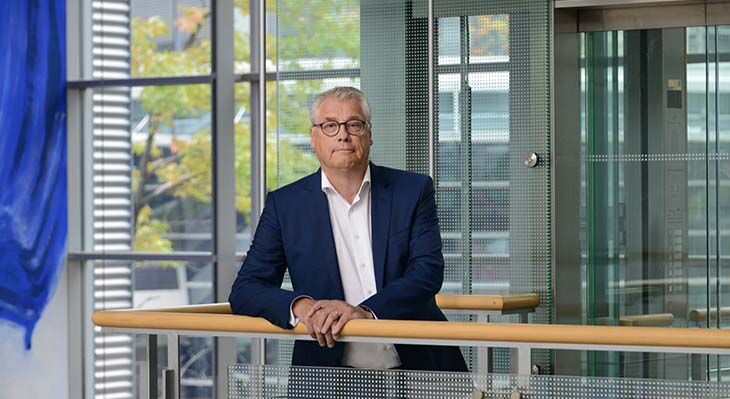
Professor Friedrich Hubert Esser
Friedrich Hubert Esser initially trained as a baker before completing his upper secondary school-leaving certificate via the “second chance route”. He went on to study business administration and business education and then spent 15 years in academic research, 13 of which were at the Research Institute for Vocational Training in the Craft Trades at the University of Cologne (FBH). Between 2004 and 2011, he was Head of the Vocational Education and Training Department at the German Confederation of Skilled Crafts (ZDH) in Berlin. He has been an honorary professor in the Faculty of Management, Economics and Social Sciences of the University of Cologne since 2005 and became President of BIBB in 2011.
Professor Esser’s main research and work focuses include occupational and skills research, the German and European Qualifications Frameworks (DQR and EQF), European VET, and entrepreneurship.
BWP Mr. Esser, what was your personal trigger to tackle the topic of education for democratic citizenship?
Esser I am part of the baby boomer generation and grew up during the economic miracle. Many aspects of life were modest in the 1960s, and people worked hard. But there was a sense of the prosperity to come. The world around you was modernising. Although the poverty and despair our parents and grandparents had told us about no longer existed, they had not been forgotten. No more war! That was the emphatic message tied to the tales of the war years with which we were also inoculated. It was also a time when democracies were advancing all over the world, particularly as a result of the post-war recovery and the economic superiority of the democratic countries. I was lucky enough to experience the end of the Cold War and German unification. From today’s point of view, these were decades of bliss. Like many others too, I have awoken to a new reality of life with the emergence of what Chancellor Scholz fittingly describes as a turning point. I now believe that I was somewhat too naive to think that our democracy can never weaken.
BWP What is jeopardising our democracy?
Esser The former German President Gauck now speaks of a double threat endangering democracy. There is an external threat from the endeavours of totalitarian regimes to gain supremacy and an internal menace from societal groups which are adopting an authoritarian and populist stance in calling democratic rules, pluralism and the rule of law into question.
As well as feeling personally affected, I am concerned by the results of current studies which suggest to me that more attention should be given to the topic of education for democratic citizenship. According to the Economist Index, for example, democracies are currently in decline all over the world. Although it shows that half of the world’s population lives in a form of democracy, only around eight percent enjoy full democracy. By way of contrast, almost a third is under authoritarian rule. This is a significantly higher figure. The study further reveals that trust in established political parties and in their governments is declining in more and more countries. For me, all of this is reason enough to ask what the situation in our country is regarding education for democratic citizenship. We need to investigate how VET is positioned in respect of this topic and look at what we can do better. We should also bear in mind that there is a direct correlation between the functioning of democracy as a form of government and the regime of the social market economy. Both systems are mutually interdependent. By the same token, this means that a weakening democracy has a negative impact on the effectiveness of our economic system. Such knowledge should therefore be part of the remit of VET.
BWP Many young people view the future sceptically, and confidence in state institutions is dwindling. What has gone wrong over recent years?
Esser I mainly see two causes. Firstly, there is the dual threat to our democracy from outside and within as we have already mentioned. This is unsettling many people, especially the young. When we have a federal government which quarrels more than it works together constructively, at least in terms of public perception, then this tends to exacerbate this mood rather than help to counter it. The second reason I see is that civic education provision within our education and training system no longer seems to be structured in line with requirements. On the occasion of the publication of the 2024 Children’s Report, Thomas Krüger, President both of the German Children’s Fund and of the Federal Agency for Civic Education, stated that democracy is a societal form that needs to be relearned by every generation and that its continuing existence cannot readily be assumed. In other words, democratic sentiments and competence are not a given component of our children’s DNA. Educational policy needs to focus much more on ensuring that education for democratic citizenship is suitably established in our child daycare centres and schools and at companies providing training. The fact that we do not listen to our children and young people enough and take too little heed of their requirements within the context of policy decisions may constitute a further major omission.
“We need to investigate how VET is positioned in respect of this topic and look at what we can do better.”
BWP How can our democracy effectively defend itself against populism and extremism? What contribution can VET make in this regard?
Esser The answer to the first question ought to be self-evident. The democratic parties and government actors must pursue good politics to win back the lost trust of persons who doubt democracy. As a business and vocational educationalist, I believe that initial responsibility rests with the schools. My question would be, what shape is education for democratic citizenship in? In this case, I would like to make reference to the Standing Research Commission of the Conference of the Ministers of Education and Cultural Affairs (SWK), which emphasises that democratic education at schools does not merely mean participation and co-involvement by pupils. Education for democratic citizenship also includes fostering democratic competence and learning how to deal with violence and processes of radicalisation. The SWK recently published proposals recommending the firm establishment of this topic in the basic subjects of politics and history and further encompass the significance of media education and cross-cutting teaching. I can imagine it may also be useful for many schools to avail themselves of support from regional educational networks when tackling the difficult issue of “extremism and radicalisation”. I am thinking, for example, of the anti-extremism guidance centres and of the Centres for Civic Education in the federal states.
Concerning the second question, the contribution of VET, I would like to point to the “Democratic Action Competence” concept drawn up by the “Quality and Competencies” working group as part of the “Learning about & Living Democracy” programme of the Federal Government-Federal States Commission for Educational Planning and Research Promotion (BLK). The competency tableau developed provides a very good illustration of how vocational learning venues can be made utilisable for education for democratic citizenship and of how training and teaching staff can be encouraged. It covers the establishment of guidance and interpretative knowledge of democratic action at vocational schools and the introduction of people’s own interests into democratic decision-making processes and extends to include the democratic negotiation of standards, ideas and objectives at companies or at inter-company training centres.
In addition to this, we are seeking to undertake a more precise investigation at BIBB into the question of what contribution can be made by VET. Clearly, training gives us a chance to bring education for democratic citizenship to around 1.3 million young people at our companies and vocational schools. We should definitely seize this opportunity! Alongside what I have just said about vocational schools, I believe a particular emphasis should be placed on how we can usefully raise awareness at companies providing training that education for democratic citizenship is an integral component. And this phrasing already tells you that I am not looking at an increase in the training content load. My focus is on good ideas that will make democratic thought and actions discernible in work and learning contexts. Of course, training staff will be of particular significance in this process.
BWP You are currently devoting yourself to numerous projects and initiatives on this topic. But how can we also succeed in enshrining education for democratic citizenship in VET in a practically related way?
Esser First of all, it is quite normal for there to be voices pointing out that everything is already being done and that there is therefore no need for innovations. Others are reticent on this topic because they fear that new learning objectives will overload the curricula and thus place too great a strain on training and teaching staff. For this reason, it will first be important for us to agree that action is also required in VET in matters relating to education for democratic citizenship. The results of recent studies help us here. They prove that democracy in our country has become less robust and that people’s doubts in this form of government and society are growing. We can only establish education for democratic citizenship in company-based training on a permanent basis if it is designed and implemented in a practical manner. This is why we must support our training and teaching staff in creating greater awareness of democratic actions and for cohesion in the learning and work context. And it is important to find the right way of addressing young people on this topic. So I am seeking a low-threshold approach for practice, for which we could also provide good support at BIBB or via relevant good practice examples for the structuring of training provision on our “Leando” portal. The standard occupational profile positions, which were updated in 2021, are also helping to integrate education for democratic citizenship into dual training. These at least formally ensure that democratic competence is a core skill which must be nurtured in a practically oriented and accessible way throughout the entire duration of training. We will need to scrutinise whether this is sufficient or whether a further standard occupational profile position for “democracy” will be necessary.
BWP What can VET stakeholders do for education for democratic citizenship at the learning venues? What is your plea?
Esser My plea would be that if we want a fundamentally democratic attitude in our society then we must do something to bring this about. In terms of VET policy, we need to come together with all important stakeholders on the basis of a status report including all learning venues to develop recommendations as to whether and how we need to adjust education for democratic citizenship to the current general conditions, particularly in training. Initiatives such as the “Alliance of Opportunities” prove that there is a need for action but also that there is a greater degree of readiness to do more for education for democratic citizenship. 70 large member companies are showing their commitment via a Democracy Manifesto they have drawn up themselves and are also exhibiting a considerable training performance with regard to diversity as the basis for successful and fair business. At the same time, they are taking a stance against exclusion, hatred, xenophobia and anti-Semitism and are also actively seeking to embrace these principles within their companies. In order to promote democratic competence, they have developed a concept which is not merely being implemented at the member companies. There is a further aim to disseminate across the breadth of German trade and industry. This example therefore shows that the call for conscious education for democratic citizenship is not merely pedagogical talk. This is a serious undertaking by companies which are important and significant providers of training.
Publications and statements mentioned
de Haan, G.; Edelstein, W.; Eikel, A. (Eds.): Qualitätsrahmen Demokratiepädagogik. Demokratische Handlungskompetenz fördern, demokratische Schulqualität entwickeln [Quality Framework for Democratic Pedagogy. Fostering democratic action competence, developing democratic school quality]. AG Qualität und Kompetenzen des BLK-Programms “Demokratie lernen & leben” [“Quality and Competencies” working group in the “Learning about & Living Democracy” programme of the Federal Government-Federal States Commission for Educational Planning and Research Promotion (BLK)]. Berlin 2007. URL: https://degede.de/wp-content/ uploads/2020/02/heft-2-demokratische-handlungskompetenz--m-t.pdf
Deutsches Kinderhilfswerk [German Children’s Fund]: Kinderreport Deutschland 2024 [2024 Children’s Report]. Demokratiebildung in Deutschland Berlin 2024. URL: www.dkhw.de/filestorage/1_Informieren/1.1_Unsere_Themen/Kinderrechte/ Kinderreport/Kinderreport_2024/DKHW_Kinderreport_2024.pdf
Ständige Wissenschaftliche Kommission der Kultusministerkonferenz (Swk) [Standing Research Commission of the Conference of the Ministers of Education and Cultural Affairs (Swk)]: Demokratiebildung als Auftrag der Schule – Bedeutung des historischen und politischen Fachunterrichts sowie Aufgabe aller Fächer und der Schulentwicklung [Education for democratic citizenship as a remit for schools – significance of specialist history and politics teaching and of school development]. Statement of 7 July 2024. URL: www.swk-bildung.org/content/uploads/2024/06/ SWK-2024-Stellungnahme_Demokratiebildung.pdf
The Economist Intelligence Unit (Ed.): Democracy Index 2023. Age of conflict. London et al. 2024. URL: www.eiu.com/n/campaigns/democracy-index-2023/
Further links
Listen to the BWP podcast on the BIBB series of events “Demokratiebildung im BIBB” at www.bwp-zeitschrift.de/p198879 (in German)
BWP In its capacity as a company which provides training, BIBB has acted on your initiative this year by instigating a series of events entitled “Education for democratic citizenship at BIBB”. Many colleagues have taken part in workshops and programmes. How do you evaluate this commitment, and have you already received initial feedback from our trainees?
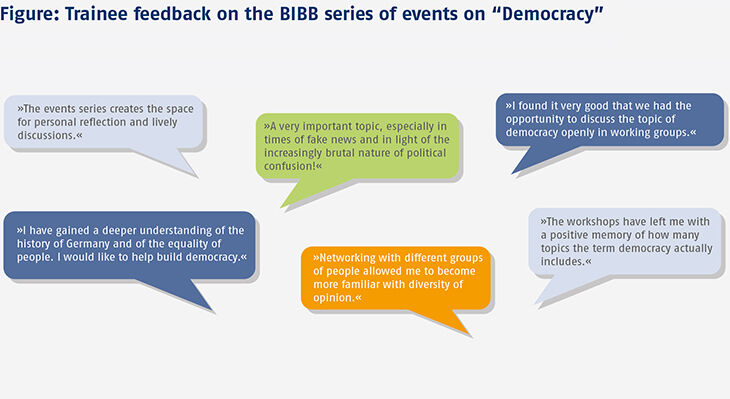
Esser I am of course delighted and very grateful that our HR and training managers have taken up my objective with a great deal of dedication. I did not need to convince anyone of its merits. We started work directly, and many committed colleagues added their own ideas and contributions. One BIBB workshop and other event formats aimed at trainees and training managers have been scheduled across the whole of 2024. Many organisational units have been involved in the design concept and realisation of these. The aims of this series of events are to speak to trainees about democracy on equal terms, to raise their awareness for this topic area and to motivate them to become active themselves. In order to assume responsibility, there is a requirement for a deeper understanding of democratic values and for the insight to take an active role in democratic processes yourself. And the feedback from our trainees is outstanding (cf. Figure). This and other positive responses from our trainees show us that we are on the right road as a company providing training. As far as we are concerned, these are also important experiences which we will use to inform the VET policy discussion on possible good practices.
BWP BIBB is planning a specialist conference on this topic in January 2025. What can we expect there, and what message do you personally associate with this conference?
Esser The aim is for the conference to provide momentum to drive forward the necessary VET policy discourse, in initial training in particular. We have invited prestigious presenters to take part, but we will also offer space for discussion and the development of ideas. I am very pleased that we have been able to secure two top-ranking speakers to give the keynote addresses – Professor Maria Böhmer, President of the German UNESCO Commission, and Kai Gehring, Chair of the Federal Parliament Select Committee for Education, Research and Technology Impact Assessment. We are also very grateful that the Standing Conference of the Ministers of Education and Cultural Affairs of the Länder in the Federal Republic of Germany (KMK) and the Federal Agency for Civic Education will co-host the event. And last but not least, we are delighted to welcome active participation by renowned experts from the associations and chambers, from the trade unions, and from the Federal Government and federal states. The key personal message that I associate with the conference is that education for democratic citizenship is essential.
BWP Let us hope that this message remains loud and clear. Mr. Esser, many thanks for taking the time for this interview.
(All links: status 4/12/2024)
(Interviewer: Christiane Jäger, BWP Editorial Team)
Translation from the German original (published in BWP 4/2024): Martin Kelsey, GlobalSprachTeam, Berlin