Inclusive vocational training - Wishful thinking or a realistic prospect?
Chances of realisation from the viewpoint of vocational education and training experts
Ruth Enggruber, Julia Gei, Dr. Joachim Gerd Ulrich
From the point of view of UNESCO inclusion in the sense of the leitmotif »Education for All« means that all people – without regard to special learning needs, gender, social and economic conditions – have the opportunity to share in high-quality education. For the dual system of vocational education and training this would mean granting immediate access to all young people interested in training after they leave school without producing their »training maturity« beforehand in the transition area. A corresponding reform of the training system would, however, be loaded with preconditions. The article describes how vocational education and training experts react to such a move and how they assess the chances of its implementation.
Inclusive initial vocational education and training – a solution to access problems in VET?
Despite the decreasing demand for training places as a result of demographic change, there are still access problems in the dual system of vocational education and training. In 2013, there were still 83,600 applicants officially looking for training places on 30 September, the cut-off date. At the same time there were 33,500 unfilled apprenticeships (cf. Matthes/Ulrich 2014, p. 6). In the face of the dearth of apprenticeships and problems finding a fit, for many applicants it takes one to several years before they begin training, and some fail to access training entirely. Especially young people with low-level school-leaving certificates and migration backgrounds have access problems.
Ever since Germany signed the UN Convention on the Rights of Persons with Disabilities in 2009, questions of participation in education have increasingly been discussed under the heading of »inclusion«. German policy-makers, however, usually situate this topic under the heading of people with disabilities (cf. BMAS 2011). In UNESCO's way of thinking, by contrast, inclusion is all about removing all possible obstacles to participation in education (cf. German Commission for UNESCO 2009). In a debate that is quite heated in Germany as well, the term inclusion certainly does not always mean the same thing (see Döbert/Weishaupt 2013; Tenorth 2013).
In a broad interpretation of inclusion such as underlies this article and is also found in the English-language version of the UN Convention on the Rights of Persons with Disabilities (cf. Seitz 2012, pp. 11 f.) the causes of obstacles to participation in education are no longer to be found in the learners and their individual requirements, but are institutional. Associated with this is the demand to revise all education sectors so that they are appropriate for all people with their specific needs and requirements. Inclusion is achieved when every person – regardless of gender, origin, and individual impairments – has access to all facilities of the education system and if necessary receives individualized support.
Applied to the dual system of vocational education and training this would mean that all school leavers interested in receiving training could immediately start a fully qualifying course of training without having to gain or improve their »training maturity« beforehand in the transition area. According to Enggruber (2013), at least the following reforms would have to be considered to implement such a broad interpretation of inclusion:
- more efficient organization of transition management in order to ensure that young people receive optimal support in finding an apprenticeship
- continuous monitoring of whether all school leavers are able to get the fully qualifying course of training they want
- relieving the transition area of its function as a catch-all for unsuccessful applicants and focusing in future on measures that lead to higher-level school-leaving certificates
- providing guaranteed extra-company and school-based training places for young people without in-company apprenticeships
- expansion of individual support for trainees in companies and vocational schools
- flexible duration of training and introduction of the obligation to accept credit for skills already acquired
- intensification of further education opportunities for teaching, training and facilitating professionals to meet the increased demands of the job, including the improvement of employment conditions in education providers.
Results of the BIBB Expert Monitor
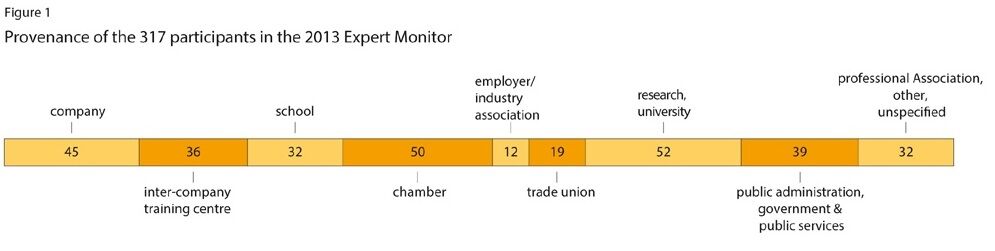
In the context of the BIBB Expert Monitor, 13 concrete reform proposals were formulated from these key points and submitted to vocational education and training experts for evaluation. The Expert Monitor is an online tool for polling vocational education and training spe-cialists by means of which educational policy issues are examined in greater detail (cf. www.expertenmonitor.de). All those who are professionally involved in vocational education and training – whether they participate in managing the system, provide initial and continuing training or do teaching and research on these aspects – are regarded as specialists. The Monitor held at the end of 2013 was attended by 317 experts (see Fig. 1).
In addition to the question of whether the experts were in favour of the reform proposals, it was particularly interesting to know how likely they thought it was that they would be implemented by the year 2020 and what factors they thought would have an inhibitory or sup-porting impact on implementation. The factors examined included the current political majorities, the attitude of the representatives of management and labour, the cost of imple-mentation and the pressure to act generated by demographic changes.
Chances of implementing inclusive vocational education and training
The table lists the 13 proposals for reform and reflects the average responses of the specialists.
1 It is clear that at least a tendency towards approval of most of the proposals exists. There is strong support in particular for intensified promotion and monitoring of young people in the transition phase and during training, as well as for improvements in continuing education and training and in the conditions of employment for the professionals. Also a training guarantee tends to be supported, although there was a cautious reaction to the emancipation of school and extra-company institutions as equal providers of training places. Only the restriction of the transition area to training programmes leading to higher-level school-leaving certificates tended to be turned down.
While most of the reform proposals thus tend to be welcomed rather than rejected, scepticism prevails regarding their implementation. Although the respondents expect that the pressure to act generated by demographic changes will probably foster implementation, they suspect that the implementation cost will almost always hinder implementation. Also, they see a reform-oriented attitude only on the employees' side, while they impute a more conservative attitude to the employers' side. The experts are also sceptical about the enthusiasm for reform, on the part of the current political majorities.
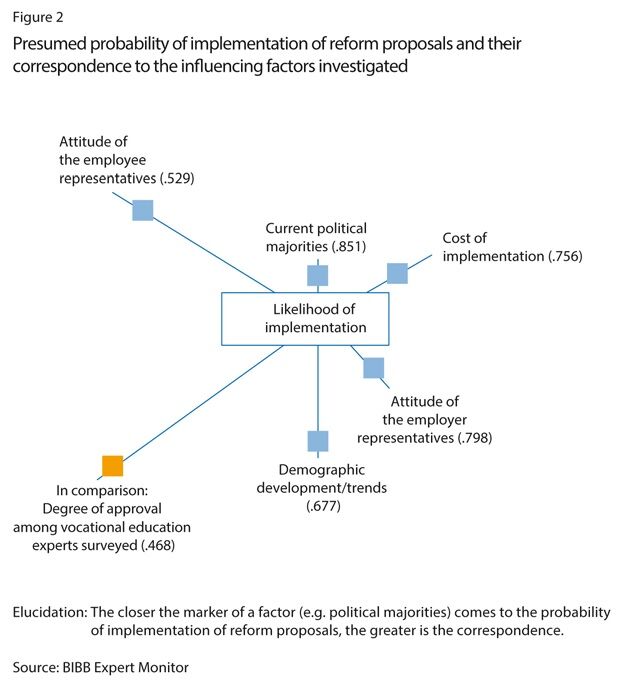
From the perspective of the experts the current political majorities, the attitudes of the social partners, demographic change, and the cost of implementation thus have quite different effects on the probability of implementation of the various reforms, and the question arises with what variables they most closely correspond. To answer that question, relevant indicators were calculated based on Osgood/Suci's distance function (cf. Fisseni 2004, p. 191) varying between 0 (»no correspondence«) and 1 (»maximum correspondence«).
2
Figure 2 illustrates that the likelihood of implementation of the reform proposals is most closely associated with the current political majorities. There are also strong dependencies on the suspected viewpoint of the employer representatives and the implementation cost. The chances of implementation are less closely connected with the suspected viewpoints of the employee representatives. The link to the approval level of the experts themselves is especially weak, confirming the results illustrated in the table: The reform wishes of the specialists display little correspondence with what they consider to be likely.

Conclusion: Scepticism preponderates
Even though the experts are on average quite sympathetic towards reforms in favour of broad inclusion, they still expect the existing institutions to display significant inertia. The cost plays a role, but so do the current political conditions, assessed to be not very reform-oriented, and the attitude of the employers' side, assessed to be rather conservative. Actually such reforms would involve a cost not only to the public sector but also to the companies providing training: Providing extra-company training places harbours the risk that young people will be more likely to pursue their careers than adapt to the requirements of the companies.
Control systems, crediting obligations, a stronger voice for third parties and co-operation requirements place limits on the autonomy of the companies. It is perhaps not by chance that the experts definitely see parallels between the effects which result from the attitudes of employers and the current political majorities (cf. Frieling/Ulrich 2013, pp. 86 f.). The policy-makers know about the cost savings and other benefits that accrue to the public sector owing to the participation of the enterprises in training and do not wish to generate any disincentives. In this context, inclusive education may certainly be easier to implement wherever government organizes and funds education largely on its own.
Literature
Federal Ministry of Labour and Social Affairs (BMAS) (ed.): Unser Weg in eine inklusive Gesellschaft. Berlin 2011 – URL: www.bmas.de/DE/Service/Publikationen/a740-aktionsplan-bundesregierung.html (as of: 21.05.2014)
German Commission for UNESCO: Inklusion: Leitlinien für die Bildungspolitik. Bonn 2009 – URL: www.unesco.de/4162.html (as of: 21.05.2014)
Döbert, H.; Weishaupt, H. (eds.): Inklusive Bildung professionell gestalten – Situationsanalyse und Handlungsempfehlungen. Münster 2013
Enggruber, R.: »Ausbildung für alle« - inklusiv verstanden. Reformidee »inklusive Berufsausbildung« im Spiegel von theoretischen Überlegungen und ExpertInnenmeinungen. Düsseldorf 2013
Enggruber, R. et al.: Inklusive Berufsausbildung. Ergebnisse aus dem BIBB-Expertenmonitor 2013. Bonn 2014 – URL: www.bibb.de/de/66848.htm (as of: 21.05.2014)
Fisseni, H.-J.: Lehrbuch der psychologischen Diagnostik. 3rd revised and expanded edition. Göttingen 2004
Frieling, F.; Ulrich, J. G.: Die Reformdebatte zum Übergang Schule-Berufsausbildung im Spiegel divergierender Interessen. In: Maier, M. S.; Vogel, T. (eds.): Übergänge in eine neue Arbeitswelt? Blinde Flecken in der Debatte zum Übergangssystem Schule-Beruf. Wiesbaden 2013, pp. 69–93
Matthes, S.; Ulrich, J. G.: Wachsende Passungsprobleme auf dem Ausbildungsmarkt. In: BWP 43 (2014) 1, pp. 5-7 – URL: www.bibb.de/veroeffentlichungen/de/publication/show/id/7191 (as of: 21.05.2014)
Seitz, S.: Inklusiv gleich gerecht? Zur Einführung in den Band. In: Seitz, S. (ed.): Inklusiv gleich gerecht? Inklusion und Bildungsgerechtigkeit. Bad Heilbrunn 2012, pp. 9–14
Tenorth, H.-E.: Inklusion – Prämissen und Problemzonen eines kontroversen Themas. In: Baumert, J.: Inklusion. Schulmanagement-Handbuch 146. München 2013, pp. 6–14
PROF. DR. RUTH ENGRUBER,
Professor for Social Science at Fachhochschule Düsseldorf
JULIA GEI,
Research associate in the "Vocational Training Supply and Demand/Training Participation" Division at BIBB
DR. JOACHIM GERD ULRICH,
Research associate in the "Vocational Training Supply and Demand/Training Participation" Division at BIBB
Translation from the German original (published in BWP 4/2014): Martin Stuart Kelsey, Global Sprachteam Berlin
-
1
We refrain from reporting the findings for subgroups at this point because there is considerably more uniformity of views among the professionals about the probability of implementation of reforms and their influence factors than about their desirability (for the reasons cf. Frieling/Ulrich 2013). The findings regarding desirability, differentiated according to organisational provenance, can be found in Enggruber et al. (2014).
-
2
First, for each of the influencing factors, a calculation is made of the amount of deviation of each of the values in the table from the presumed probabilities of implementation of the reform proposals. The squares of the deviations are summed up across all 13 proposals and relativized to the theoretically maximum possible deviation amount. The result is a standardized measure of distance varying between 0 and 1 that is transformed into the measure of correspondence reported here by subtracting 1.