Implementation of the German Qualifications Framework - development of a quality system in vocational education and training demanded at all levels
Irmgard Frank
The decision to develop and implement a German Qualifications Framework (GQF) has increased the importance of questions of quality development in vocational education and training. One of the key requirements of a quality development model is to ensure that the graduates of the various training programmes at all levels do indeed dispose of the skills described in the curricula for those programmes. The focus here is on output orientation, that is, what a person can do after completing a training programme. The article takes up aspects of quality development in the areas important for vocational education and training on the basis of the quality principles formulated in the European Qualifications Framework and describes current practice. It then outlines steps to be taken to develop a systemic quality development model for vocational education and training.
Continual quality development - a neglected issue in vocational education and training
With the amendment to the Vocational Training Act (BBiG) in 2005, quality development issues of vocational education and training were given added importance (see § 79 paragraph 1 and § 83 paragraph 1 BBiG). In the recommendation of a resolution regarding the draft legislation presented by the Federal government, the Bundestag demanded "to work out procedures for the external evaluation of quality assurance practice in initial and continuing vocational education and training" (see Deutscher Bundestag 2005, pp. 24 f.). No far-reaching initiatives for the implementation of these demands are to be seen at present; the data available on the current quality of training are on the whole very incomplete. That is remarkable, because within the entire range of school learning venues in the past ten years substantial efforts have been undertaken to implement comprehensive quality development systems (see EULER 2005 a). Quality management and quality development systems have a long tradition in enterprises as a basis for continual improvement processes (CIPs) in value added processes.
From input to outcome - what is what?
Inputs are curricula and syllabuses that contain defined learning content; they are to be seen as formal, legal provisions.
Process means the organization and design of teaching and learning processes, the instruction procedures and didactic concepts used so as to achieve the intended goals within the courses of education.
Output characterizes orientation on the result of the learning achievements. It centres on what someone can do and what he or she is in a position to do.
Outcome refers to the application of what has been learned (competence) and its transfer into vocational and general practice.
The recommendations of the European Parliament and Council on the establishment of the European Qualifications Framework for Lifelong Learning (see EU Parliament and Council 2008) provided new fodder for the quality debate: The catalogue covers nine principles altogether that confront vocational education and training with the challenge of creating a sustained and at the same time transparent quality management system at all levels. It is important in this context to focus on the quality goals of output and learning outcomes and not neglect the interfaces?, input and process dimensions. In addition it is necessary to ensure "that the courses of education are linked to the various qualification levels on the basis of appropriate quality assurance procedures" (see EU Commission 2008).
Six elements are planned for continual quality development, intended to ensure transparency and promote mutual confidence building (see info box).
Quality assurance in initial vocational education and training - at present input factors predominate
The Vocational Training Act stipulates "vocational competence" as the overriding goal of the in-company part of vocational education and training, meaning "to impart ... the vocational skills, knowledge and capabilities necessary to perform a skilled occupation in a changing world of work" (§ 1 paragraph 3 BBiG). This goal is specified for the individual recognised training occupations in their respective general training plans, their training occupation descriptions, their examination requirements and by the duration of the occupation. The regulations represent minimum requirements which must be fulfilled by the enterprises. The content included in the job profiles is to be formulated so that it is enterprise-independent and technology-neutral. The enterprises providing training have the obligation to prepare and implement a company training plan.
As far as the practical configuration of the job profiles is concerned, the features specified in the legal provisions were interpreted and operationalised by the former Federal Committee for Vocational Training (successor institution: BIBB Board) in a recommendation adopted in 1974 under the heading "criteria and procedures for the recognition and abolition of training occupations" (see Bundesausschuss für Berufsbildung 1974). As recommendations, the still valid criteria provide those involved in developing the regulatory instruments with a relatively "soft" quality instrument, giving them ample leeway for configuring the job profiles. This is meant to guarantee that the occupations to be reconfigured ensure sustainable and future-oriented employment prospects, span a broad range, are sufficiently autonomous and are delineated enough from existing occupations. However, it is not always sufficiently guaranteed that the criteria are taken into consideration in the practice of restructuring.
Common principles for quality assurance in the EQF
Within the European Qualifications Framework (EQF) the following common principles for quality assurance have been agreed upon:
- Quality assurance strategies and procedures should underlie all levels of the European Qualifications Framework.
- Quality assurance should be an integral component of the internal administration of general and vocational education establishments.
- Quality assurance should include the regular evaluation of institutions and their programmes and quality assurance systems by external auditing bodies or agencies.
- External auditing bodies or agencies that carry out quality assurance should themselves be regularly audited.Quality assurance should cover the dimensions of context, input, process and output and put the emphasis on output and learning outcomes.
- Quality assurance systems should include the following elements:
- clear and measurable goals and standards,
- guidelines for implementation, including the integration of those affected,
- appropriate resources,
- uniform evaluation methods, interconnecting self-evaluation and external auditing,
- feedback mechanisms and procedures for improvement,
- generally accessible evaluation results - Initiatives for quality assurance at the international and regional levels should be coordinated in order to ensure clarity, coherency, synergy and analysis that embraces the entire system.
- Quality assurance should be a process in which there is cooperation over all qualification levels and all systems of general and vocational education with the participation of those primarily affected in the member states and in the community.
- Guidelines for quality assurance at the community level can serve as points of reference for evaluations and peer learning.
(EU Commission 2008, p. 15)
The Vocational Training Act provides further for essential quality-assurance principles for conducting initial vocational education and training: For example, potential training providers have to prove they are qualified (§ 27 BBiG). This means that the companies must have the substantive and organisational framework for enabling proper execution of initial vocational education and training in the occupation. In addition, the persons involved in training must have the interpersonal and technical skills needed to train the trainees appropriately (§§ 28-30 BBiG). The competent authorities, usually the chambers of commerce and industry, assume responsibility for monitoring such suitability (§ 32 BBiG). As early as 1972 the Federal Committee for Vocational Training adopted the still applicable "Recommendations on the eligibility of vocational training venues" with which criteria for eligibility were formulated; the "Principles for the counselling and monitoring of training venues by training counsellors" followed in 1973 (see Bundesausschuss für Berufsbildung 1972 and 1973). In amending the Vocational Training Act in the year 2005 the legislator assigned the additional task to the vocational training committees of the competent bodies and the Länder committees "to work toward the continual development of vocational education and training" (§ 79 paragraph 1; § 83 paragraph 1 BBiG). These measures can be interpreted altogether as legal standards for assuring the quality of in-company training; they are geared primarily to input factors and thus establish the framework for proper initial education and training.
Data on training quality at the national level are published in the annual Report on Vocational Education and Training of the Federal government, in the BIBB Data Report and in the National Education Report. Here too, input and process factors predominate, for example the training participation rate, the educational background of the trainees, the contract dissolution rate or the rate of attendance of examinations. Evaluations of the number of examinations passed can be rated as output-oriented performance indicators. In addition, findings regarding the quality of the training are available for some occupations. In a BIBB research project, 6,000 trainees in 15 training occupations were asked about current training practice in the enterprises as well as in the vocational schools and asked to assess the quality. There was considerable diversity in the results, and at the same time it was clear that further research was needed (see BEICHT et al. 2009). Training quality issues from the perspective of the trainees are also taken up by the Confederation of German Trade Unions (DGB) in the "Training Report", which appears at regular intervals (see DGB Jugend 2012). Further findings are lacking, particularly on the quality of the training processes. A possible access is provided here by the research project conducted by the BIBB in co-operation with the University of Stuttgart on the influence of company training quality on vocational competence in selected occupations (see DIETZEN/TSCHÖPE/VELTEN 2010). Project results can be expected by the end of 20131. Detailed concepts of the vocational training committees of the competent bodies and the Länder committees are not known.
Systemic quality development - new impetus from the GQF - a journey begins
Against the background of the European requirements to implement a comprehensive quality management system which guarantees that graduates of the various courses of education at all levels really do dispose of the skills and learning outcomes described in the curricula, the question arises of how a corresponding system can be designed and implemented that includes all relevant stakeholders and processes. In connection with the promotion of quality at the European level, a quality initiative was started by 33 European states. The so-called EQAVET Process is the result of the effort to develop and make more comparable the different systems of vocational education and training in Europe. National contact points were established in each country for that purpose. In Germany this function has been assumed since 2008 by DEQA-VET, the national reference point for quality assurance in vocational education and training, located at the BIBB in Bonn (see GRUBER/SABBAGH in this issue). The highest quality target is set by the Vocational Training Act in its education claim with the construct of "vocational competence or capacity to act". This education concept is taken up in the GQF, which states: "Competences refers to the capabilities and willingness to use knowledge, skills and personal, social and methodical capacities in working and learning situations and for vocational and personal development. (.) Competence in this sense is seen as comprehensive action competence" (see Arbeitskreis DQR 2011). This defines the point of reference for the development of a quality framework. On the basis of the quality control loop model (see DEMING 1982), as a first step, a model is outlined that can be taken as basis for the assurance of quality (see also the explications in the article by GRUBER/SABBAGH in this issue).
The model consists of four steps:
- Plan. This contains the following bundle of measures (see EULER 2005 b):
- a comprehensive understanding on the part of the stakeholders as to the goals and procedures of quality development; clarifying the time frame,
- clarifying and defining the quality concept; determining the quality areas and competences; specifying quality targets,
- clarifying and defining the evaluation procedures and methods, defining responsibilities.
- Do
- carrying out the evaluation.
- Check
- evaluating and documenting results,
- determining utilisation and follow-up activities.
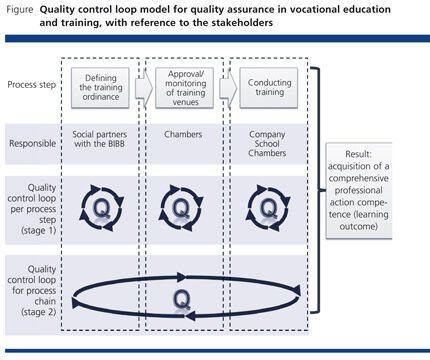
- Act. The total value added chain of vocational education and training with the relevant process steps and responsibilities is shown in the illustration. The process steps and assigned responsibilities included were:
- determining measures for continual further development,
- ensuring the implementation of the results.
The total value added chain of vocational education and training with the relevant process steps and responsibilities is shown in the illustration. The process steps and assigned responsibilities included were:
- defining the training ordinances,
- approval and monitoring of the training venues,
- conducting training in the school and enterprise learning venues as well as the examining responsibilities of the chambers.
In the first step (stage 1) a quality control loop similar to the Deming model is to be established for each process step. In the second step the individual control loops are to be transferred into an overall system (stage 2). Here particular attention is to be given to the effectiveness and quality of the interfaces between the individual process steps.
Outlook
A comprehensive output-oriented quality development system still has no tradition in Germany, particularly in in-company initial vocational education and training. Agreements among those involved will be no easy undertaking. It is not clear whether the recommendations of the European Union are sufficient to shatter the reticence that has existed up to now. One fundamental condition for systemic quality development embracing the areas mentioned is the development of a "quality culture" at all levels and between all stakeholders, designed to demonstrate to those involved the purpose and value of quality development. A fundamental openness to feedback and constructive criticism, as well as the interest and the readiness to point out and implement improvements, are of crucial importance in this regard.
At the same time, as experience from the school and company contexts shows, the introduction of comprehensive quality development systems involves a substantial effort and can hardly be done in a short period of time. One first step could be to develop a prototype for a comprehensive quality development system for in-company training (see Fig.) and to test it in enterprises. This could follow up the research work of the BIBB on the quality of in-company initial vocational education and training (see BEICHT et al. 2009; DIETZEN/TSCHÖPE/VELTEN 2010). A further option is to develop an appropriate "good practice set" for the area of responsibility of the chambers and subject it to practice trials. Here too, previous approaches should be taken into consideration.
Literature
ARBEITSKREIS DQR: Deutscher Qualifikationsrahmen für lebenslanges Lernen, verabschiedet am 22. März 2011 - URL: https://www.dqr.de/media/content/Der_Deutsche_Qualifikationsrahmen_fue_lebenslanges_Lernen.pdf (as of: 14.02.2013)
BEICHT, U. et al.: Viel Licht - aber auch Schatten. BIBBREPORT 9/2009, URL: http://www.bibb.de/veroeffentlichungen/de/publication/show/id/2270 (as of: 14.02.2013)
BUNDESAUSSCHUSS FÜR BERUFSBILDUNG: Empfehlung über die Eignung der Ausbildungsstätten vom 28./29.03.1972 URL: www.bibb.de/dokumente/pdf/HA13.pdf (as of: 14.02.2013)
BUNDESAUSSCHUSS FÜR BERUFSBILDUNG: Empfehlung über Grundsätze für die Beratung und Überwachung der Ausbildungsstätten durch Ausbildungsberater vom 24.08.1973 - URL: www.bibb.de/dokumente/pdf/HA19.pdf (as of: 14.02.2013)
BUNDESAUSSCHUSS FÜR BERUFSBILDUNG: Empfehlung betr. Kriterien und Verfahren zur Anerkennung und Aufhebung von Ausbildungsberufen vom 25.10.1974 - URL: www.bibb.de/dokumente/pdf/HA28.pdf (as of: 14.02.2013)
DEMING, W. E.: Out of the Crisis. Cambridge 1982
DEUTSCHER BUNDESTAG: Beschlussempfehlung und Bericht des Ausschusses für Bildung, Forschung und Technikfolgenabschätzung zu dem Entwurf eines Gesetzes zur Reform der beruflichen Bildung (Berufsbildungsreformgesetz - BerBiRefG) u.a. BTDrucks. 15/4752 of 26/01/2005 - URL: http://dip21.bundestag.de/dip21/btd/15/047/1504752.pdf (as of: 14.02.2013)
DGB JUGEND (eds.): Ausbildungsreport 2012. Berlin 2012 - URL: http://0cn.de/vqek (as of: 14.02.2013)
DIETZEN, A.; TSCHÖPE, T.; VELTEN, ST.: In die Blackbox schauen - Kompetenzen messen, Ausbildungsqualität sichern. In: BWP 39 (2010) 1, pp. 27-30 - URL: www.bibb.de/veroeffentlichungen/de/publication/show/id/6148 (as of: 14.02.2013)
EU COMMISSION: The European Qualifications Framework for Lifelong Learning (EQF), Luxemburg 2008. URL: http://ec.europa.eu/education/pub/pdf/general/eqf/broch_en.pdf (as of: 18.02.2013)
EU PARLIAMENT AND COUNCIL: Recommendation on the establishment of the European Qualifications Framework for lifelong learning of 23 April 2008. ABl C 111 of 6.5.2008 - URL: http://eurlex.europa.eu/LexUriServ/LexUriServ.do?uri=OJ:C:2008:111:0001:0007:EN:PDF (as of: 14.02.2013)
EULER, D..: Qualitätsentwicklung in der Berufsausbildung, Materialien zur Bildungsplanung und zur Forschungsförderung, BundLänderKommission für Bildungsplanung und Forschungsförderung (BLK), Issue 127, Bonn 2005 a - URL: http://www.blkbonn.de/papers/heft127.pdf (as of: 14.02.2013)
EULER, D.: Qualitätsentwicklung in den Lernorten - ein Ansatz zur Weiterentwicklung der Berufsbildung? In: ZBW 101 (2005 b) 1, p. 1
IRMGARD FRANK
Head of the “Structure and Regulation of Vocational Education and Training / Staff Department for the Vocational Education and Training for People with Disabilities” Department at BIBB
Translation from the German original (published in BWP 2/2013): Paul David Doherty, Global Sprachteam Berlin
-
1
See the project outline and the first interim results at www.kibb.de/wlk54563.htm