European standards for quality assurance in vocational education and training and their implementation at the national level
Thomas Gruber, Helena Sabbagh
Comparability, transparency and mobility - this triad stands for one decade of extensive developments that were launched as part of the systematic efforts towards establishing a European education area. The establishment of a European quality assurance reference framework for initial and continuing vocational education and training is an important milestone in this process. The article enumerates the goals of the European process of quality assurance in vocational education and shows what relevance the European standards developed have for quality assurance in the German context. It also refers to the opportunities now open to Germany for having a say in the European discourse. The role of the German Reference Point for Quality Assurance in Vocational Education and Training is dealt with against that background.
Background and objective of EQAVET
How can Europe's economic and social future be assured? This question gained relevance for European cooperation at the turn of the millennium through globalization, scarcity of resources and technical change. Although it quickly became clear that solutions had to be sought in high-quality education, among other factors, it was not until the so-called Copenhagen 1 process began that systematic efforts in that direction were undertaken. The goals formulated in the Declaration of Copenhagen provide for the building of mutual confidence in the education systems of the European member states as well as the promotion of transparency and the mutual recognition of learning outcomes. This is meant to support the mobility of EU citizens and improve access to lifelong learning.
EQAVET
The acronym stands for "European Quality Assurance in Vocational Education and Training "and designates
- the European Quality Assurance Reference Framework for vocational education and training as well as
- the network of the EQAVET member states (the 27 EU countries, the two EEA countries Liechtenstein and Norway and the candidate countries Croatia, Macedonia, Turkey and Iceland). The Working Group on Quality specified in the text initially became the "Technical Working Group on Quality in VET". Later this evolved into the "European Network on Quality Assurance in Vocational Education and Training" (ENQA-VET), until in the 2009 Recommendation the network finally adopted the name EQA-VET.
The EU Commission had installed the Working Group on Quality in Vocational Education and Training .to attain these objectives. The Working Group fulfilled its task of developing common quality assurance instruments for vocational education by presenting the Common Quality Assurance Framework (CQAF) in the year 2004 (see KÜßNER 2009). The implementation of the CQAF at the national level was to happen on a voluntary basis via networking.
The 2009 Recommendation: Commitment and toolbox approach
The recommendation on the establishment of a European Quality Assurance Reference Framework for Initial and Continuing Vocational Education and Training adopted by the EU Parliament and Council on 18 June 2009 converted the network activities, which up to then had been voluntary, into an obligatory procedure. It went hand in hand with the following obligations for the member states:
- establishment of reference points committed to quality assurance in vocational education and training at the national level,
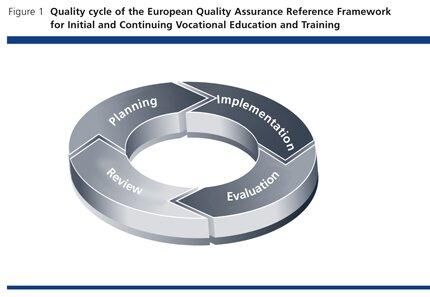
- use and further development of the European Quality Assurance Reference Framework for Vocational Education and Training (EQAVET Reference Framework) on the basis of the quality cycle (see. Fig. 1),
- active participation in the work of the EQAVET Network to advance the further development of common principles and instruments as well as
- review of progress made during the implementation process (see EU Parliament and Council 2009).
The vocational training and qualification systems in Europe are very heterogeneous with regard to their organizational principles and frameworks as well as their job profiles and training objectives. The commission used the "open method of coordination" (see FROMMBERGER 2006) to achieve results while taking national diversity into consideration. In the course of this procedure the EQAVET states agreed on the European reference framework. They did not commit themselves to a definite quality assurance model but agreed to promote the national use of approaches which correspond to the PDCA cycle (see Fig. 1). This quality cycle, also known as the Deming circle, embodies the principle of continuous effort to assure quality with its four phases, plan, do, check, act. It is essential for the cycle that results of phase four flow into re-planning so that continuity is assured.
To make the European Reference Framework more manageable for practitioners, the EQAVET member states developed two web-based English-language tools which have been freely available on the EQAVET website since 20122. The first of the two tools is intended for representatives of the system level in the vocational education and training system and the second for VET providers, that is, for vocational schools and in particular for SMEs. The toolbox approach applies together with the above-mentioned four obligations of the EQAVET Network. The analogy of the toolbox stands for the principle that each country should find the most suitable pathway for itself. Already existing quality assurance efforts in vocational education and training are not to be replaced but rather to be developed further.
The German reference point DEQA-VET: Hub for the flow of information
In accordance with the administrative agreement concluded in July 2008 between the Federal Ministry of Education and Research (BMBF) and the BIBB, the German Reference Point for Quality Assurance in Vocational Education and Training (DEQA-VET) was established on 1 August 2008. It was domiciled at the BIBB and has since then striven to promote the networking of vocational education and training stakeholders and institutions in Germany.
The establishment of the Reference Point created in Germany for the first time a central contact point on questions of quality assurance in initial and continuing vocational education and training. On the basis of the mandate contained in the 2009 Recommendation to keep Europe informed at all times of the progress made in implementing the EQAVET process nationally, DEQA-VET is thus fulfilling a coordinating and bundling function and assuming this task while preserving the cultural autonomy of the Federal states.
As a node within the European EQAVET network, the Reference Point can both pass on stimuli from Europe nationally to the Länder and regions and interchange experiences horizontally with other Member States (for example by means of peer review3).
Benefits of the EQAVET process for Germany can be seen in the many networking activities, the integration of stakeholders and the initiation of discourses. These contributions are among the essential fields of activity of the DEQA-VET Reference Point. Together with participation in external events, the annual DEQA-VET conventions4 in particular serve to promote interchange with stakeholders and participants in quality assurance and to provide stimuli for dealing with the topic. In so doing, the Reference Point strives to promote discourse transcending the limits of education segments as well, and the image of the "House of Lifelong Learning and Quality Assurance" as one of the outcomes of the fourth annual convention in September 2012 stands for that endeavour5.
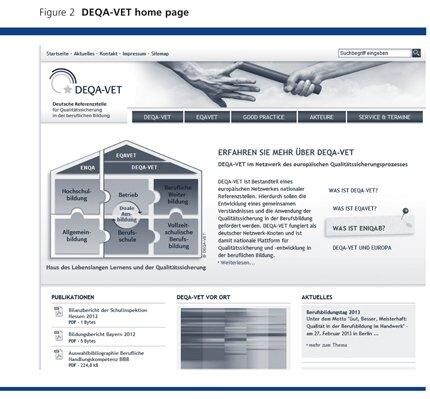
The development of the eponymous portal (www.deqa-vet.de; see Fig. 2) is part of the core business of the Reference Point, so that the website has developed in the past few years into an extensive and constantly growing topic-relevant on-line platform. The work benefited from the DEQA-VET being connected through a content partnership with the German Education Server (DBS), which performs the function of a central Internet guide to the education system in Germany as a joint service provided by the federal and federal state governments. This co-operation makes it possible for DEQA-VET to document the quality assurance within the vocational schools, which are the second learning venue in the dual system of vocational education and training. Apart from numerous other services provided on the website, successful quality-assurance efforts are presented, in part through examples of good practice.
These include, for example, the LEONARDO DA VINCI project for "Europeanisation of the National Pilot Initiative for Quality Development and Assurance in Company-Based Vocational Education and Training" (ENIQAB) which as one of the five EQAVET projects selected across Europe pursues the goal of making the results of the pilot projects in the funding priority "Quality" (see SCHEMME in this issue) accessible in Europe. The documentation of the ENIQAB results appears on the DEQA-VET website in German and English. There will be an English version of the website starting in 2013. Thus the DEQA-VET web presence - as the hub for the flow of information about quality assurance in vocational education and training - is designed to make the state of the art of quality assurance efforts at the national level visible throughout Europe and in this way to advance co-operation with the European partners.
What national relevance do the EQAVET standards have?
The issue of quality assurance is anchored in the school laws of all 16 Federal states. Looking at the DEQA-VET map of the quality-cycle based quality management systems used in the vocational schools in the Länder, one can see that with one exception all the Länder of the Federal Republic are represented7.
In continuing education and training as well, the Recognition and Authorization Ordinance for Continuing Education, AZWV (since 2012 the Recognition and Authorization Ordinance for Employment Promotion, AZAV) meets the requirements of the PDCA cycle. The European principles agreed upon are thus of a reaffirming and confirmatory nature for these areas.
The responses to questions of quality assurance are less consistent for the in-company part of vocational education and training. It is predominantly the small and medium-sized enterprises, which provide the majority of the training places, that need individual solutions in the field of quality assurance. The same demands cannot be made on these enterprises as on corporations operating internationally. From the point of view of the DEQA-VET Reference Point, however, the use of low-threshold instruments such as, for instance, feedback questionnaires or model development aids can greatly improve training quality in such cases. It is necessary to make sure that these - in compliance with EQAVET standards - are used according to the criteria of the constantly continuing PDCA cycle.
Where do the opportunities for Germany lie?
When vocational education and training is spoken of in the European context, it is usually initial and continuing education and training in school that is meant and not the dual system of vocational education and training that is typical of Germany. This fact implies fundamentally diverging ways of looking at the issue of quality assurance in vocational education and training.
One great opportunity offered by the German engagement in the EQAVET process is the opportunity to draw attention to these systemic differences and their implications for the quality assurance debate. EQAVET offers a suitable platform for demonstrating the advantages of job-related learning and the dual system of education and training. This has been given a boost by the recent sharp increase in the interest shown by other European countries in the dual system of vocational education and training8. The effort to constantly safeguard the quality of initial and continuing vocational education and training is an integral component of the German VET system. It can be assessed as positive from a German and European perspective if standards inherent to the system (see the contributions of Frank und Brötz/Schwarz in this issue) are communicated and disseminated throughout Europe within the EQAVET process (for example via the EQAVET annual conference or via project, sector and information seminars9).
At the European level there are clear efforts to see in more certifications a substantial contribution to quality assurance in order to meet Europe's economic and social challenges. Thus the topic of the "EQAVET Label" is concretely addressed in the current EQAVET Work Programme: A working group on approaches to certification for vocational education and training modelled on the Bologna process is to be developed in 2013 (see EQAVET 2012, p. 7).
Building on the minimum standards: The efforts should continue
From the German point of view the real challenge in the end will be to help shape the process that has begun at the European level in such a way that it reflects the individuality of the dual system of vocational education and training and the specific needs resulting from it as well as the implications for political developments in the area of quality assurance. Thus in the long run, for example, agreements with the European Union are conceivable that see the system-inherent aspects of quality assurance in the dual system of vocational education and training referred to as conforming to the European quality criteria. This would clear the way for enterprises offering training to obtain an EQAVET certificate without further external evaluation if there are such certificates in the future.
In principle it is the case for vocational education and training in Germany that the quality assurance status quo already corresponds to a large extent to European standards. Building on those minimum standards, however, the efforts should continue, and for this the EQAVET process can provide valuable stimuli. For the Reference Point the success of its commitment in the area of in-company initial and continuing education and training will depend considerably on whether it succeeds to a greater extent in the future in getting the chambers of commerce and industry to be cooperation partners. Apart from developing tools, DEQA-VET plans to intensify its efforts to track down and document examples of quality assurance that have been successful for in-company training in practice. Unless such content is passed on and unless the chambers cooperate as a matter of principle, however, the message behind it of a "culture of quality improvement" (EU Parliament and Council 2009) will hardly have the necessary effectiveness. The time, however, is ripe: Ever more enterprises are having trouble finding suitable recruits - there is potential for a steady growth in awareness of the relevance of providing excellent training and the associated need to invest in it.
Literature
EU PARLIAMENT AND COUNSIL: Recommendation on the establishment of a European Quality Assurance Reference Framework for Vocational Education and Training of 18 June 2009 (2009/C155/01) - URL: http://www.deqavet.de/_media/PDF_allgemein/Recommendation_2009_deutsch.pdf (as of 4 February 2013)
EQAVET (2012): EQAVET Work Programme 2013-2015 - URL: www.eqavet.eu/Libraries/Miscellaneous/EQAVET_Work_Programme_2013-2015.sflb.ashx (as of 4 February 2013)
FROMMBERGER, D.: Europäische Union - Berufsbildungspolitik. 1: Aktuelle Situation und historische Entwicklung. In: GROLLMANN, PH.; FROMMBERGER, D. (eds): Internationales Handbuch der Berufsbildung. Bielefeld 2012
KÜßNER, K.: European Quality Assurance Reference Framework for Vocational Education and Training - Implementation in Germany. In: BWP 39 (2009) 5, pp. 5-8
THOMAS GRUBER
Research associate in the “Vocational Teaching and Learning, National Programmes and Pilot Schemes” Department at BIBB
HELENA SABBAGH
Research associate in the “Quality, Sustainability, Permeability” Division at BIBB
Translation from the German original (published in BWP 2/2013): Paul David Doherty, Global Sprachteam Berlin
-
1
https://www.na-bibb.de/ (as of 4 February 2013).
-
2
See www.eqavet.eu/gns/home.aspx (as of 4 February 2013).
-
3
On 16 and 17 January 2012, for example, a peer learning group from Norway visited Frankfurt on Main. The programme on the topic "Measuring and evaluating quality in vocational education and training" was prepared and carried out by DEQA-VET in co-operation with the Länder.
-
4
See the documentation of the annual DEQA-VET conventions under www.deqa-vet.de/de/3263.php (as of 4 February 2013).
-
5
See www.deqa-vet.de/de/3141.php (as of 4 February 2013).
-
6
See the overview map at www.deqa-vet.de/de/2770.php (as of 4 February 2013).
-
7
In North Rhine-Westphalia, participation in the Quality Analysis (QA) procedure has been obligatory for all schools since August 2006. This is a procedure for external evaluation.
-
8
See, for example, the memorandum of 10 December 2012 on international vocational education and training co-operation at www.bmbf.de/pubRD/memorandumvocational_education_and_training_2012.pdf (as of 4 February 2013).
-
9
See www.deqa-vet.de/de/2189.php (as of 4 February 2013).