Validation of non-formal and informal learning in Europe
Results from the 2016 European inventory
Ernesto Villalba-García
Validation of non-formal and informal learning is an important policy tool for the promotion of more permeable educational systems, adaptable to the changing nature of skills demand. It is also a way of giving those most at risk of social exclusion access to the formal education system or the opportunity to gain employment from skills acquired in non-formal and informal settings. The European inventory1, published on Cedefop’s webpage and carried out in collaboration with the European Commission, has been in place since 2004 and provides an overview of the situation regarding validation in European countries. This article presents a summary of the current situation in Europe using data from the latest update of the inventory of validation of non-formal and informal learning.
Introduction
The European Council Recommendation of December 20122 asks member states to have arrangements for the validation of non-formal and informal learning in place by no later than 2018. Obtaining a qualification through validating work experience has been a possibility in several countries for many years. In France, the bilan de compétence was established in 1985, and from 1992 vocational certificates (certificat d’aptitude professionnelle) could be achieved on the basis of assessment of non-formal and prior learning. In 2002, legislation was adopted establishing a comprehensive national framework for validation (VAE). During the late 90’s and the first decade of the 2000s, European countries increasingly created mechanisms and frameworks for validation. The 2012 Recommendation concluded a period of expansion and experimentation on validation and established a basic, common definition of validation in Europe (cf. VILLALBA/BJORNAVOLD 2017). The Recommendation defines validation as a “process of confirmation by an authorised body that an individual has acquired learning outcomes measured against a relevant standard” (p. 398/5). As a process, validation includes four distinct phases—identification, documentation, assessment and certification. Validation processes will differ in the emphasis placed in each of the phases, depending on the individual’s objective upon entering the process (cf. ANNEN/BRETSCHNEIDER 2014; Cedefop 2014).
This article presents the current state of play as described in the European inventory on validation last updated in 20163. It focuses on specific aspects of validation, mainly the existing arrangements and their link to National Qualification Frameworks (NQF) and standards. Before presenting the results, the article explains the objectives of the European inventory and its methodological approach.
The European inventory on validation—2016 update
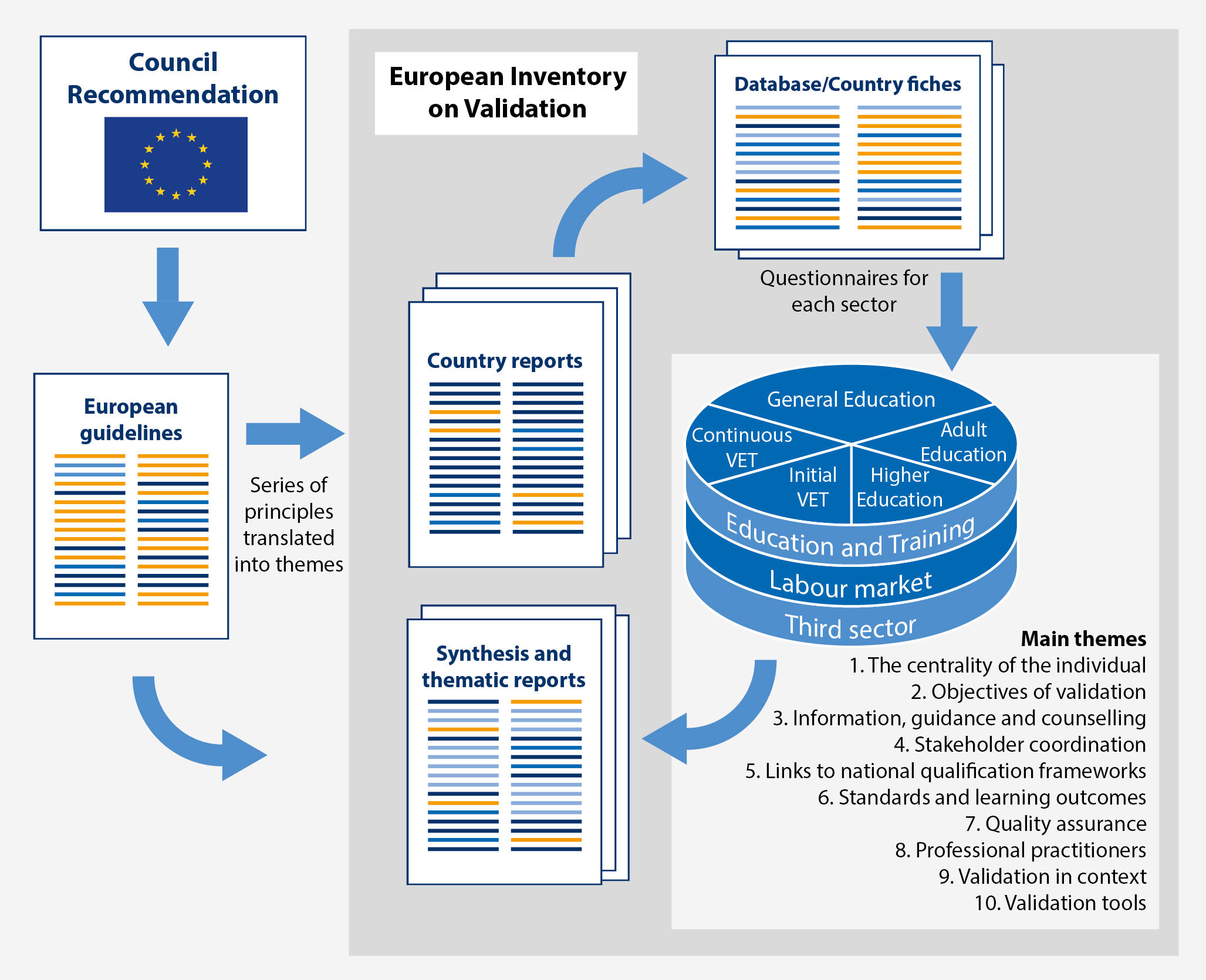
The Recommendation established political agreement on basic features for validation systems in Europe. It outlined a series of principles that are building blocks for functioning validation arrangements. It also asked for the European guidelines and inventory on validation to be reviewed regularly, giving them further political backup. The first edition of the European guidelines was published in 2009 (cf. Cedefop 2009). They were reviewed in 2015 after a process of consultation with member states and stakeholders. The guidelines further define the principles outlined in the recommendation and clarify the conditions for their implementation, highlighting the critical choices to be made by stakeholders (cf. Cedefop 2015). While the guidelines present a general idea of the choices to be made, the inventory presents how EU countries are actually implementing those principles outlined in the recommendation and guidelines. The objective of the inventory is to provide a trustworthy source of information on the issue of validation in Europe. Through the analysis of what different countries with different systems are doing, countries can learn from one another and see how validation systems function within a given context. The guidelines and the European inventory work together as tools for peer learning and exchange of policy practices.
The inventory consists of a series of country reports and other specific outcomes, such as thematic reports, databases or case studies that vary from edition to edition. The 2016 inventory consists of a total of 36 country updates (two reports were prepared for Belgium and three for the UK)4 for 33 countries (all member states, Switzerland, Turkey, Iceland, Norway, and Liechtenstein).
- The country reports were written by an expert in each country. The expert produced a first draft of the report based on desk research and information gathered from national contacts and a range of stakeholder interviews. This first draft was reviewed by the EQF AG member for each country. In addition, other (up to two) country experts commented on the reports. This input was processed by the authors of the country reports and sent back to the EQF AG for final review in order to make sure that there were no inaccuracies. The reports are, however, the responsibility of the authors. The reports present information up to June 2016.
In addition to writing the 2016 country reports, country experts were also required to complete a “country fiche database”. - The country fiche database summarised the information presented in the country report according to a standardised set of indicators. The database allows the translation of the different principles outlined in the Recommendation into a series of indicators (or areas of analysis) that provide a general overview of the situation in Europe. Figure 1 shows how the Council, guidelines and inventory relate to one other as well as the main themes collected in the European inventory. The data for the database was collected separately by sub-sectors of education (general, vocational – initial and continuous, higher education and adult education) as well as by sectors of activity (education, labour market and third sector).
Validation initiatives in the labour market are defined as initiatives where private sector institutions play a central role (alone or in collaboration with public sector institutions), i.e. validation initiatives in the private sector that aim to enable individuals to access private sector jobs or to move within the private sector labour market (to support career development). These initiatives might therefore be promoted, for example, by employers or employers’ associations.
Validation initiatives in the third sector are defined as validation to support youth work, to support volunteers, to validate non-formal learning opportunities offered by third sector organisations, or validation arrangements developed by third sector organisations such as charities or NGOs to support a variety of target groups (e.g. refugees/migrants, the unemployed, young people facing exclusion, people with a disability, etc.).
The 2014 inventory showed that validation varies greatly both across and within countries. Different education sub-sectors will have different degrees of development of validation, and it is thus necessary to separate them in the analysis of existing practices. The 2016 database allows for a clearer overview of validation arrangements as it is possible to differentiate between sectors and sub-sectors of education within a country.
Selected results for 2016 European inventory
VALIDATION ARRANGEMENTS
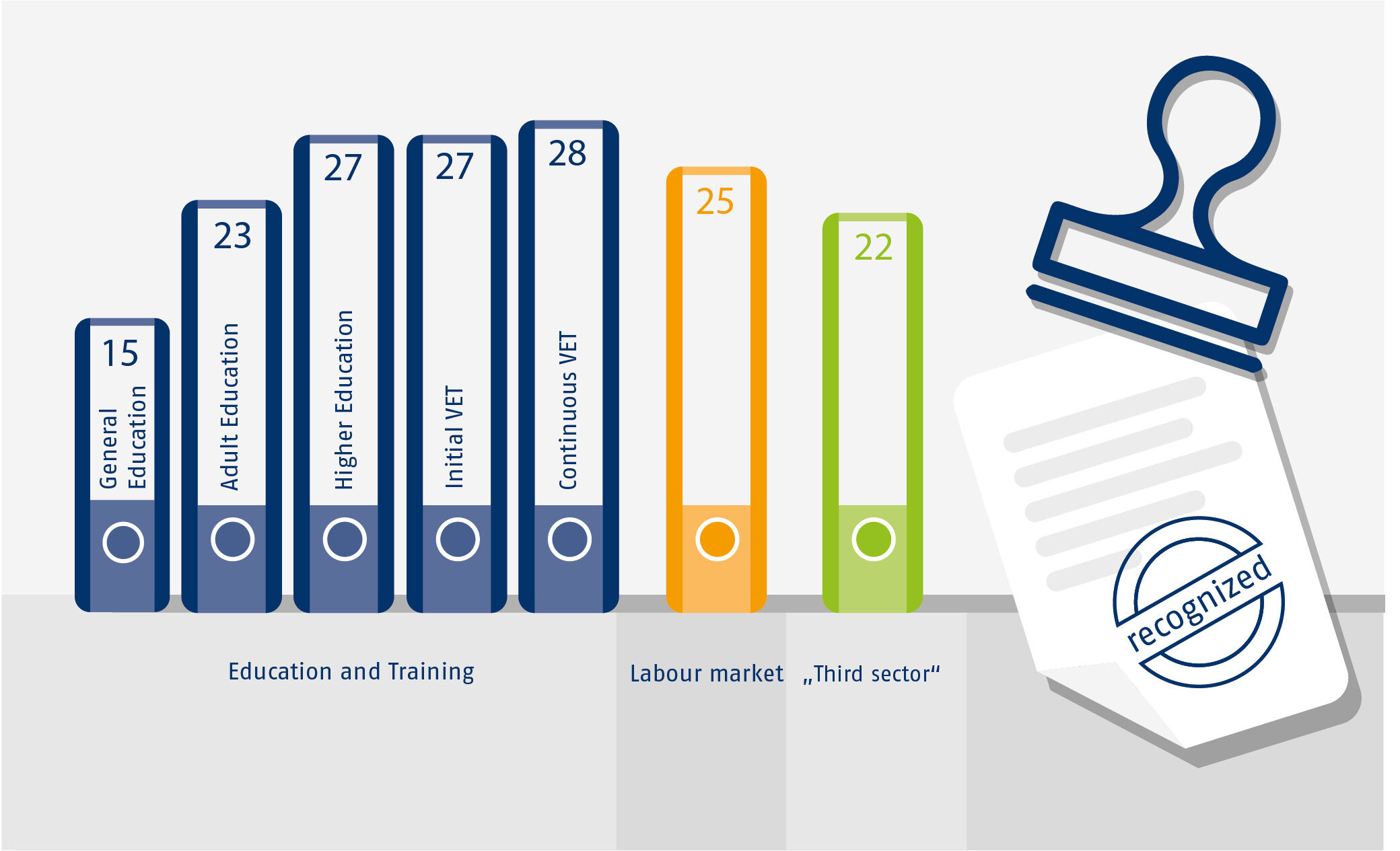
Country experts reported validation arrangements in at least one sector of education in all countries except in Croatia, where the system was still being developed in June 2016 within the framework of its NQF implementation. In Europe, validation is mainly possible for continuous or initial vocational training (cf. Figure 2). Higher education institutions have also increased opportunities for the validation of non-formal and informal learning in recent years. Validation arrangements are less common within labour market initiatives or in the third sector. However, some countries have other arrangements linked to the third sector or labour market in addition to validation connected to formal education. 15 countries have systematic validation arrangements in the labour market, mainly in relation to the VET sector or to some specific sector of activity, such as in Malta where validation is being developed for the child care and construction sectors. In 22 countries, the experts reported at least some validation arrangements in the third sector. These are mainly linked to certificates with which non-governmental organisations provide their volunteers, with little or no connection to formal qualifications. Validation arrangements in education and training tend to include the four stages of validation, whereas validation processes within the labour market or third sector are mainly focused on identification and documentation.
As in the case of 2014, the 2016 inventory shows that the possibilities for validation remain rather fragmented and there is a need to enhance coherence across sectors. Countries seem to be making an effort to create this coherence by developing overarching strategies that cut across sectors and mechanisms for coordination. The number of countries with mechanisms in place for coordination across sectors has practically doubled since 2010. In Sweden, for example, the National Delegation for Validation has the mandate to follow, support and encourage coordinated work to develop validation on both a regional and national level. In Ireland, the Recognition of Prior Learning Practitioner Network was created with the aim of providing a coherent voice and a peer support environment for practitioners.
LINKS TO NQF AND LINKS TO CREDITS
The NQF can serve as a tool for bridging the validation arrangements in the different sectors. NQFs are becoming increasingly operational and are expanding across Europe (cf. Cedefop 2017). The connection between NQFs and validation has been growing since NQFs started to be developed, especially after the 2008 Recommendation (cf. Council of the European Union 2008). In many countries, the development of validation arrangements is carried out together with the establishment or review of NQFs. In most cases, NQF developments are primarily concerned with formal qualifications that might open doors to non-formal and informal learning. Certificates that are not awarded by formal education institutions are normally not included within NQFs in the first stages of development.
Experts reported a link between validation and NQFs in at least one sector of education in 28 countries. This is compared to 20 countries with a link in the 2014 inventory. However, the way in which they are linked may differ. There are 22 countries that allow for the acquisition of a NQF qualification or parts of such a qualification through validation. In 19 countries, access to NQF qualifications can be granted through validation of non-formal and informal learning in at least one sector of education. Access is slightly more common for higher education than for other sub-sectors of education, while obtaining qualifications (or parts of a qualification) is a main link in VET (both continuous and initial). Obtaining a qualification is achieved through credits in many instances. There are a total of 26 countries that allow individuals to obtain credits through validation of non-formal and informal learning. This was the case in 23 countries in 2014 and in 19 countries in 2010. This also includes countries that grant qualifications that are not part of the NQF through validation. Granting credits is the most common way of carrying out validation in higher education, and the development of ECTS and the Bologna Process has probably had an important impact. In IVET and CVET, credits are granted through validation in ten countries.
VALIDATION STANDARDS EQUIVALENT TO QUALIFICATIONS OBTAINED THROUGH FORMAL EDUCATION PROGRAMMES
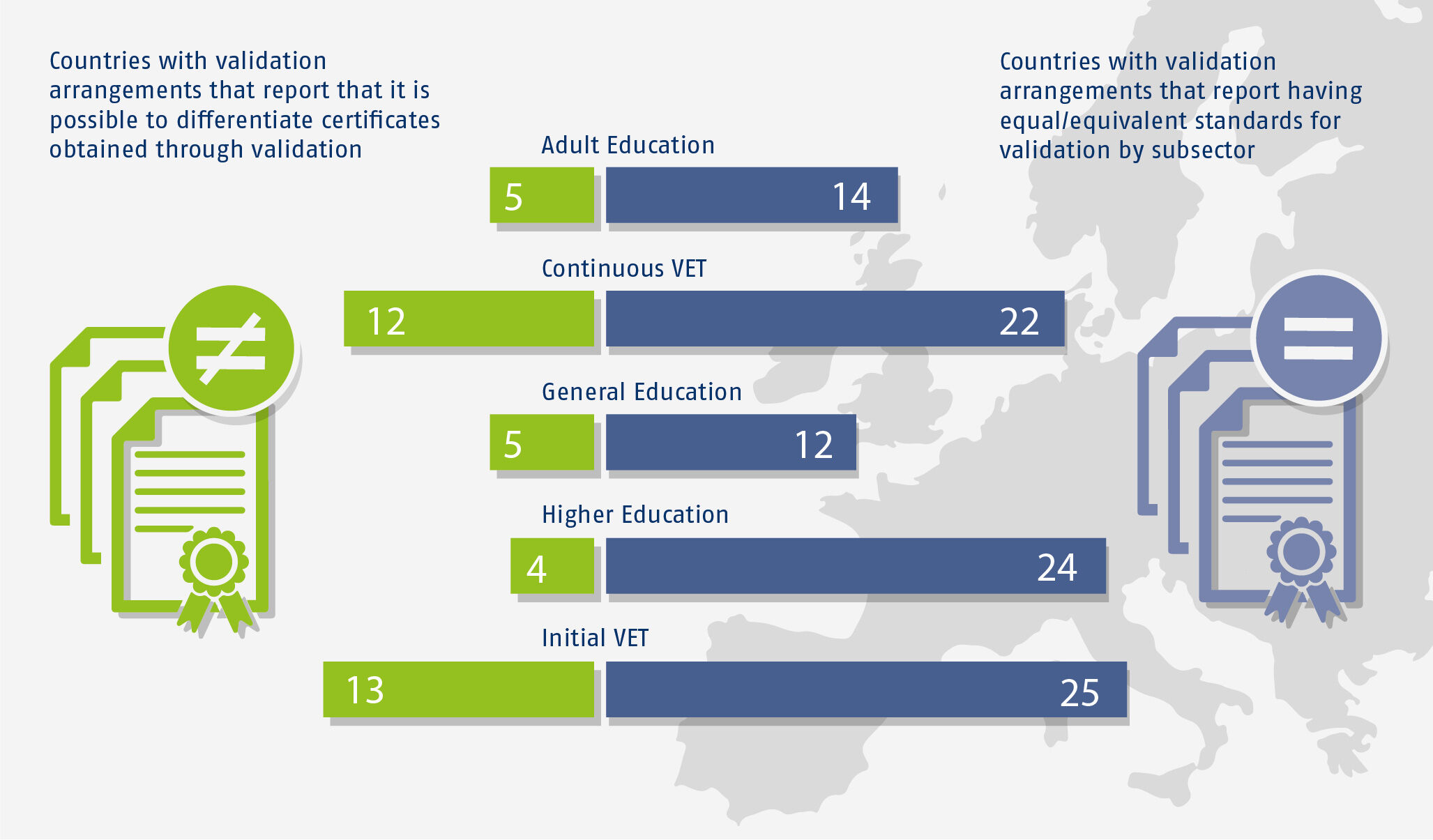
26 countries use exactly the same or equivalent standards for validation as the ones used in formal education in at least one sub-sector of education (cf. Figure 3). The majority of the countries with validation arrangements will use the same standards, especially in IVET and higher education, and to a lesser degree in adult education or CVET. However, having similar standards does not necessarily mean that certificates (or qualifications) obtained through validation are the same as those obtained through formal education. Country experts were asked if it is possible to differentiate between a certificate obtained through validation and certificates obtained through formal education in the same sector. In IVET, it was possible to make such a differentiation in 13 countries, whereas in CVET this was the case in 12 countries. Differentiation is possible to a lesser extent in higher education. The possibility of differentiating certificates has the potential to value qualifications differently, even if these qualifications refer to equivalent standards, thus preventing validation becoming an accepted route to obtaining qualifications. However, we know little of the perceived differential value of qualifications obtained through validation and those obtained via more traditional routes.
Conclusions
The 2016 inventory update shows that there has been steady progress towards the 2012 Recommendation objectives, but there are still certain areas where further improvement is necessary. Overall validation of non-formal and informal learning is becoming an increasingly common feature of the European educational landscape. Most countries are developing national or sectoral strategies, and putting structures, mechanisms and legislation in place that permit the acquisition of full or parts of qualifications through validation. In many instances, this will be done by means of granting credits and will use standards that are similar or equivalent to the formal qualification. These qualifications will be, in more and more cases, part of the NQFs, whose design and implementation is contributing to the development of validation arrangements. More needs to be done, however, in connecting certificates and qualifications awarded by private and third sector organisations—outside the formal system—to the NQFs as well as in the coordination between these sector initiatives and state-run validation strategies.
Countries use similar or equivalent standards for validation and formal education, and this is contributing to easing this connection and assuring the equivalent value of qualifications acquired through validation. However, in many countries, it is still possible to differentiate qualifications depending on how they have been obtained. This might jeopardise the potential of validation, thus creating a stigma and not allowing validation to become an accepted route to obtaining qualifications.
Nevertheless, while institutions, structures and standards are being put in place, there is still a lack of accurate information at the country level on who is benefiting from validation and how this is taking place. Consequently more needs to be done in collecting data and carrying out impact analysis. Based on the little information available, it seems that the individuals that could benefit the most from validation are not being sufficiently targeted by validation initiatives. More emphasis needs to be placed on using validation to reach people at risk of social exclusion, through a better integration of validation with guidance practices and other policy initiatives.
-
1
The current article does not constitute policy and might not necessarily present the views of the European Commission, Cedefop, or the European Qualification Framework Advisory Group.
The article is based on the current synthesis report (cf. Cedefop/EU Commission/ICF 2017). The synthesis report was drafted by: JO HAWLEY, ILONA MURPHY, MANUEL SOUTO-OTERO, ERNESTO VILLALBA-GARCIA, BIANCA FARAGAU, and DAVID SCOTT. The article, however, is sole responsibility of the author. -
2
Cf. http://eur-lex.europa.eu/legal-content/EN/TXT/?uri=CELEX:32012H1222(01) (retrieved: 11.10.2017)
-
3
The 6th inventory update was financed by the Cedefop and carried out by ICF International (lead consultants: JO HAWLEY, ILONA MURPHY, and MANUEL SOUTO-OTERO) under the supervision of a Steering Committee formed by Cedefop (ERNESTO VILLALBA-GARCIA, HANNE CHRISTENSEN, and JENS BJØRNÅVOLD), the European Commission (KOEN NOMDEN, LIEVE VAN DEN BRANDE, MARTINA NI-CHEALLAIGH, CORINNA LIERSCH, ANNA NIKOWSKA) and the ETF (ANNA KAHLSON and EDUARDA CASTEL-BRANCO). Work was carried out under Cedefop’s service contract No 2014-0182/AO/ECVL/JB-EVGAR/ 2016-Validation-Inventory/014/14. The inventory has benefited from the involvement and input of the European Qualification Framework Advisory Group.
-
4
For the sake of simplicity, the article refers to the two regions of Belgium and the three nations of the UK as “countries” in the different figures and reports.
References
ANNEN, S.; BRETSCHNEIDER, M.: The process of validation of non-formal and informal learning: Specification of terminology and the status of debate in the German-speaking countries. In: BWP 43 (2014) 5, pp. 11-15 – URL: https://www.bibb.de/en/18155.php
CEDEFOP: European Guidelines for validating non-formal and informal learning. Luxembourg 2009
CEDEFOP: European guidelines for validating non-formal and informal learning (Cedefop reference series; No 104). Luxembourg 2015 – URL: http://dx.doi.org/10.2801/008370 (retrieved: 11.10.2017)
CEDEFOP: Analysis and overview of national qualifications framework developments in European countries. 2017 (forthcoming)
CEDEFOP, EUROPEAN COMMISSION, ICF INTERNATIONAL: European inventory of Validation of non-formal and informal learning – 2016 update. Synthesis report. Luxembourg 2017
COUNCIL OF THE EUROPEAN UNION: Recommendation on validation of non-formal and informal learning (2012/C 398/01). 2012
COUNCIL OF THE EUROPEAN UNION: Recommendation of the European Parliament and of the Council of 23 April 2008 on the establishment of the European qualifications framework for lifelong learning. In: Official Journal of the European Union, C 111, 6.5.2008, pp. 1-7 – URL: http://eur-lex.europa.eu/LexUriServ/LexUriServ.do?uri=OJ:C:2008:111:0001:0007:EN:PDF (retrieved: 23.07.2017)
EUROPEAN COMMISSION: Communication from the commission, Making a European Area of Lifelong Learning a Reality. Brussels 2001. COM(2001) 678 final, 2001 – URL: http://eur-lex.europa.eu/LexUriServ/LexUriServ.do?uri=COM:2001:0678:FIN:EN:PDF (retrieved: 23.07.2017)
EUROPEAN COMMISSION; CEDEFOP; GHK: European inventory on validation of non-formal and informal learning 2010
VILLALBA, E.; BJORNAVOLD, J.: Chapter 5: validation of non-formal and informal learning; A reality in Europe? In: CEDEFOP, ETF, UNESCO (eds.): Global Inventory of Regional and National Qualifications Frameworks 2017. Volume I: Thematic Chapters (forthcoming)
ERNESTO VILLALBA-GARCÍA
Expert at Cedefop, Thessaloniki, Greece