Should companies retain their trained apprentices or let them go?
Changes to the traditional career model in the restaurant trade
Anke Bahl, Margit Ebbinghaus, Thomai Gruber
Virtually no other branch is older, more colourful or more international than the restaurant trade, and this diversity is also reflected in the employment histories of those who work in it. These are frequently characterised by several changes of employer and by moves from place to place or from country to country. Various indicators suggest that a model of internal company employment histories is being established alongside this traditional “nomadic” model. This article uses the occupation of restaurant specialist as an example in order to show what is behind this development and how human resources managers are thinking about.
Career options for trained restaurant specialists
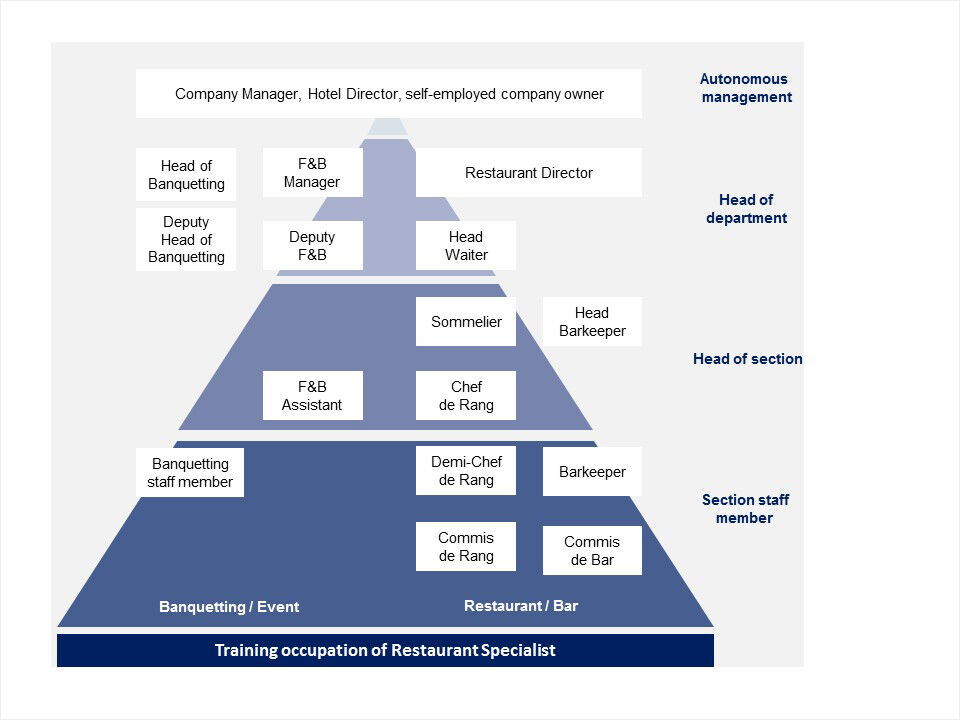
After completing dual vocational training of (usually) three years’ duration and passing the final examination, a restaurant specialist will typically progress to a position as commis de rang within the salary and career system of the restaurant trade. A commis de rang is a junior waiter who is in his or her first two years of employment practice following conclusion of training. Commis de rang work under instruction. They are responsible for mise en place, carry out all kinds of service-related work, lay tables and look after table linen and cutlery stocks. A commis de rang also relays orders to the kitchen and assists both the demi chef de rang and the chef de rang. The demi chefs de rang (senior waiters) support the chef de rang. Task areas include laying additional cutlery, bringing bread to tables, refilling wine glasses and serving dishes. Commis de rang and commis de bar fulfil certain “posts” within the organisational structure of a restaurant. They have their own areas of responsibility and may achieve higher positions once they have gained greater experience (for more information on career options for trained restaurant specialists, cf. Figure).
Changing employers as an explicit criterion for advancement
In other sectors, frequent changes of employment and switching between very different types of company are something which tends to be frowned upon. In the restaurant trade, however, it is an accepted and established practice. The branch has always been characterised by high levels of staff turnover, and this also constitutes a key feature of the skills profile of experienced restaurant specialists. Although waiters1originally travelled around out of necessity2, such movement became the norm over the course of time. Multiple changes of company initiated by workers themselves once they have spent two or three years in the same job are viewed within the branch as the usual form of individual continuing training (cf. KATENKAMP/GUHLEMANN/GEORG 2014). The taking on of different posts at various companies is also considered to be evidence of fulfilment of the skills prerequisites to exercise higher-level tasks and build a career in a system which is hierarchically structured. Advancement, however, mostly takes place when workers are still young. The process is also comparatively rapid, meaning that senior positions can be achieved after between ten and 15 years of occupational experience. Phases of longer or permanent employment at the same company do not tend to occur until workers have reached the age of approximately 40 (cf. ibid., p. 39).
Debates ongoing within the branch (cf. inter alia DEHOGA 2016) and research works (cf. inter alia GUHLEMANN 2014) indicate that movement has been taking place for some time in a pattern that has been established for decades. Indications of this were also revealed within the scope of the BIBB research project “Recruitment of apprentices – company recruitment behaviour in the context of demographic change” (cf. Information Box).
Qualitative data material
The qualitative data material used to inform this article comprises transcripts from a total of twelve problem-centred interviews. These were conducted in the winter of 2012/13 within the scope of the BIBB research project “Recruitment of trainees”, which ran from 2012 to 2016. The interviewees were human resources managers from twelve small and medium-sized restaurant companies in four regions of Germany. The survey included owner-managed restaurants, chain restaurants and restaurants integrated into hotels. Each transcript was initially considered on an individual case basis and subjected to reconstructive analysis via an integrative text-hermeneutic procedure. The second stage of the analysis involved the search of repeating argumentation patterns across the whole of the body of the text.
Attractiveness of the training occupation in decline whilst the need for skilled workers is rising
Qualifications and advancement practice within the restaurant sector was previously viewed as ideal. However, one essential factor that is now calling this traditional path into question is the increasing shortage of skilled workers. Whereas the branch is continuing on a course of growth (cf. inter alia DEHOGA 2017), a process which means that the requirement for skilled workers is high, especially in such a personnel-intensive sector, trainee numbers in occupations related to the restaurant trade are in serious decline. The training occupation of restaurant specialist has been particularly affected. The number of newly concluded training contracts in this occupation has halved within the space of only a few years (falling from around 6,300 in 2009 to about 3,100 in 2016), and one in three training places now remains unfilled (cf. BIBB 2016a). Because half of training contracts are also prematurely dissolved (cf. BIBB 2016b), qualified skilled workers are becoming a rare commodity.
The companies questioned all view young people’s dwindling interest in career prospects available in the restaurant trade with concern, especially as they agree that there is no feasible alternative to VET. Although they state that short-term bottlenecks can be covered by using students and other semi-skilled auxiliary workers, they know that regular restaurant operations cannot be maintained in this way, let alone a whole sector.3 One conspicuous aspect of how the respondents address their difficulties in recruiting suitable young people on the training market is the strong difference in the way in which the sector perceives itself as compared to its external reputation, which tends to be poor. In many cases, the human resources managers stress the “great career options” and the multifarious chances for development that the branch offers, even without considering higher education qualification. Such options are closely linked with a willingness to go out into the “great wide world” upon completion of training and to make use of the virtually unlimited employment prospects on offer in order to build up an individual profile.
One food and beverage manager explains, “At the end of the day, it is important to gain as many different impressions as possible, not just for your occupation but also for yourself. This is what makes you strong. [...] If you are good and show the necessary persistence, you can work anywhere in the world, anywhere. And you can always come back home.” This particular manager believes that it is part of the “occupational profile” of the sector for employees to work their way through “different sections”, each of which is accorded a varying degree of significance. She illustrates this with examples from her own employment history. “I worked at a gourmet restaurant, where we served up gala dinners with 14-course menus. I chose my next hotel because I then got the chance to flambé, slice and fillet dishes at the table. Just for myself. [...] And that’s why I say that it’s essential to switch jobs. You always have to keep moving!” (Refa-Ib-1)
We find repeated emphasis of the fact that the strength of the branch lies in the diversity of experiences gained by its employees and that novices need to travel around in order to complete their skills set. One restaurant owner points out, “The restaurant trade lives by a wide range of experiences, and you should make sure you gather these. When people finish their training, no matter how good they are, I always say, ‘Do me a favour. Don’t try to cling to your mother’s apron strings or hang around at this company. Go out into the world and have a good look at what’s going on.” (Refa-Ib-2)
A considerable collapse in the number of training contracts concluded (cf. above) is, however, now destabilising the previous strategy for securing a supply of skilled workers in a branch which was originally a major provider of training. Several HR managers described that they were contradicting their own belief of an ideal career start within the sector and were moving away from the existing usual practice of providing training on behalf of the branch as a whole. Their companies had now adopted the strategy of using training to secure their own supply of skilled workers. Whereas there was previously no problem in letting skilled workers go upon completion of training because companies could always rely on the market to deliver sufficient numbers of other specialists when the time was ripe, this confidence now appears to be dwindling.
Although it was not possible to interview any young people within the scope of the project, the statements made by the human resources managers indicate that in providing training to meet their own needs they are also meeting the wishes of young people, who want to commit to a fixed location whilst also seeking job security. This approach gives the companies a better chance of persuading the small numbers of training applicants who are still available to enter into a contract.
Hesitant reorientation from a culture of switching to a culture of staying put
Reports from within the branch show that the issue of acquiring staff and securing their loyalty has been the number two main problem area in the restaurant trade for several years (DEHOGA 2015, 2017). More than half of companies in the sector believe that they face this difficulty (ibid.). Evidence that this is producing changes to employment histories is also revealed by the fact that there has been a considerable rise in the proportion of persons offered subsequent employment by their company offering training. Whereas the rate of retainment with the same company upon completion of training in the hotel and restaurant sector was just over 30 per cent for many years, significantly below the general average of 55 per cent, this figure has now risen to approximately 58 per cent and is making clear strides towards approaching the current average level of 68 per cent (cf. DUMMERT/LEBER 2016, pp. 34 ff.).
Why, however, are the human resources managers sceptical about this shift, and why do they believe that that are “not doing young people any favours” by offering subsequent employment to those completing training? Alongside the arguments relating to professional development already expounded upon, the respondents also mention personal opportunities for development, including acquiring greater autonomy and powers of self-assertion. Young skilled workers who have just emerged from training only realise in retrospect, when they are already employed at a different company, just how valuable their vocational education and training actually was. They do not learn to appreciate the experience they have gained with their first employer until they switch to another firm. This increases the future chances of making a voluntary return to the original company that provided training. In a branch which is strongly based upon levels of experience, there is a strong emphasis on acquiring the merit of status by working for various employers. Those who remain behind at their first company risk being stigmatised as “eternal trainees”. Companies which form part of chains and can thus at least provide rotation between their various locations tend to be better able to confront this dilemma than independent single restaurants.
However, what opportunities are also offered by this new strategy for securing a supply of skilled workers? Opening up prospects for immediate employment upon conclusion of training could (once again) increase the attractiveness of training occupations in the restaurant trade to young people. Internal development and career pathways may also enable companies to tap into new applicant groups. These include young women wishing to start a family or who already have children as well as older workers. One of the ways in which companies are seeking to accommodate these groups is by offering more flexible working time models (cf. DEHOGA 2016a). The Head of Human Resources at one hotel reports, “We are working on our job advertisements and on the areas in which we are seeking to advertise. We have now, for example, taken photographs of female staff who have children. This shows that nothing needs to stand in the way of training or working in the hotel business, even if you have a child or are an older applicant. Of course, these are typical prejudices reported about our branch. But all of this can be reconciled.” (Refa-IIa-1)
Conclusion
The extent to which the developments described will lead to the medium-term establishment of a career model within the company which either replaces or supplements the present system of switching employers remains unclear. The process does not, however, appear to be a “flash in the pan”. The question of internal competence development, which will inevitably grow in significance as periods of employment become longer, would otherwise scarcely be addressed in connection with new strategies for securing staff loyalty. Recently published practical guides on securing a supply of skilled workers in the restaurant trade, for example, explicitly point out that “attractive continuing training provision for all employees [forms part of] measures aimed at securing staff loyalty [...]” (Guter Gastgeber – Guter Arbeitgeber 2017, p. 28).
We also need to wait and see whether the internal company career model succeeds in freeing itself from its current status of predominantly being viewed as an “emergency solution”, especially as DEHOGA, the branch’s umbrella association, was emphasising in a position paper on training published as late as 2016 that “having a series of changing international jobs on a curriculum vitae and varied professional experiences [...] are part of the career concept in the branch” (DEHOGA 2016b, p. 2).
To this extent, further research activities will need to be carried out to continue to trace how the further development of typical careers within the sector pans out in practice.
-
1
Although the job title of “waiter” was replaced with the occupational designation of “restaurant specialist” as long ago as 1980, when the training occupations in the restaurant sector were updated, the former term continues to be very current both within the branch itself and in everyday speech.
-
2
At the end of the 19th century, Catholic homes were established in Germany to provide housing for tradesmen undertaking their traditional “journeyman years”. There were also Christian homes for waiters both in Germany and abroad. These provided workers with inexpensive accommodation as well as offering assistance with finding jobs (cf. LEE 2012, p. 12, for more details on the genesis of the occupational profile cf. DURST 1993).
-
3
HORLACHER (2015) looks in detail at the issue of “the indispensable need to have a proportion of very well trained skilled workers” and at the impending deprofessionalisation of workers in the restaurant trade.
Literature
BIBB: BIBB-Erhebung über neu abgeschlossene Ausbildungsverträge zum 30.09.2016 [BIBB survey of newly concluded training contracts as of 30 September 2016], Table 59, retrieved 12.12.2016. Bonn 2016a. URL: https:// www.bibb.de/dokumente/pdf/naa309_2016_tab59_0bund.pdf (retrieved: 31.07.2017)
BIBB: BIBB-Datenblatt Restaurantfachmann/-frau [BIBB data sheet on the occupation of restaurant specialist], retrieved 10.10.2016. Bonn 2016b. URL: https://www2.bibb.de/bibbtools/tools/dazubi/ data/Z/B/30/1351.pdf (retrieved: 31.07.2017)
BOTT, P. et al.: Qualifikationsstruktur und Erwerbstätigkeit im Gastgewerbe. Brauchen Hotel- und Gaststättenberufe neue Rezepte? [Qualifications structure and employment in the restaurant trade – do occupations in the restaurant trade need new recipes?] (Wissenschaftliche Diskussionspapiere 150) [Academic Research Discussion Papers 150]. Bonn 2014
DEUTSCHER HOTEL- UND GASTSTÄTTENVERBAND E.V. [GERMAN HOTEL AND RESTAURANT ASSOCIATION] (DEHOGA DEUTSCHLAND): DEHOGA-Konjunkturumfrage Frühjahr 2017 [Dehoga Economic Survey, Spring 2017]. Berlin 2017
DEUTSCHER HOTEL- UND GASTSTÄTTENVERBAND E.V. [GERMAN HOTEL AND RESTAURANT ASSOCIATION] (DEHOGA DEUTSCHLAND) Standpunkt Fachkräftesicherung [Position paper on securing a supply of skilled workers]. Berlin 2016a. URL: www.dehoga-bundesverband.de/fileadmin/Startseite/05_Themen/99_DEHOGA-Standpunkte/Fachkraeftesicherung.pdf (retrieved: 31.07.2017)
DEUTSCHER HOTEL- UND GASTSTÄTTENVERBAND E.V. [GERMAN HOTEL AND RESTAURANT ASSOCIATION] (DEHOGA DEUTSCHLAND): Standpunkt Ausbildung [Position paper on training]. Berlin 2016b. URL: www.dehoga-bundesverband.de/fileadmin/Startseite/05_Themen/99_DEHOGA-Standpunkte/Ausbildung.pdf (retrieved: 31.07.2017)
DEUTSCHER HOTEL- UND GASTSTÄTTENVERBAND E.V. [GERMAN HOTEL AND RESTAURANT ASSOCIATION] (DEHOGA DEUTSCHLAND): DEHOGA-Konjunkturumfrage Frühjahr 2015 [DEHOGA economic survey, autumn 2015]. Berlin 2015
DUMMERT, S.; LEBER, U.: IAB-Expertise Betriebliche Berufsausbildung und Weiterbildung in Deutschland. Ergänzende Informationen zum Datenreport zum Berufsbildungsbericht 2016 [IAB report on company-based VET and continuing training in Germany. Supplementary information to accompany the 2016 Report on VET]
DURST, A.: Bedienen zwischen dienen und verdienen. Eine berufssoziologische empirische Untersuchung zur Dienstleistungsarbeit im Gastgewerbe [Earnings and work in the service sector. A socio-occupational empirical survey of service work in the restaurant trade]. Bielefeld 1993
GUHLEMANN, K.: Jung, ausgebildet – weg. Wechselpläne und Fachkräftemangel in Zeiten des Demografischen Wandels im Gastgewerbe [Young, trained, gone away. Movement plans and skilled worker shortages in the hotel and restaurant sector during times of demographic change]. In: Zeitschrift für Pädagogik [Journal of Work Science], 68 (2014), pp. 45-53
GUTER GASTGEBER – GUTER ARBEITGEBER (Ed.): Praxishilfe zur Fachkräftesicherung und Steigerung der Arbeitgeberattraktivität im Gastgewerbe [Practical guide to securing a supply of skilled workers and raising employer attractiveness in the restaurant trade]. Zweibrücken 2017. URL: https://guter-gastgeber-guter-arbeit geber.de/sites/all/themes/ggga/files/PDFs/Broschur_Praxishilfe_Web.pdf (retrieved: 31.07.2017)
HORLACHER, F.: Eating out of home als Professionalisierungszone – (De-) Qualifizierungstendenzen im Gastgewerbe [Eating out of home as a professionalisation zone – (de)skilling tendencies in the restaurant trade]. In: bwp@ (2015) 29 – URL: www.bwpat.de/ausgabe/29/horlacher (retrieved: 31.07.2017)
KATENKAMP, O.; GUHLEMANN, K.; GEORG, A.: Herausforderungen des demografischen Wandels im Gastgewerbe [Challenges of demographic change in the restaurant trade]. In: BWP 43 (2014) 2, p. 38-39 – URL: www.bibb.de/veroeffentlichungen/de/bwp/show/7231 (retrieved: 31.07.2017)
LEE, R.: Die Unterkunft und Versorgung in (Hafen-)Städten für Durchreisende und Alleinstehende: Das Ledigenheim in Hamburg im internationalen Vergleich [Accommodation and care in (port) cities for through travellers and single persons – the singles home in Hamburg in international comparative terms]. Hamburg 2012 – URL: www.boell.de/sites/default/files/assets/boell.de/images/download_de/2012-Vortrag-Das-Ledigenheim-in-Hamburg-im-internat-Vergleich-Robert-Lee.pdf (retrieved: 31.07.2017)
ANKE BAHL
Research Associate in the “Competence Development” Division at BIBB
MARGIT EBBINGHAUS
Research Associate in the “Vocational Training Supply and Demand/Training Participation” Division at BIBB
THOMAI GRUBER
Research Associate in the “Vocational Teaching and Learning, National Programmes and Pilot Schemes” Department at BIBB
Translation from the German original (published in BWP 5/2017): Martin Kelsey, GlobalSprachTeam, Berlin