Reform of Aged Care Training in Japan
Keiichi Yoshimoto , Katsuhiko Kikuchi, Chisako Eto
By world standards, Japan’s population is ageing at an unprecedented level and speed. This development cannot be met due to the shortage of a sufficiently skilled aged care workforce. After giving a short overview of the Aged Care System in Japan, its current situation and challenges the authors therefore emphasize the need for a reform of career paths, curricula and training contents. A proposal for a standardized training programme is presented in the form of the so-called “Mt. Fuji shape”.
Japan’s ageing population
According to the 2015 nationwide census, 34 million people or 26.7 per cent of the total population of 130 million are aged 65 or older (12.9 % of the population are aged 75 or over). This reflects a complete change in the age composition of society. As the overall population decreases, the percentage of older people is predicted to rise further, reaching 30.3 per cent in 2025, 33.4 per cent in 2035, and 39.9 per cent in 2060. For this reason, the Aged Care Insurance System was introduced in 2000.
Because there are more and more older people, a new demand for “certified care workers” (kaigo fukushishi) has been created. The care workforce grew by 1.16 million people by 2013, making a total of 1.71 million care workers (cf. METI 2016). However, according to figures published by the Ministry of Health, Labour and Welfare (cf. MHLW 2015a) on the future demand for care workers, demand is anticipated to rise by around 70,000 people per annum between 2012 and 2025 (cf. JILPT 2014), resulting in a demand for a total of 2.53 million care workers in 2025. This exceeds the 2.152 million workers that are anticipated to be supplied through expansion of the current supply routes, leading to an anticipated shortfall of 377,000 workers.
Diversification of education and training programmes
In addition to the anticipated shortage in numbers, Japan’s care workforce lacks a system of specialized qualifications that correspond to the wide range of different and specialized needs. It is therefore urgently necessary both to increase the number of care workers and upgrade knowledge and skills. It is also essential to train workers to be equipped with a range of qualities and abilities, such as advanced workers capable of leading and running care services, as well as providing large numbers of staff and citizens with basic service competency. This should ensure that the care system is specialized according to its various different functions and that workers are supplied systematically – producing a “Mt. Fuji shape” (cf. Figure).
Figure: The care workforce portfolio “Mt. Fuji shape”
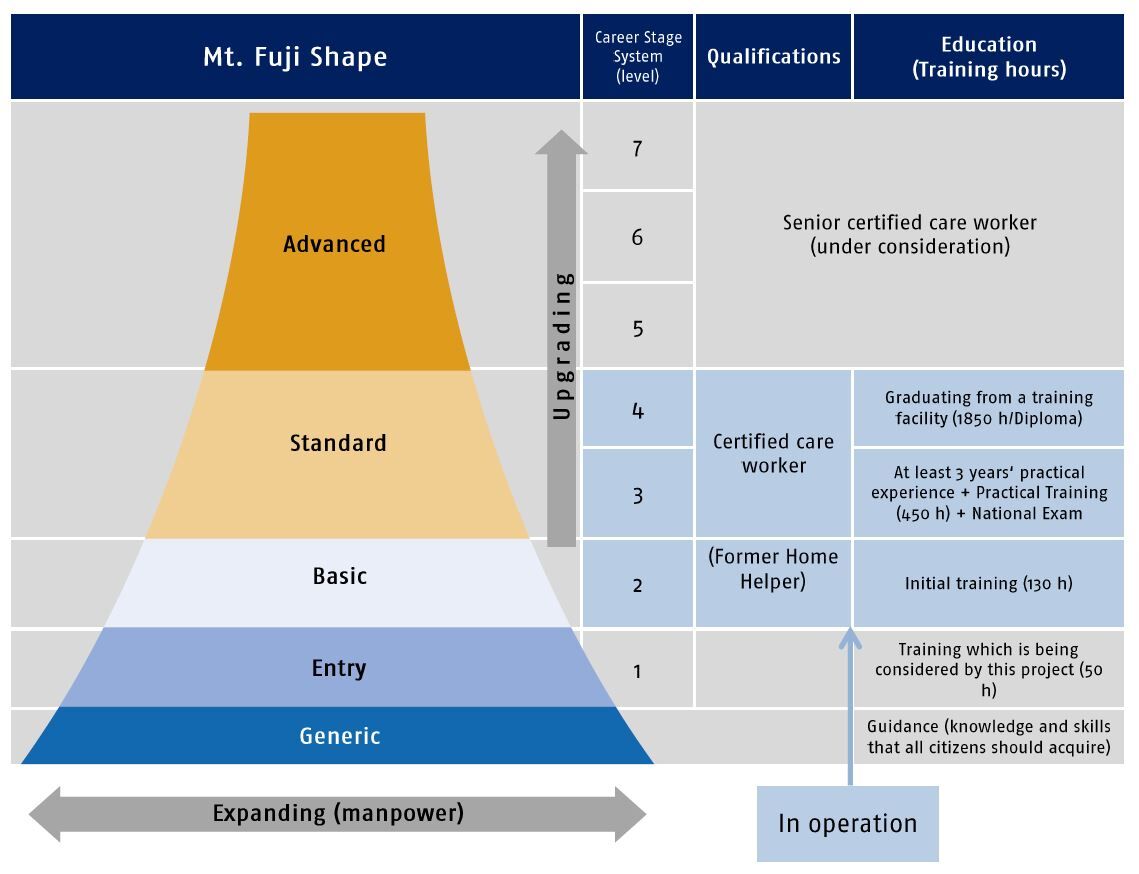
The “Mt. Fuji shape” is a care education and training system that reflects the policy of Japan, in which clarification and sophistication of specialities are mandatory. It is based on national policy. The entry level for people who intend to work as a care worker and the advanced level for people who have highly professional expertise still have to be developed, but the programme of entry level will be worked out this year by publishing a pilot textbook (cf. KOBAYASHI 2016). In the future, we will seek to define the differences in vocational abilities at each level by clarifying the learning and career path from basic to advanced levels.
Future Tasks
Further education is an issue to be discussed. Various further education programmes including training for practical instructors, geriatric medicine, geriatric psychiatry, palliative care, expert assessment of care requirements and facilities management are on offer, but discussions on standardisation have only just begun in Japan, as well as in Germany. Through further education, both “upgrading” knowledge and skills in the vertical direction and “specialisation (creating specialist fields)” in the horizontal direction are being explored in the MEXT-commissioned project by Kyushu University and Keishin Gakuen (cf. YOSHIMOTO 2016).
Japan’s population ageing, which is heading a global trend, has led to advanced initiatives in areas such as aged care insurance and the cultivation of human resources. By way of contrast, it has not yet developed an appropriate framework that guarantees quality in accordance with global standards. While “certified care worker” is a relatively new healthcare-related occupation in Japan and approaches for developing it as a specialist occupation are still being investigated, the higher the level of care required, the more medical elements there are involved, and the greater the tendency for conflict with bordering healthcare occupations will be. Even in other advanced countries with highly standardised qualification systems, there are different positioning of care workers. The contrast between Germany and Australia is particularly great, and the MEXT project makes reference to both of these countries. To secure the position of care workers in Japan, different levels of care related qualifications in National Qualifications Frameworks in reference countries need to be carefully compared, especially in terms of knowledge, skills and competencies.
Literature
JAPAN INSTITUTE FOR LABOUR POLICY AND TRAINING: The current state and challenges of the structure of care worker supply and demand: Toward enriching the system for care provision and securing a supply of caregivers (Research report No. 168). 2014 – URL: www.jil.go.jp/english/reports/jilpt_01.html (retrieved: 30.11.2016)
KOBAYASH, MITSUTOSHI (ed.): MEXT project report FY 2015: Project for module-style development of a regional care worker training programme of international standard. 2016
MINISTRY OF ECONOMY, TRADE AND INDUSTRY (METI): Report of the research council on providing care services suited to future care demands. 2016
MINISTRY OF HEALTH, LABOUR AND WELFARE: Regarding estimates (final estimates) of supply and demand for care workers toward 2025. 2015a
MINISTRY OF HEALTH, LABOUR AND WELFARE: Comprehensive/systematic promotion of securing care workers: From the dome shape to the “Mt. Fuji shape”. 2015b
YOSHIMOTO, K. (ed.): MEXT project report FY 2015, vol. 13: Global consortium for the development of core specialist human resources. 2016
KEIICHI YOSHIMOTO
Prof. Dr., Distinguished Professor, Kyushu University, Fukuoka, Japan
KATSUHIKO KIKUCHI
Deputy Director, Keishin Gakuen Educational Group, Tokyo, Japan
CHISAKO ETO
Dr., Associate Professor, Kurume University, Fukuoka, Japan
German translation published in: BWP 1/2017