Increasing shortage of nursing and healthcare staff
Caroline Neuber-Pohl
Demand for nursing and healthcare services is expected to grow in the wake of demographic developments in Germany. Securing a supply of skilled workers in this area is associated with considerable challenges. The BIBB/IAB qualifications and occupational field projections show how supply and demand in these occupations may develop in the long term.
Database
The BIBB/IAB qualifications and occupational field projections (QuBe Project, cf. information box) illustrate the future risk of a bottleneck of skilled workers in the 50 BIBB occupational fields (cf. TIEMANN 2016) under the assumption that there is a continuation of the trends currently observable in educational, employment and change of occupation behaviour amongst the population and of the attitude towards recruitment adopted by employers. The occupational field “nursing and healthcare occupations not requiring a medical practice licence” encompasses all professions in healthcare provision except doctors and dispensing chemists. According to the 2012 Microcensus, registered general nurses and geriatric nurses made up just under 55 per cent of persons working within this field, the largest employee group. Medical assistants, occupations in non-medical treatments and alternative medicine, and technical medical and pharmaceutical occupations accounted for further large proportions of workers in this field.
Database of the QuBe Project
The fourth projection wave of the BIBB-IAB qualifications and occupational field projections (QuBe Project), which were conducted in conjunction with the Gesellschaft für Wirtschaftliche Strukturforschung (GWS) [Institute of Economic Structural Research] and the Fraunhofer Institut für Angewandte Informationstechnik (FIT) [Fraunhofer Institute for Applied Information Technology], use model calculations as a basis for showing how the supply of and demand for qualifications and occupations may develop on a long-term basis whilst taking wage adjustments and changes of occupation into account (cf. MAIER et al. 2016; www.qube-projekt.de). The database for the investigation is provided by the Microcensus (in the present projection up to the year 2013), by the input-output tables of the National Accounts produced by the Statistisches Bundesamt [Federal Statistical Office] and by wage information from IAB Employment Histories relating to workers subject to mandatory social insurance contributions (in the present projection up to 2013).
Long-term development of nursing and healthcare professions
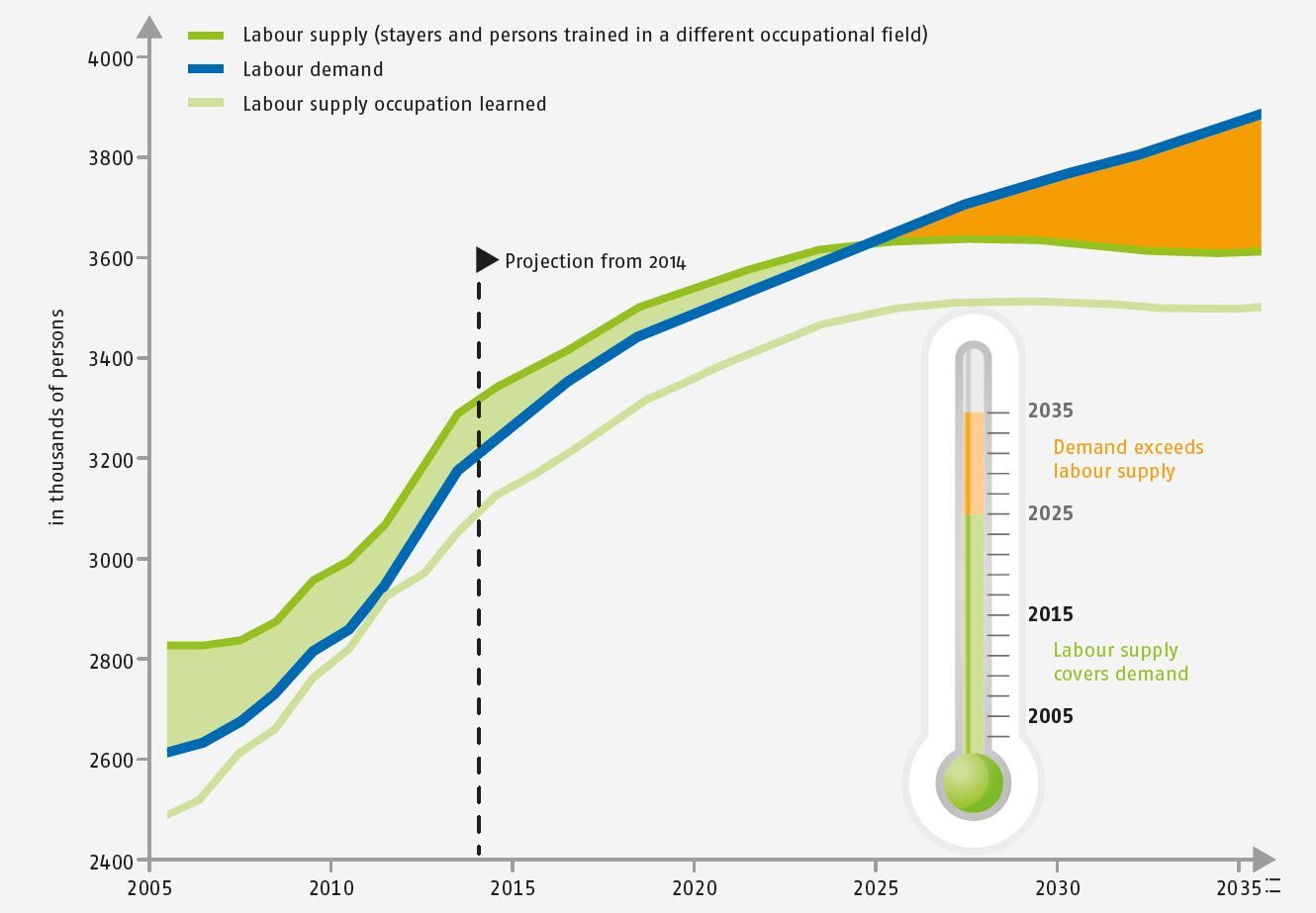
Development and projection of labour supply and demand in the occupational field of “nursing and healthcare occupations not requiring a medical practice licence”
As illustrated by the figure, the labour supply of persons trained in occupations not requiring a medical practice licence was not even sufficient to cover demand in the past. This is by no means unusual. In most occupational fields, demand can only be met by persons who have completed training in a different profession or who are not in possession of any vocational qualification at all. However, because of the high degree of regulation that applies to work entitlement in the field of nursing in particular, the number of persons from other occupational fields available to the nursing and healthcare professions is relatively low. Nevertheless, their deployment has secured an adequate supply of workers up until now, although regional and occupation-specific shortages cannot be ruled out. Notwithstanding this, the projection reveals that a national shortage of workers could occur as early as the year 2025. By 2035, the shortfall would be as many as approximately 270,000 employees. This shortage could not even be resolved by longer working times because capacities based on numbers of hours would also be exhausted.
What could influence this development?
The projection contains two main compensatory mechanisms which also exert an influence on this development to a certain degree. These are wage development and the occupational mobility of the labour supply. One of the crucial factors for persons who have completed training in a certain occupation is how wages develop in their own occupational field compared to other areas of employment that are possible to enter with the qualification. Under current price-setting conditions, wages for nursing and healthcare staff working in occupations not requiring a medical practice licence will rise less than the reference wage for this group by the year 2035. This increases incentives to leave the occupational field. At the same time, the proportion of persons remaining within the occupation in which they have trained, the so-called stayer rate, will also fall.
Members of the labour supply who have completed training in a nursing or healthcare profession are less likely to change jobs compared to other occupational fields. In 2013, the stayer rate was 74.4 per cent. This is comparatively high in light of an average stayer rate of about 46.7 per cent. The only fields in which the stayer rate was higher were security occupations (79.3 %), healthcare professions requiring a medical practice licence (83.8 %), and social occupations (76 %). The projection shows that the stayer rate in nursing and healthcare professions will fall by about four percentage points by 2035 because of wage development. This will reduce the supply of qualified skilled workers and must be viewed as critical given the limited chances for many of these professions to be accessed by staff from outside the specialist area. Nevertheless, the stayer rate will remain at the very high level of 70 per cent. This shows both the effectiveness of measures to retain existing personnel and that it is particularly worthwhile to promote training in this area. The fact is that most persons completing training would remain within the occupational field.
Strengthening training endeavours
If the current trends continue, a nationwide shortage in nursing and healthcare occupations not requiring a medical practice licence may occur as early as 2025. Because of the comparatively weak wage development in this occupational field and in light of the constant increase in demand for nursing and healthcare services, the projection shows that the requirement for skilled workers will exceed supply by approximately 270,000 persons in the year 2035. Because persons who complete training in a nursing or healthcare profession not requiring a medical practice licence are highly loyal to their occupational field, greater investment should especially be made in training in this field. Ultimately, remuneration plays a major role in structuring the occupational field in an attractive way. However, other important influencing factors for securing a supply of skilled staff include an improvement in working conditions and in opportunities for advancement.
Literature
MAIER, T. u.a.: Die Bevölkerung wächst – Engpässe bei fachlichen Tätigkeiten bleiben aber dennoch bestehen [Despite a growing population, shortages remain in the area of skilled tasks] (BIBB-Report 3/2016). Bonn 2016 – URL: www.bibb.de/veroeffentlichungen/de/publication/show/id/8147 (retrieved: 17.11.2016)
TIEMANN, M.: Die BIBB-Berufsfelder in der Klassifikation der Berufe 2010 [The BIBB occupational fields in the 2010 Classification of Occupations]. In: Forschungsdatenzentrum der Rentenversicherung [Pension Insurance Research Data Centre] (Ed.): Berufsangaben [Occupational information]. Berlin 2016 (awaiting publication)
CAROLINE NEUBER-POHL
Research associate in the “Qualifications, Occupational Integration and Employment” Division at BIBB
Translation from the German original (published in BWP 1/2017): Martin Stuart Kelsey, Global Sprach Team, Berlin