Matching problems on the training market – developments in the year 2015
Bettina Milde, Stephanie Matthes
The training market situation has been characterised by two seemingly contradictory developments for a number of years. On the one hand, companies are experiencing increasing difficulties in filling the training places they offer. On the other hand, there are still too many young people who are unsuccessful in their search for a training place. It is clear that the fit between company supply and demand from young people is becoming ever worse. The present article describes developments in 2015 on the basis of central training market data.
Overall training situation in 2015
In accordance with § 86 of the Vocational Training Act (BBiG), the overall training market situation is calculated on the basis of developments in supply and demand (cf. information box).
Supply and demand
Supply is computed from the number of newly concluded training contracts as identified within the scope of the BIBB survey as of 30 September and the unfilled vocational education and training places registered with the Federal Employment Agency (BA) [Bundesagentur für Arbeit]. A differentiation can be drawn between company-based provision, i.e. training which is not (predominantly) publicly financed, and so-called “extra-company” training, meaning provision which is (predominantly) publicly financed.
Demand is expressed in this case in terms of its extended definition as the total of newly concluded training contracts as of 30 September (BIBB survey) plus the number of applicants registered with the BA who are still searching for a training place at the end of the placement year. Alongside unplaced applicants who have not found any alternative provision, this figure also includes those who have commenced an alternative measure (such as a vocational preparation scheme or an internship) but who are still seeking a training place and wish to receive a placement via the BA.
The extended supply-demand ratio states the number of places available for each 100 persons wishing to enter training. It may relate either to overall provision or solely to company-based training.
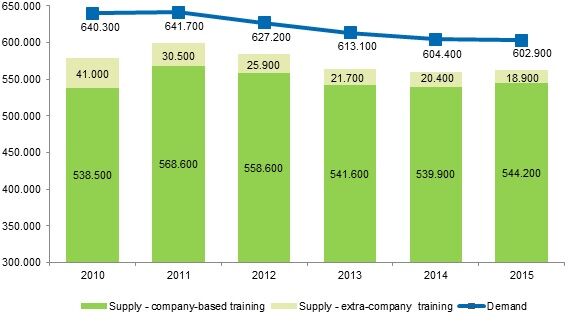
In 2015, following a fall in training supply in previous years, supply rose slightly once again for the first time since 2011 to reach 563,000. This represents an increase of around 2,800 training places (+0.5 %) compared to 2014. This rise is solely due to an increased supply of company-based training places (cf. Figure 1), something which was recorded in both West and East Germany.
Despite the fact that numbers of school leavers are falling nationally, demand for training places was virtually at the same level as in the previous year. According to the extended definition, demand in 2015 was 602,900. This constitutes a decrease of 1,500 persons (-0.2 %) compared to the previous year.
Whereas demand in West Germany fell slightly (-0.3 %), East Germany saw an increase (+0.6 %). This development needs to be viewed in connection with the numbers of school leavers in East Germany, a figure which is once again rising slightly (for more detailed information, cf. MATTHES et al. 2016; BMBF 2016).
As a result of the increase in supply accompanied by a level of demand that remained almost constant, in arithmetical terms 93.4 places were available per 100 persons seeking to enter training (+0.7 compared to the previous year). The corresponding figure for company-based provision was 90.3 (+1.0).
Although the ratio between supply and demand improved in 2015, the additional provision did not lead to more newly concluded training contracts. According to the results of the BIBB survey as of 30 September, a total of 522,100 new training contracts were concluded nationwide. The number of newly concluded contracts was thus below the figure for the previous year (-1,100 or -0.2 %), albeit slightly. How can this be explained?
In the case of the above indicator, consideration needs to be accorded to the fact that the calculations on the supply side are also informed by the unfilled training places and the demand side takes account of applicants who are still seeking a training place. The representation thus also encompasses places and applicants which were (registered as being) unsuccessful, i.e. in respect of which no “match” was found.
In order to record developments on the training market in full, it is thus essential to consider not only the supply-demand ratio but also proportions of unsuccessful market participants.
Figure 1: Training place supply and demand 2010 to 2015
Matching problems are increasing
Although more training places were offered in 2015 than in the previous year, significantly more training places remained unfilled. With a total of 41,000 such vacancies (+3,900 or +10.4 %), a new peak was registered by the BA (since 1996). Company surveys show that recruitment of trainees is becoming increasing difficult (MOHR et al. 2015).
But also on the demand side, many market participants were unsuccessful in 2015. As of 30 September 2015, 20,700 unplaced applicants who had progressed neither to training nor to alternative provision were registered with employment agencies and Job Centres nationally. In addition to this, 60,100 applicants had commenced an alternative to training (such as a vocational preparation scheme, internship or introductory training etc.) but irrespective of this were continuing their search for a training place and still wished to obtain a placement via an employment agency or Job Centre. This means that the number of unplaced applicants and the number of those who have entered alternative provision have fallen slightly compared to the previous year (-0.8 % and -0.4 % respectively). Nevertheless, as of the cut-off date of 30 September, there were still 80,800 unsuccessful applicants as opposed to 41,000 vacant training places. There are clearly difficulties in bringing together company supply and demand from young people.
Depending on the proportion of unfilled training places and of applicants still seeking a training place, a differentiation can fundamentally be drawn between three types of problems on the training market. These are termed integration problems, recruitment problems and matching problems. If the proportion of training places unsuccessfully offered is relatively high whilst the ratio of unsuccessful applicants remains low, a recruitment problem exists. A integration problem exists if many young people are unsuccessful in their applications but only a small number of training places are unfilled. Matching problems occur if company recruitment problems coincide with integration problems on the part of the young people.
In 2015, the different types of problem on the training market developed in the following manner:
- Recruitment problems on the labour market are increasing: The number of unfilled places as a proportion of total company-based provision has continuously risen over recent years (2013: 6.2 %, 2014: 6.9 %, 2015: 7.5 %). This has occurred both in West Germany (2013: 5.9 %, 2014: 6.5 %, 2015: 7.1 %) and in East Germany (2013: 8.5 %, 2014: 9.0 %, 2015: 9.9 %).1
- Integration problems are virtually unchanged: The proportion of applicants still seeking a training place has scarcely altered. Although there were small decreases nationally (2013: 13.6 %, 2014: 13.4 %, 2015: 13.4 %) and in West Germany (2013: 13.9 %, 2014: 13.7%, 2015: 13.6%), East Germany once again saw a small rise (2013: 11.5 %, 2014: 11.2 %, 2015: 11. 9 %).
- Matching problems are rising as a consequence of increasing recruitment problems: Because recruitment problems exacerbated in 2015 whilst integration problems remained virtually unchanged, matching problems have been rising recently.
Considerable differences by occupations
One main reason for the increasing matching problems on the training market is the fact that supply and demand are more poorly aligned at occupational level. The Table illustrates that certain occupations (in areas such as the hotel and restaurant sector, craft trade occupations in the food industry and the cleaning sector) suffer from recruitment problems whilst not having any major integration problems. By way of contrast, other occupations (such as in media and in the commercial sector) primarily have to contend with integration problems and do not show any significant recruitment problems. Across the country as a whole, these two phenomena add up to relatively high numbers of unfilled places and of applicants who are still searching.
Table: Occupations with particularly large recruitment or integration problems (figures in percent)

Significant regional differences
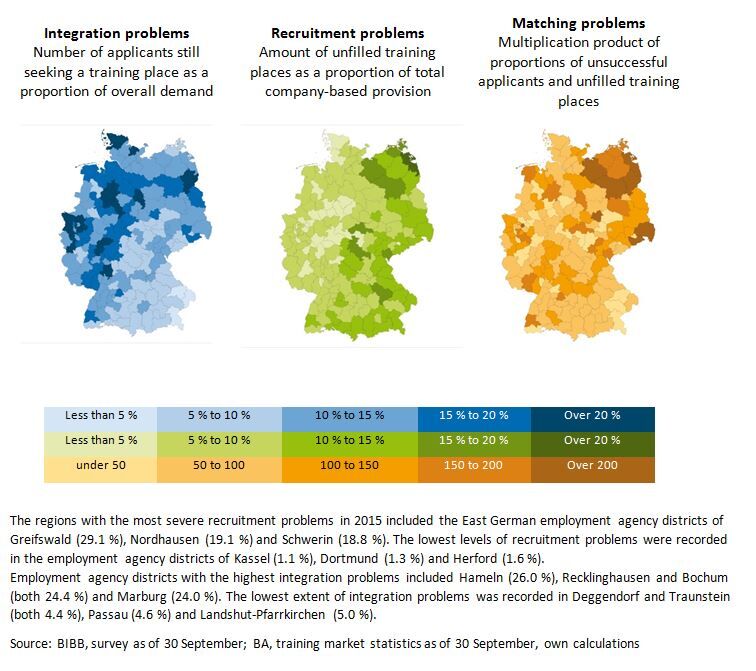
Alongside the occupational disparities, regional differences also play a role in explaining matching problems.2 Figure 2 shows the considerable regional disparities which exist in some cases in the extent of recruitment, integration and matching problems by employment agency districts. In overall terms, the number of unfilled places as a proportion of total company-based provision in 2015 varied between 1.1 percent and 29.1 percent. The amount of applicants still searching for a training place as a proportion of total demand ranged from 4.4 percent to 26.0 percent.
In a similar way to the situation at occupational level, the employment agency districts frequently have either recruitment problems or integration problems. For example, in large parts of Bavaria in 2015, relatively high proportions of training places remained unfilled whilst the proportion of applicants still seeking a training place was relatively low (e.g. in Regensburg, where the number of unfilled places as a proportion of total company-based provision was 17.4 percent and the amount of applicants still searching for a training place as a proportion of total demand stood at 5.1 percent). By way of contrast, the problem situation was precisely the opposite in other regions. In Recklinghausen in North Rhine-Westphalia, for instance, the proportion of vacant places was only 2.0 percent whereas 24.4 percent of applicants were unsuccessful in their search. In national terms, these two phenomena also ultimately mean relatively high numbers of vacant training places and of applicants who are still searching.
At the same time, Figure 2 makes it clear that, in some regions of Germany, many market participants were unsuccessful both on the supply and on the demand side and that matching problems occurred accordingly, even within a single employment agency district. In 2015, this was for example the case in Greifswald, which had both high recruitment problems (29.1 %) and a relatively large proportion of unsuccessful applicants (14.7 %). Greifswald also recorded a score of 427.2 with regard to the indicator of matching problems, which is calculated by multiplying the proportions of unsuccessful participants on both sides of the training market (cf. information box), the highest level in Germany.
Indicator for the calculation of matching problems
The matching indicator is arrived at by multiplying the proportion of training places which have remained vacant expressed as a percentage of overall company-based provision by the proportion of applicants still seeking a training place as a percentage of total demand (extended definition). In arithmetical terms, the range of values thus varies between 0 % x 0 % = 0 (no matching problems, no registered training places remain unfilled and no applicant is still seeking a training place at the end of the year) and the mathematically feasible but practically impossible value of 100 % x 100 % = 10,000 (all registered training places remain vacant and every single applicant is continuing to search for a training place at the end of the reporting year). This multiplicative link ensures that the indicator does not show any matching problems if there are severe recruitment problems but no integration problems (in the most extreme case 100 % x 0 % = 0) and, by the same token, if there are no recruitment problems but integration problems are severe (in the most extreme case 0 % x 100 % = 0) (cf. MATTHES et al. 2016.)
Major matching problems also ensued in Neuruppin (249.0) and in Eberswalde (242.2). Comparatively slight matching problems were revealed in the employment agency districts of Kassel (18.4), Dortmund (23.0) and Mannheim (25.4).
The rise in recruitment problems compared to the previous year is also reflected in the fact that, in 2015, 100 (65 %) of the total of 1543 employment agency districts experienced a year-on-year increase in the number of unfilled places as a proportion of overall company-based provision. Only 54 employment agency districts (35 %) saw a fall in this figure compared to the year before. In regional terms, the development with regard to integration problems is more favourable. Just under half of employment agency districts (74 of 154 or 48 %) experienced a fall in the proportion of unsuccessful applicants compared to the previous year. Matching problems increased in 97 (63 %) of the 154 employment agency districts and fell in 57 districts (37%).
Figure 2: Regional disparities on the training market in 2015
Identifying strategies for the avoidance of matching problems
Although the theme of “matching problems” has formed an object of the current debate surrounding the training market situation for a number of years and various measures for their prevention have been realised, this is a topic which will remain one of the major challenges over the coming years. Work needs to take place in conjunction with all stakeholders with responsibility for vocational training to develop effective strategies in order to bring supply and demand together in a better manner in future. Otherwise, the danger is that unsuccessful companies or young people will withdraw from the training market.
The various training reporting indicators provide a good way of showing where the problems lie, both regionally and in which occupations. Investigations into the causes of the problem (both on the company side and with regard to the young people) and successful measures already initiated are, however, further objects of interest. This is the only route via which effective approaches can be identified and made utilisable.
Literature
BMBF: Berufsbildungsbericht 2016 [Report on Vocational Education and Training 2016]. Bonn, Berlin 2016
MATTHES, S.; ULRICH J. G.: Wachsende Passungsprobleme auf dem Ausbildungsmarkt [Growing matching problems on the training market]. In: BWP 43 (2014) 1, pp. 5-7 – URL: www.bibb.de/veroeffentlichungen/de/bwp/show/id/7191 (retrieved: 13.06.2016)
MATTHES, S. et al.: Mehr Ausbildungsangebote, stabile Nachfrage, aber wachsende Passungsprobleme. Die Entwicklung des Ausbildungsmarktes im Jahr 2015 [More training provision, stable demand, but growing matching problems. The development of the training market in the year 2015]. Bonn 2016 – URL: https://www.bibb.de/dokumente/pdf/a21_beitrag_naa-2015.pdf (retrieved: 13.06.2016)
MOHR, S.; TROLTSCH, K.; GERHARDS, C. : Rückzug von Betrieben aus der betrieblichen Ausbildung: Gründe und Muster [Declining company participation in apprenticeship training: Reasons and patterns]. BIBB Report 4/2015 – URL: https://www.bibb.de/veroeffentlichungen/en/publication/show/id/7883 (retrieved: 13.06.2016)
BETTINA MILDE
Head of the “Vocational Training Supply and Demand/Training Participation” Division at BIBB
STEPHANIE MATTHES
Research Associate in the “Vocational Training Supply and Demand/Training Participation” Division at BIBB
Translation from the German original (published in BWP 4/2016): Martin Kelsey, Global Sprach Team, Berlin
-
1
Consideration needs to be given to the fact that these calculations are by definition only informed by unfilled training places and applicants still searching that were registered with the BA. Using the services of the BA is voluntary. Not all young people register with the BA as applicants, and not all companies report their vacant training places to the agency. Therefore, company surveys on vacant training places, for example, show higher proportions.
-
2
As well as occupational and regional disparities, qualification-specific differences are also ultimately relevant to the explanation of increasing matching problems. The former, however, cannot be investigated in greater detail within the scope of the BIBB survey as of 30 September.
-
3
Employment agency districts within Berlin are combined to form a single district.