Higher education doubters and their view of vocational education and training
Results of a student survey
Barbara Hemkes, Kim-Maureen Wiesner
This article deals with the issue of the direction of orientation of higher education students who express doubts that they will successfully complete their current course of study. One particular focus of interest is their perception of dual vocational education and training (VET) as a possible alternative to higher education study. The basis for the analysis is provided by the results of a student survey into the attractiveness of VET conducted by BIBB in conjunction with the Department of Labour Economics at the University of Maastricht.
Higher education doubters and their view of company-based education and training
According to the calculations of the Deutsches Zentrum für Hochschul- und Wissenschaftsforschung (DZHW) [German Centre for Higher Education Research and Science Studies], 28 out of 100 students starting a Bachelor’s programme will abandon their studies (cf. HEUBLEIN et al. 2014, p. 3). The reasons cited for this decision are varied and include performance issues, lack of motivation to study, financial hardship and even the desire to change course (cf. HEUBLEIN et al. 2010, p. 17 ff.). The results of the DZHW study on these causes suggest that the decision to leave a degree course is rarely spontaneous, as it takes a great deal of consideration in the vast majority of cases. But where do students turn once they embark on this process? How important is company-based education and training for the further development of their educational and professional careers, and what supportive measures are relied upon – or wanted – for this kind of reorientation?
Student survey into the attractiveness of VET
In order to answer these questions, the BIBB conducted a representative student survey in September 2015 in cooperation with the Department of Labour Economics at Maastricht University. This survey involved around 12,000 students at German universities and looked at the attractiveness of VET. Using a comprehensive online questionnaire, students were asked to answer questions on the perception and attractiveness of initial and continuing company-based education and training in terms of their own educational pathways (cf. info box).
Survey design
- The online survey was incorporated into the seventh round of questionnaires in the biannual “Fachkraft 2020” study series at Maastricht University. First published in September 2012, this series looks at the life situation of students in Germany from both a general and economic perspective.
- The data was gathered by means of a questionnaire developed by the Department of Labour Economics at Maastricht University in cooperation with the BIBB. Questions covered topics such as the general perception of (dual) vocational training, the attractiveness of (dual) vocational training for individual educational pathways, contact with – or awareness of – vocational training, and the role of information and guidance services. All of the questions referred exclusively to initial and advanced training in the dual system; full-time education and other educational pathways were not taken into consideration.
- All 420,147 people registered with internet site Jobmensa.de at the time of the survey were asked to take part, with 20,621 agreeing to go ahead. Invalid questionnaires, including those completed by schoolchildren or university graduates, were filtered out of the results, leaving a total sample size of n = 12,143 people. In addition to current students, this number also includes those who had either dropped out or taken a break from their studies. As these latter categories constitute just two per cent of the overall sample, the evaluation of the results focuses on the group of current students, leaving an analysis sample size of 11,894 students.
- The representativeness of the sample is ensured by means of a comparison with the 20th social survey conducted by the Deutsche Studentenwerk (DSW) [German National Association for Student Affairs], and census data from the Statistisches Bundesamt [Federal Statistical Office].
- The survey was carried out between 7 and 21 September 2015.
In reference to the current educational debate (cf. EULER/SEVERING 2014, p. 26 ff.) it also looks at whether permeability-enhancing measures, such as the recognition of prior educational achievements, can actually encourage young people to continue their educational pathway in the VET system. To this end, respondents were asked to estimate which specific propositions would make the transition to VET more attractive to them
Almost one in three students has doubts that they will successfully complete their course of study
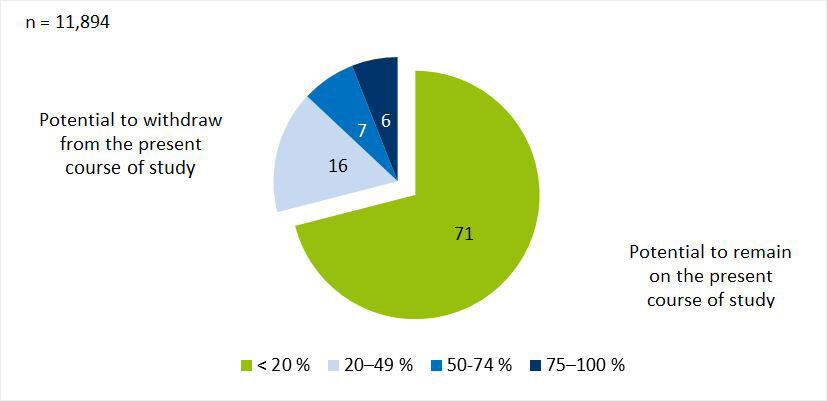
On a scale of 0 to 100 per cent, students were asked to estimate how likely they were to leave their present course of study without graduating. Seven out of ten respondents indicated that the likelihood of them dropping out was rather low at less than 20 per cent. One in six, however, suggested that the likelihood of them ending their studies early was between 20 and 50 per cent, while one in eight revealed a probability of over 50 per cent (cf. Figure 1). In total, 29 per cent of those who took the survey can be classified as being doubtful about their studies or a potential drop-out.
Transition into the employment system is more attractive than company-based education and training
For students choosing to leave their current course of study early, a number of different options are available to them. The most obvious of these include changing course, starting initial and continuing VET, or even going straight into a full-time or part-time position (cf. HEUBLEIN/SPANGENBERG/SOMMER 2003, p. 123).
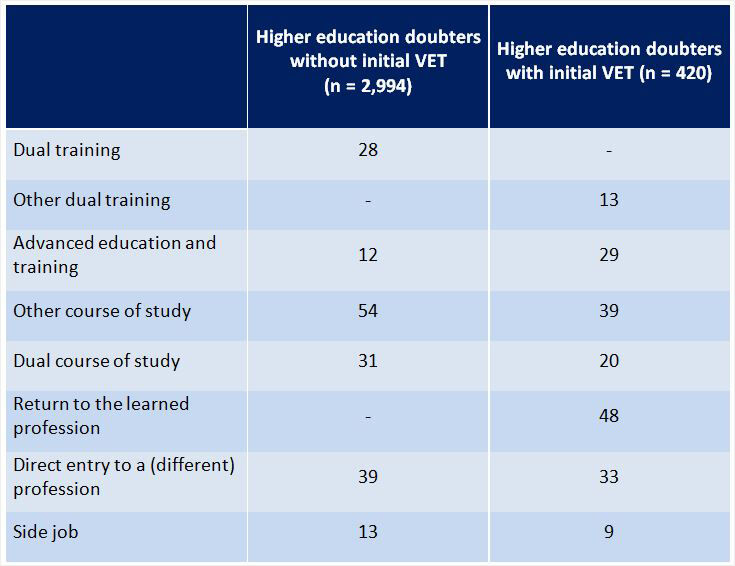
Higher education doubters (n = 3,414) were asked which alternative educational pathways would appeal to them if they were to leave their current course of study early. Around half of these feel that there are many other options available instead of continuing with their studies.
This reveals that training provisions with company-based elements are viewed as a viable alternative to their current course of study. For higher education doubters who have not completed their initial VET, company-based education and training and the dual course of study are considered potential options at around 30 per cent each. The same value also applies to advanced vocational training among higher education doubters who have completed their initial VET. Nevertheless, the option of dual VET remains significantly less likely than a direct transition into the employment system without VET qualifications, which 39 per cent of higher education doubters are considering (cf. Table).
Company-based orientation placements and recognition of academic performance make VET more attractive
More than two thirds of higher education doubters without initial VET cannot envisage themselves starting company-based education and training after deciding to leave their degree course; however, from a VET perspective, this same group is a particularly interesting target category when it comes to taking on those quitting their studies.
For this reason, this group (n = 2,143) was asked which supporting measures could persuade them to consider continuing their educational pathway in the dual system after all. 81 per cent of those asked indicated that recognition of their prior educational achievements in the final examination and the total duration of the training would make a difference. For seven out of ten higher education doubters, an orientation placement within the company they will potentially be training with offers an excellent opportunity to make the transition to the dual training programme.
Discussions surrounding the integration of potential drop-outs into the dual VET system repeatedly revolve around the issue that vocational education could represent a stumbling block. The results of the investigation, however, suggest that it is irrelevant whether the vocational education is designed to suit the specific target group, or higher education doubters are exempt from attending classes entirely. Not even half of the higher education doubters considered this a key factor in deciding to make the transition. The individual preferences of the doubters are apparent – for example, for classes with a homogeneous rather than heterogeneous educational background; however, these aspects are not definitive when it comes to deciding to switch to the dual VET system.
This is also evident when students have to decide between specific training profiles. These profiles comprised ten core criteria, including occupational field, training duration, company size, and chances of being offered a job on successful completion of the training, all of which were organised differently. The evaluation revealed that the vocational training criterion had no impact whatsoever on the selection of the best possible training profile. This is not the case, however, when evaluating a reduction in the duration of the training programme by recognising previous academic performance. The effect here, in fact, is clear: the shorter the training programme, the more likely students are to select that particular profile, regardless of the training sector or allowance. The reduction is, however, limited, and the effect is lost entirely in the case of training programmes lasting less than 18 months.
Guidance services are widely known but rarely used
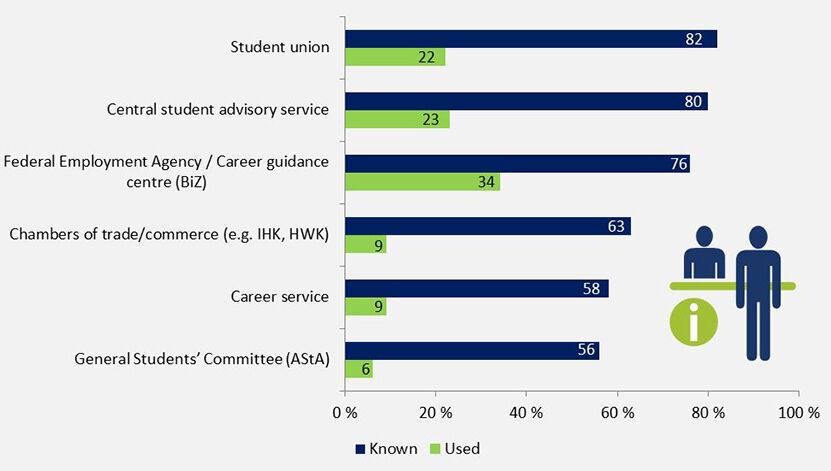
The survey also includes information on the type of information and guidance services available. 61 per cent of all higher education doubters indicate that they feel either quite-poorly or poorly informed about the options of transition to a dual training programme. Despite being entirely familiar with the existing information and guidance services, they hardly ever make use of them (cf. Figure 2). Studentenwerk [Student services] is the best-known resource for guidance (at 82 %), although it is only used by one in five higher education doubters. The guidance provided by the Bundesagentur für Arbeit (BA) [Federal Employment Agency] and associated Berufsinformationszentren (BiZ) [career guidance centres] is sought out most frequently (34 %), and three quarters of doubters know it exists. Although at least 63 per cent of doubters know that the various chambers have information and guidance to offer, only nine per cent of those surveyed actually take advantage of this service. Demand for guidance from these chambers does, however, increase slightly in line with the probability of dropping out (demand of barely 8 % at a probability of 20 – 49 % compared to a demand of 11 % at a probability of over 75%).
Promoting access to practical experience and appreciation through targeted guidance
Even when students have considerable doubts about successfully completing their current course of study, VET only plays a secondary role as a possible alternative in their ongoing educational career. Most of these want to remain at university and start afresh on a new course. Even going straight into working life without a vocational qualification is a significantly more attractive option for doubters than a dual training programme. In light of the somewhat sobering findings of the student survey, the question arises as to whether – and, if so, which – efforts can be made to attract those dropping out of university towards VET, particularly as this will then probably be focused on a few occupations that are already in high demand, and there is virtually no expectation of this eliminating shortages in the education and training market (cf. EBBINGHAUS et al. 2014, p. 11).
At the same time, the results of the survey provide clear starting points for determining which VET options would be the most logical to encourage more doubters to pursue vocational educational careers. In this regard, two essential aspects have been established: On the one hand, the options to offset skills acquired at university against the dual training programme should be strengthened. Students would then associate this with a notable reduction in the duration of the training period, which would have a significant impact on the decision for or against training options. Furthermore, the value of prior achievements is expressed by recognising them. VET offers formal options to reduce the duration of the training time; however, these are generalised courses of action and not specifically tailored to the skills acquired at university.
Allowing students to create an accurate picture of their potential training options is another contributing factor that appears to be equally important. With this in mind, it makes sense to offer taster sessions in company-based education and training for higher education doubters, for example, to provide them with the opportunity to learn more about the company they will potentially be training with. This serves to dispel any transitional stumbling blocks that may occur from the perspective of both the companies and the students.
These aspects that serve to promote transition should be taken into consideration in the form of guidance that is specifically tailored towards the clientele of the higher education doubters. In this respect, however, it is important to bear in mind that existing information and guidance services on VET for students who feel largely uninformed are familiar; however, they do not seem to play any part in the decision-making process. Notable reasons for this are likely to include poor correlation between supply and demand, and a lack of consideration for the target audience on the part of the guidance services. Similarly, information and guidance services should focus less on their quantitative structure and more on the development and interconnection between the needs and interests of higher education doubters in their reorientation phase.
Literature
EBBINGHAUS, M. et al.: Studienabbrecher für die duale Berufsausbildung gewinnen – Ergebnisse aus dem BIBB-Expertenmonitor Berufliche Bildung 2014 [Leaving degree courses in favour of dual VET – results from the BIBB VET 2014 expert monitor]. Bonn 2014 – URL: www.bibb.de/dokumente/pdf/Bericht_Expertenmonitor_2014.pdf (retrieved: 04.04.2016)
EULER, D.; SEVERING, E.: Durchlässigkeit zwischen beruflicher und akademischer Bildung: Hintergründe kennen. Initiative „Chance Ausbildung – jeder wird gebraucht!“ [Permeability between vocational and academic education and training: understanding backgrounds. The “Training opportunities – everyone plays their part!” initiative]. Updated version, January 2015 – URL: www.bertelsmann-stiftung.de/fileadmin/files/BSt/Publikationen/GrauePublikationen/LL_GP_HP_Durchlaessigkeit_150122_2_.pdf (retrieved: 04.04.2016)
HEUBLEIN, U. et al.: Ursachen des Studienabbruchs in Bachelor- und in herkömmlichen Studiengängen – Ergebnisse einer bundesweiten Befragung von Exmatrikulierten des Studienjahres 2007/08. [Reasons for dropping out of Bachelor’s programmes and other conventional courses of study – results of a nationwide survey of those who dropped out in 2007/08]. Hanover 2010 – URL: www.dzhw.eu/pdf/pub_fh/fh-201002.pdf (retrieved: 04.04.2016)
HEUBLEIN, U. et al.: Die Entwicklung der Studienabbruchquoten an den deutschen Hochschulen – Statistische Berechnungen auf der Basis des Absolventenjahrgangs 2012 [The development of drop-out rates in German universities – statistical calculations based on the class of 2012] (Forum Hochschule 4/2014). Hanover 2014 – URL: www.dzhw.eu/pdf/pub_fh/fh-201404.pdf (retrieved: 04.04.2016)
HEUBLEIN, U.; Spangenberg, H.; Sommer, D: Ursachen des Studienabbruchs [Reasons for dropping out]. Hanover 2003
BARBARA HEMKES
Head of the “Quality, sustainability and permeability” Division at BIBB
KIM-MAUREEN WIESNER
Research Associate in the “Quality, sustainability and permeability” Division at BIBB
Translation from the German original (published in BWP 3/2016): Martin Kelsey, Global SprachTeam, Berlin