Indicators-based vocational education and training reporting in Germany – the foundation for policy advice
Elisabeth M. Krekel, Bettina Milde
Evidence-based policy advice has increased in significance over recent years, and various foundations have been created for this purpose. Examples include international competence assessment studies such as TIMMS and PISA, and there have also been surveys in the form of PIAAC or the National Educational Panel Study (NEPS), which is used to investigate lifelong educational processes. In vocational education and training, evidence-based policy advice in the form of VET reporting has a tradition which goes back as far as the 1970s and is also firmly established in statutory terms. After a brief outlining of the basic principles and development of evidence-based policy advice, the article presents examples of two newer indicators that describe the training situation and goes on to explore the scope of these for indicators-based VET reporting.
The Report on Vocational Education and Training and the Data Report
The Report on Vocational Education and Training1 has been published annually since 1977. It provides information on main developments on the training market and on the further development of vocational education and training in overall terms. Its current statutory foundation is § 86 of the Vocational Training Act (BBiG, cf. information box).
§ 86 BBiG: Report on Vocational Education and Training
(1) The BMZ shall constantly track developments in vocational education and training and shall submit a corresponding report (Report on Vocational Education and Training) to the Federal Government by 1 April each year. The Report shall describe the current state and probable further development of vocational training. If there are indications that a regionally and sectorally balanced supply of initial training places may be at risk, the report shall include proposals for remedying such a situation.
(2) The Report shall specify
1. for the preceding calendar year
a) on the basis of the data furnished by the competent bodies, the initial training contracts entered in the register of initial training relationships pursuant to this Act or pursuant to the Crafts and Trade Regulation Code which were concluded during the twelve months prior to 1 October of the preceding year and were still in existence on 30 September of the preceding year, as well as
b) the number of initial training places offered to the BA for placement which were not filled on 30 September of the preceding year and the number of persons registered with the BA on that date as seeking initial training places;
2. for the current calendar year
a) the number of persons expected to be seeking initial training places up to 30 September of the current year,
b) an estimate of the number of initial training places expected to be on offer up to 30 September of the current year.
This states that the Bundesministerium für Bildung und Forschung (BMBF) [Federal Ministry of Education and Research] is required to submit the Report on Vocational Education and Training to the Cabinet by 1 April. Prior to this, the Report is agreed with the various departments and forms an object of consultation for the BIBB “Report on Vocational Education and Training” Sub-Committee and the BIBB Board.
In its capacity as an advisory body to the Federal Government in all fundamental issues relating to vocational education and training, the BIBB Board may “issue an Official Statement on the draft of the annual Report on Vocational Education and Training” pursuant to § 92 BBiG. The Board includes representatives of the employers, the employees, the federal states and the Federal Government, all of whom have equal voting rights. Both the Federal Government resolution on the adoption of the Report on Vocational Education and Training and the official statements of the social partners are published in the Report.
Since 2009, a Data Report to accompany the Report on Vocational Education and Training published by BIBB has also been released. This contains extensive information and analyses on the development of vocational education and training. This is the result of a recommendation adopted by the BIBB Board to the effect that “the Report on Vocational Education and Training should be separated into a political part to be consulted upon and adopted by the Federal Government and a non-political part for which BIBB will be responsible” (cf. BIBB Board 2007). Since this time, the Report on Vocational Education and Training has appeared in a streamlined form. It includes the main benchmarks, data and Information relating to the training market, gives details of current educational policy priorities and also provides information on measures and programmes in a national and international context.
The Data Report represents the main source of information and database. A systematic indicators-based vocational education and training reporting system has been established in order to create a better and more transparent foundation for evidence-based and therefore data-based policy advice. Aspects such as “long series” have been identified to enable developments in vocational education and training to be observed and updated. The focus is, however, also on reacting to change and to new facts and circumstances. For this purpose, it may be necessary to relinquish indicators or develop new indicators.
Main indicators for the training market
Since the first Report on Vocational Education and Training in 1977, information has been provided on an annual basis on the number of newly concluded training contracts and on the supply of and demand for training places in accordance with the core statutory remit pursuant to § 86 BBiG. Ratios between supply and demand are presented as indicators for evaluating the overall training situation. The foundations used are the BIBB survey of newly concluded training contracts as of 30 September and the Training Market Statistics produced by the Bundesagentur für Arbeit (BA) [Federal Employment Agency].
Because the indicator does not provide any information as to how many persons originally interested in entering training during the course of a year actually progress to training, the progression rate of those interested in training has been calculated since the 2012 Report on Vocational Education and Training.
The statutory task also only relates to all training occupations governed by the Vocational Training Act/Crafts and Trades Regulation Code, i.e. training courses which require the conclusion of a contract between a company and a trainee. This consideration is, however, not sufficient in itself for an interpretation of the current training situation. For this reason, the “Integrated Training Reporting System” was introduced in 2009.
Both these extensions will be considered in more detail below. Because data from the Integrated Training Reporting System is only available from 2005, the last ten years will be used as the period of observation.
PROGRESSION RATE OF THOSE INTERESTED IN TRAINING
The progression rate of those interested in training states the proportion of persons interested in training institutionally recorded who progress to vocational education and training in a reporting year. This involves relating the number of newly concluded training contracts as of 30 September to the total number of persons institutionally recorded as being interested in training (804,400 in 2015). This is calculated arithmetically by adding registered training place applicants who have not progressed to VET according to the statistics of the BA to the number of newly concluded training contracts (cf. ULRICH 2012).
Information on the progression rate of those interested in training has been included in the Data Report since 2011 and in the Report on Vocational Education and Training since 2012. It replaced the arithmetic progression rate, which compared newly concluded training contracts with school leavers and had been used up until this point. This further development became necessary in the light of double upper secondary leaver cohorts and a limited interest in the part of upper secondary school leavers in dual vocational education and training (cf. ULRICH 2012).
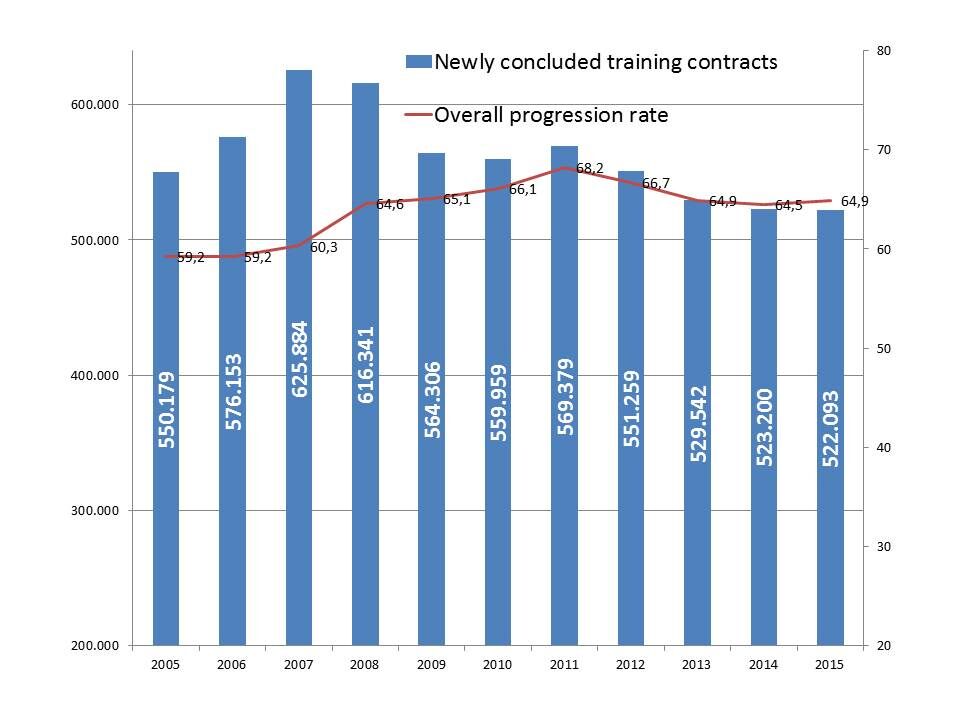
Figure 1 shows how many persons interested in training were able to conclude a training contract. Whereas the proportion of such persons was under 60 per cent in 2005, this has risen continuously over recent years to reach 68.2 per cent in 2011. It also becomes clear that, despite high numbers of contracts concluded in the years 2007 and 2008, fewer persons were able to progress to training than in years with lower numbers of contracts concluded. Not least as a consequence of demographic developments, the progression rate of those interested in training has grown once again in the last few years, although by less than expected due to increasing matching problems which have meant that there has been no discernible fall in the proportion of unsuccessful applicants. At a nationwide level in 2015, the progression rate of those interested in training reached a level of 64.9 per cent, 0.4 per centage points higher than in 2014.
The progression rate of those interested in training can be differentiated in accordance with various characteristics, such as gender as well as in line with different regional units (e.g. federal states, Employment Agency districts). Consideration, however, needs to be accorded to the fact that commute movements (i.e. non-concordance of district of residence and district of training) may distort the characteristic of the indicator. Another factor that needs to be taken into account is that young people interested in training also include applicants who have abandoned their wish for placement before the cut-off date of 30 September because, for example, they may have gone in a new direction and opted for a course of higher education study or other fully qualifying training.
Irrespective of this, however, the progression rate of those interested in training provides information on how successfully the training preferences of young people interested in training in the dual system have been served (cf. MATTHES et al. 2015). It is available in a timely manner for the respective current reporting year.
INTEGRATED TRAINING REPORTING SYSTEM
Demographic development and the trend for higher training are creating new challenges for the dual system. More and more young people are obtaining and making use of a higher education entrance qualification. As far as vocational education and training reporting is concerned, this means that it is not sufficient merely to consider the training situation in occupations governed by the Vocational Training Act/Crafts and Trades Regulation Code. There is a greater focus than ever before on observing the whole of the education and training system. The Integrated Training Reporting System funded by the BMBF makes it possible to undertake such a simultaneous consideration of training following general schooling (post lower secondary level). It differentiates the four sectors of “vocational education and training”, “integration into training” (transitional area), “acquisition of a higher education entrance qualification” and “higher education study” and links in with various official statistics (cf. DIONISIUS/ILLIGER/SCHIER 2015).
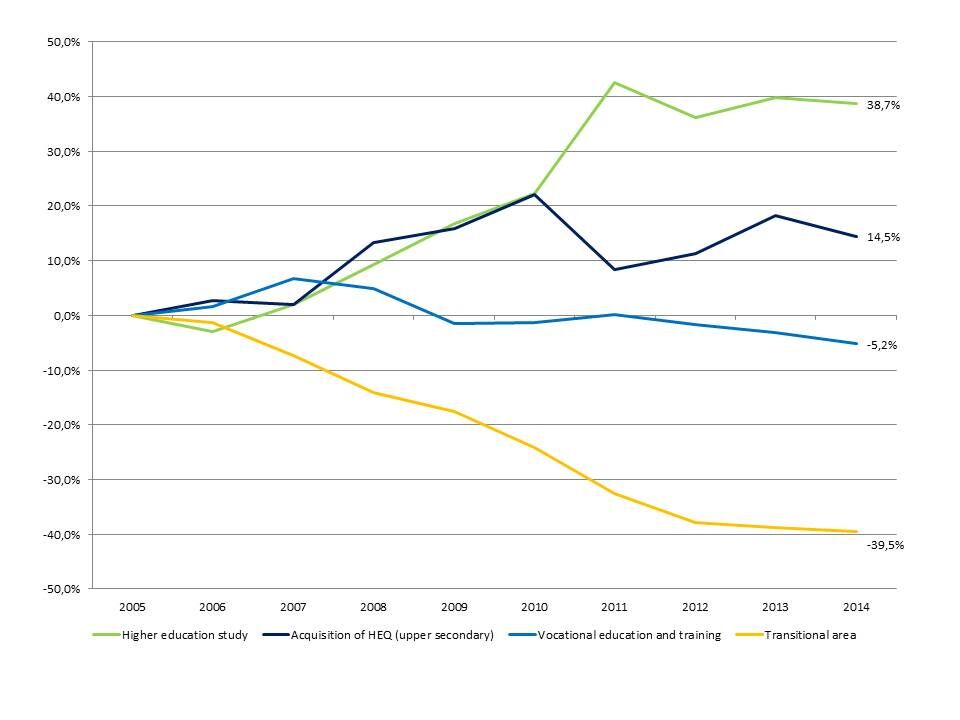
Figure 2 shows the increasing numbers of persons commencing higher education study since 2005. The numbers of those entering the transitional sector have also fallen significantly since 2005.
The Integrated Training Reporting System also makes it possible to undertake a more detailed consideration of development in the separate sectors, including differentiated by individual so-called learning accounts. For the sector of vocational education and training, which encompasses all education and training courses leading to a full vocational qualification, it is clear that the number of entrants has decreased by a total of 5.2 per cent since 2005. This does not, however, affect all learning accounts equally. Whereas the number of entrants in the healthcare, education and social occupations (including registered general nurse and geriatric nurse) has risen, there has been a significant fall since 2005 in other fully qualifying training courses, such as those offered at full-time vocational schools (cf. here also DIONISIUS/ILLIGER 2015).
Account needs to be taken of the fact that the Integrated Training Reporting System is based on different data sources (including the statistics for vocational schools produced by the Statistisches Bundesamt [Federal Statistical Office] and the funding statistics of the BA). Secondly, pupils at part-time vocational schools for dual vocational education and training pursuant to the Vocational Training Act/Crafts and Trades Regulation Code are also included. Although this is necessary for comparability at the system level, it can be an irritation with regard to the number of newly concluded training contracts. Nevertheless, this method of consideration integrates dual VET into the system analysis of all training and qualification pathways in a clear-cut manner.
The number of newly concluded training contracts is not the only aspect which is central to educational policy evaluation. Development of the overall system of vocational training including the transitional area and the higher education sector also needs to be considered. This is something which the Integrated Training Reporting System is able to ensure.
Vocational education and training reporting and policy advice
Evidence-based VET reporting is the central foundation for educational policy decision-making processes. It is directly addressed to parliament, which debates the current training situation on this basis every year. In addition, it is an important basis for further committees or advisory groups such as the “Alliance for Initial and Continuing Training”, which was agreed in 2014 to replace the “National Pact for Training and Young Skilled Workers in Germany” and now includes the involvement of the trade unions.
The separation between the Report on Vocational Education and Training and the Data Report has achieved a distinction between academic research and analysis and policy evaluation. Respective current developments on the training market are interpreted differently by the groups represented on the Board, something which may also be expressed in their official statements which are published together with the Report on Vocational Education and Training.
The indicators in the Data Report describe the latest situation and developments. This enables problems to be made visible and makes clear what action is needed. They cannot, however, also supply explanations. More detailed analyses are necessary for this purpose. BIBB addresses various of these topics in its research work. The BIBB Transitional Study (cf. EBERHARD et al. 2013), for example, analyses the amount of time spent in the transitional area and transitions to training whilst the Applicant Survey carried out by the BA and the BIBB looks at the career choice processes of training place applicants (cf. GRANATO et al. 2016).
-
1
Cf. www.bmbf.de/de/berufsbildungsbericht-1077.html (retrieved 10.02.2016).
-
2
Cf. www.bibb.de/datenreport/de/index.php (retrieved 10.02.2016).
Literature
BIBB Board: Empfehlung zu einer Neustrukturierung des Berufsbildungsberichts [Recommendation for restructuring of the Report on Vocational Education and Training]. Recommendation of 13.12.2007 – URL: www.bibb.de/dokumente/pdf/HA123.pdf (retrieved 10.02.2016).
DIONISIUS, R.; ILLIGER, A.: Mehr Anfänger/-innen im Studium als in Berufsausbildung? [More entrants to higher education study than to vocational education and training?] In: BWP 44 (2015) 4, pp. 43-45 – URL: www.bibb.de/veroeffentlichungen/de/publication/show/id/7689 (retrieved 10.02.2016).
DIONISIUS, R.; ILLIGER, A.; SCHIER, F.: Die integrierte Ausbildungsberichterstattung im Überblick [A summary of integrated training reporting]. In: BIBB (Ed.): Datenreport zum Berufsbildungsbericht 2015: Informationen und Analysen zur Entwicklung der beruflichen Bildung [Data Report to accompany the Report on Vocational Education and Training. Information and analyses on the development of vocational education and training]. Bonn 2015, pp. 255-269
EBERHARD, V. et al.: Perspektiven beim Übergang Schule – Berufsausbildung. Methodik und erste Ergebnisse aus der BIBB-Übergangsstudie 2011 [Perspectives at the transition from school to vocational education and training. Methodology and initial results of the 2011 BIBB Transitional Study]. Bonn 2013
FRIEDRICH, M.; KREKEL, E. M.: Die Vermessung der (Berufs-)Bildungswelt – Berufsbildungsbericht und BIBB-Datenreport [Surveying the world of (vocational) education – the Report on Vocational Education and Training and the Data Report]. In: BWP 39 (2010) 3, pp. 26-30 – URL: www.bibb.de/veroeffentlichungen/de/publication/show/id/6234 (retrieved 10.02.2016).
GRANATO, M. et al.: Warum nicht ››Fachverkäufer/-in im Lebensmittelhandwerk‹‹ anstelle von ››Kaufmann/-frau im Einzelhandel‹‹? Berufsorientierung von Jugendlichen am Beispiel zweier verwandter und dennoch unterschiedlich nachgefragter Berufe [Why not “salesperson specialising in foodstuffs” rather than “management assistant for retail services”? Vocational orientation of young people taking as an example two occupations which are related yet different in terms of demand] (BIBB Report 1/2016) – URL: www.bibb.de/veroeffentlichungen/de/publication/show/id/7890 (retrieved 10.02.2016)
MATTHES, S. et al.: Ausbildungsmarktbilanz: Die Entwicklung 2014 im Überblick. Ausbildungsplatzangebot und -nachfrage [Training market figures – a summary of development in 2014. Training place supply and demand]. In: BIBB (Ed.): Datenreport zum Berufsbildungsbericht 2015: Informationen und Analysen zur Entwicklung der beruflichen Bildung [Data Report to accompany the Report on Vocational Education and Training. Information and analyses on the development of vocational education and training]. Bonn 2015, pp. 10-28
ULRICH, J. G.: Indikatoren zu den Verhältnissen auf dem Ausbildungsmarkt [Indicators for circumstances on the training market]. In: DIONISIUS, R.; LISSEK, N.; SCHIER, F.: Beteiligung an beruflicher Bildung – Indikatoren und Quoten im Überblick [Participation in vocational education and training – a summary of indicators and rates] (Wissenschaftliche Diskussionspapiere [Academic Research Discussion Papers] No. 133). Bonn 2012, pp. 48-65 – URL: www.bibb.de/veroeffentlichungen/de/publication/show/id/6830 (retrieved 10.02.2016).
ELISABETH M. KREKEL
Prof. Dr., Head of the “Sociology and Economics of Vocational Education and Training” Department at BIBB
BETTINA MILDE
Head of the “Vocational Training Supply and Demand/Training Participation” Division at BIBB
Translation from the German original (published in BWP 2/2016): Martin Kelsey, Global SprachTeam, Berlin