(Full-time) vocational training courses in schools – an underestimated quantity in vocational education and training
Maria Zöller
About a quarter of all trainees in Germany are currently in non-academic training courses outside the dual system of vocational education and training. This training area is diverse and heterogeneous in terms of legal bases and in other ways. What are these training courses? Where are they offered? What are the characteristics of this training area? The paper gives an insight into the field of training that is pertinent to professionals in the area of health, education and social work and gives examples of selected characteristics and peculiarities as compared to training in the dual system.
Diversity of training courses and legal bases
Training in the dual system is regulated at national level by the Vocational Training Act (BBiG) and the Crafts and Trades Regulation Code (HwO). However, for training courses outside the BBiG/HwO it is first necessary to distinguish between those which are subject to federal law and those subject to state law.
Training subject to federal law outside the remit of BBiG/HwO includes the so-called skilled healthcare occupations such as care of the elderly, healthcare, nursing/paediatric nursing, physiotherapy, occupational therapy, logopedics. Training in these non-academic healthcare occupations is implemented on the basis of the respective occupational act (e.g. the Midwifery Act - HebG (the act governing the occupations of the midwife and the obstetrician) or the Occupational Therapist Act - ErgThG) as well as the corresponding national training and assessment regulations which are governed by national law. In these occupations the training generally takes three years.
Training subject to state law includes on the one hand the health, education and social care occupations such as social care assistants, care of the elderly, childcare assistants, and on the other assistant occupations such as stated-certified commercial assistants, clothing technology assistants, biological technical assistants or chemical technical assistants. Training in occupations regulated by state law generally takes two years. The respective state education acts constitute the legal basis for the vocational qualifications (cf. KMK 2015a). Depending on the state and the training occupation concerned, training is provided outside the remit of the BBiG/HwO, in particular by full-time vocational schools and schools in the healthcare sector.
The figure provides an overview of the number of students on the training courses.
Characteristics and peculiarities compared to training in the dual system
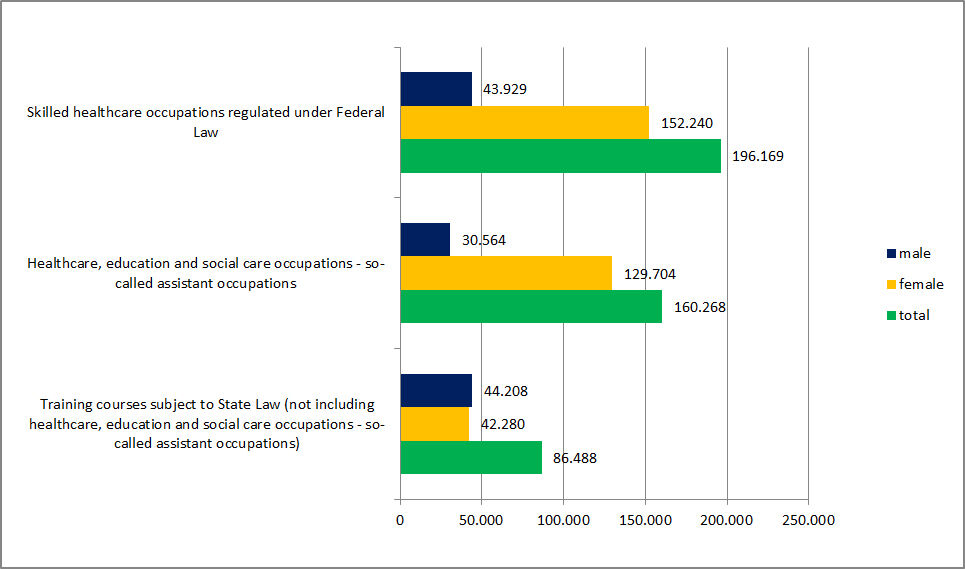
In addition to the specific legal bases, the full-time vocational training courses in schools referred to above have other features which distinguish them from dual training courses. Four of these peculiarities are presented below.
ENTRY REQUIREMENTS FOR TRAINING
In contrast to training in the dual system for which no formal entry requirements must be met, it is generally the case that, for full-time vocational training courses in schools, a school leaving certificate from a general or intermediate secondary school (Hauptschule or Realschule) or an intermediate school leaving qualification is required depending on the training objective.1
There are some peculiarities which should be noted in the area of skilled healthcare occupations regulated under Federal Government Law: In addition to the intermediate school-leaving qualification, a further entry requirement exists which states that “in terms of general health, the applicant must not be unfit for work in the occupation” (cf. eg. Section 5(1) of the Nursing Act – KrPflG).
HETEROGENEITY OF THEORETICAL AND PRACTICAL ELEMENTS
Within the dual system, teaching is delivered in the vocational school on a part-time basis and can also be delivered as block teaching. There are at least twelve hours of teaching a week. The duration and scope of compulsory attendance at the vocational school is regulated by the states (cf. KMK 2015b, p. 3 f.). Three-year training courses include 3,600 hours of practical training based in the company.2
By contrast, a feature of training in specialist healthcare occupations are the heterogeneous structures with differing proportions of theoretical and practical teaching and practical training time. In this case, the school takes overall responsibility for the training. Statistically these are therefore included in school-based training courses. However, they have an entirely “dual” structure and differing proportions of theoretical and practical teaching and practical training depending on the training course concerned. For example, the minimum number of hours required by law for midwifery training is 1,600 hours of theoretical and practical teaching and 3,000 hours of practical training. In care of the elderly or healthcare and nursing/paediatric nursing the minimum number of hours for teaching is 2,100 hours with a further 2,500 hours of practice. The provision for physiotherapy is 2,900 hours theoretical and practical teaching, and 1,600 hours of practical training (cf. ZÖLLER 2014).
Students are expected to complete industrial placements for training courses regulated by state law in full-time vocational schools. The state guidelines apply to the placement (cf. KMK 2013, p. 3). For example, at least eight weeks are scheduled for an industrial placement on the “stated-certified commercial assistant training course” in North Rhine-Westphalia.3
HIGHER PROPORTION OF WOMEN AND INCREASING STUDENT NUMBERS IN HEALTHCARE, EDUCATION AND SOCIAL CARE OCCUPATIONS
Women are underrepresented overall in the dual system, with a proportion of just 39 per cent in 20134. By contrast, the total was 73.2 per cent for full-time vocational training courses in school. This high proportion is largely due to the relevance of healthcare, education and social care occupations to this segment. When broken down, the proportion of women in specialist healthcare occupations for the 2013/14 academic year was approximately 78 per cent and even higher at 81 per cent for healthcare, education and social care occupations subject to state law. For the assistant training occupations with training courses partly related to the dual training courses, the proportion of women was approximately 49 per cent (cf. ZÖLLER 2015).
In addition to this, continuously rising student numbers have been a feature of training in the healthcare, education and social care occupations over recent years (cf. DIONISIUS/ILLIGER 2015). For the academic year 2013/14 compared to 2007/08, results from a BIBB study show an increase in student numbers of 11.4 per cent in specialist healthcare occupations, and approximately 38 per cent in the area of healthcare, education and social care occupations regulated by state law (cf. ZÖLLER 2015). By contrast, student numbers in assistant occupations regulated by state law are falling and have reduced by one fifth over the same period. According to vocational education and training statistics, the level also fell in the dual system by 2.7 per cent in 2013 compared to the previous year (cf. BIBB 2015 p. 9).
UNCLEAR DATA SITUATION IN SPECIALIST HEALTHCARE OCCUPATIONS
Under section 87(1) of the BBiG, federal statistics are collected on training in the dual system for the purposes of planning and regulation of vocational education and training. The vocational education and training statistics represent a complete survey of dual vocational education and training subject to BBiG/HwO. The survey is completed annually and the reporting period is the calendar year in each case. Under section 88 of the BBiG, the data is collected by the statistical departments of the federal and state governments and is passed to the BIBB for the purposes of preparing the Report on Vocational Education and Training and for conducting research into vocational education and training.5
The Federal Statistical Office has actually published data for specialist healthcare occupations regulated under federal government law in subject matter series 11, series 2, however it must be noted that, to date, no complete database exists at federal level for these training courses because some states have either not passed on the data or not passed on a complete data set (cf. Federal - State working group 2012, p. 44). Furthermore, only limited in-depth analyses are available. For example, there is no information regarding prior learning in school or the number of contract terminations.
A growing, but less obvious area of training
Training in the area of health, education and social work represents the main focus of training courses outside the remit of the BBiG/HwO. In contrast to training within the dual system, this training segment is characterised by differing legal bases, formal entry requirements, heterogeneous training structures with varying amounts of time for theory and practice and a high proportion of women; and overall increasing student numbers in healthcare, education and social care occupations.
In view of the way in which society is developing, these qualification pathways are hugely relevant both in terms of training as well as labour market policy. In order to ensure that development trends are identified in good times in this area of vocational education and training, one of the essential requirements is a complete data base of the training situation at Federal level as well as the option for differentiated analyses as provided on the basis of the vocational education and training statistics. In addition, efforts must be made to harmonize the differing proportion of hours allocated to theory and practice as part of the modernization of training courses.
One of the measures taken to draw attention to this growing area of training outside the remit of the BBiG/HwO is the presentation and continual extrapolation of current developments in the annual BIBB data report for the Report on Vocational Education and Training.
Literature
BIBB (Ed.): Datenreport zum Berufsbildungsbericht 2015 [Data report for the Report on Vocational Education and Training]. Bonn 2015 – URL: www.bibb.de/veroeffentlichungen/de/publication/show/id/7604 (retrieved 06.08.2015)
BUND-LÄNDER-ARBEITSGRUPPE „WEITERENTWICKLUNG DER PFLEGEBERUFE“: Eckpunkte zur Vorbereitung des Entwurfs eines neuen Pflegeberufegesetzes vom 1. März 2012 [Main issues in the draft preparation of the new Caring Occupation Act of 1 March 2012] - URL: www.bmg.bund.de/fileadmin/dateien/Downloads/P/Pflegeberuf/20120301_Endfassung_Eckpunktepapier_Weiterentwicklung_der_Pflegeberufe.pdf (retrieved 06.08.2015)
DIONISIUS, R.; ILLIGER A.: Mehr Anfänger/-innen im Studium als in Berufsausbildung? [More people starting degree courses than vocational education and training?]. In: BWP 44 (2015) 4, pp. 43-45 – URL: www.bibb.de/veroeffentlichungen/de/bwp/show/id/7689 (retrieved 11.08.2015)
SEKRETARIAT DER KULTUSMINISTERKONFERENZ (KMK): Rahmenvereinbarung über die Berufsfachschulen. Beschluss der Kultusministerkonferenz vom 17. Oktober 2013[Framework agreement regarding full-time vocational schools. Resolution of the Conference of Ministers of Education and Cultural Affairs of 17 October 2013] – URL www.kmk.org/fileadmin/veroeffentlichungen_beschluesse/2013/2013_10_17-RV-Berufsfachschulen.pdf (retrieved 06.0.8.2015)
SEKRETARIAT DER KULTUSMINISTERKONFERENZ (KMK): Dokumentation der Kultusministerkonferenz über landesrechtlich geregelte Berufsabschlüsse an Berufsfachschulen. Beschluss des Unterausschusses für Berufliche Bildung vom 6. Februar 2015 [zit. KMK 2015 a] [Documentation from the Conference of Ministers of Education and Cultural Affairs regarding vocational qualifications from full-time vocational schools governed by state law. Resolution of the subcommittee for vocational education and training of 6 February 2015] [cited KMK 2015 a]]
SEKRETARIAT DER KULTUSMINISTERKONFERENZ (KMK): Rahmenvereinbarung über die Berufsschule. Beschluss der Kultusministerkonferenz vom 12.03.2015 [Framework agreement regarding vocational schools. Resolution of the Conference of Ministers of Education and Cultural Affairs 12.03.2015] – URL: www.kmk.org/fileadmin/veroeffentlichungen_beschluesse/2015/2015_03_12-RV-Berufsschule.pdf (retrieved 06.08.2015) [cited KMK 2015 b]
SEKRETARIAT DER KULTUSMINISTERKONFERENZ: Bildung und Kultur – Berufliche Schulen, Fachserie 11, Reihe 2 [Education, training and culture – vocational schools, subject matter series 11, series 2]. Wiesbaden 2014
ZÖLLER, M.: Gesundheitsfachberufe im Überblick – Neues Serviceangebot des BIBB. Wissenschaftliche Diskussionspapiere Heft 153 [Overview of specialist healthcare occupations – new service provision from the BIBB Wissenschaftliche Diskussionspapiere [Issue 153]. Bonn 2014 – URL: www.bibb.de/veroeffentlichungen/de/publication/show/id/7369 (retrieved 06.08.2015)
ZÖLLER, M.: (Vollzeit-)Schulische Ausbildungsgänge mit einem beruflichen Abschluss gemäß und außerhalb BBiG/HwO. Wissenschaftliche Diskussionspapiere Heft 159 [Full-time vocational training courses in schools with a vocational qualification both under and outside the remit of BBiG/HwO. Wissenschaftliche Diskussionspapiere [Issue 159]. Bonn 2015 – URL: www.bibb.de/veroeffentlichungen/de/publication/show/id/7661 (retrieved 06.08.2015)
MARIA ZÖLLER
Research associate in the “Customer Service Occupations, Cross-Cutting Tasks” Division at BIBB
Translation from the German original (published in BWP 5/2015): Martin Stuart Kelsey, Global SprachTeam, Berlin
-
1
cf. www.kmk.org/bildung-schule/berufliche-bildung/berufsfachschule.html (retrieved 06.08.2015)
-
2
cf. BIBB-CBS 2012/2013: www.bibb.de/veroeffentlichungen/de/pubication/show/id/7558
-
3
cf. www.berufsbildung.nrw.de/cms/informationen-zu-bildungsgaengen/hoehere-berufsfachschule/mit-berufsabschluss/ (retrieved 06.08.2015)
-
4
cf. BIBB Trainee data system (DAZUBI) www.bibb.de/de/12129.php (retrieved 06.08.2015)
-
5
cf. BIBB Trainee data system (DAZUBI) www.bibb.de/de/12129.php (retrieved 06.08.2015)