International teacher training in the GDR – throwback to the past, learning for the present
Philipp Phan Lassig
When it comes to qualifying technical and vocational education and training (TVET) personnel, many countries want to learn from Germany. There are two major models in German dual vocational education and training: academic education of vocational school teachers and continuing education of skilled workers to become in-company trainers. These models, however, are often not suited to the conditions and requirements prevailing in other countries. The "integrated teacher" approach, on the other hand, could be of interest. In the last years of the GDR, following this approach, foreign students were trained as "teachers for vocational instruction" in the frame of a technical college training programme. The training programme is presented in this paper. How the approach may stimulate today's vocational education and training cooperation is discussed at the conclusion of the article.
Demand for TVET teachers in developing and emerging countries
In order to compete internationally, developing and emerging countries are forced to improve their economic performance not just in terms of quantity, but also in terms of quality. However, to achieve this, the necessary company-based training structure is often missing. Local companies are rarely willing and scarcely able to provide a company-based learning environment, where young people can acquire the competencies needed for their future profession. Common, instead, is an environment where workers learn on-the-job and in an ad hoc manner. This is one of the reasons why, in those countries, TVET is provided mainly by public TVET institutes. In contrast to vocational education schools in the dual vocational education and training system in Germany, these TVET institutes are required to impart competencies in both vocational theory and practise. One “sticking point” here is the teaching personnel. Many of whom, coming straight from university without hands-on work experience, are not in a position to impart the occupational knowledge, skills and attitudes required. In order to be able to encourage and support young people en route to their professional career, needed are TVET teachers with work experience in addition to technical expertise and pedagogical competence.
Looking for ways to train this type of TVET teacher, many countries are turning to German expertise. One ‘quality feature’ of German vocational education and training is qualified TVET personnel. However, it is hard to find the right type of vocational teacher these countries need within the German dual vocational education and training system. German vocational school teachers, educated at university and trained through teaching practise at vocational schools, are little suited to the extensive practical training requirements at a TVET institute. Master craftsmen or full-time company training staff, in contrast, often lack the methodological and didactical skills required to develop and deliver training offers at TVET institutes. In light of this, it seems worthwhile taking a closer look at a technical college training programme developed in the GDR in the 1980s.
“Unity of teaching, learning and production” – Training to become integrated teachers
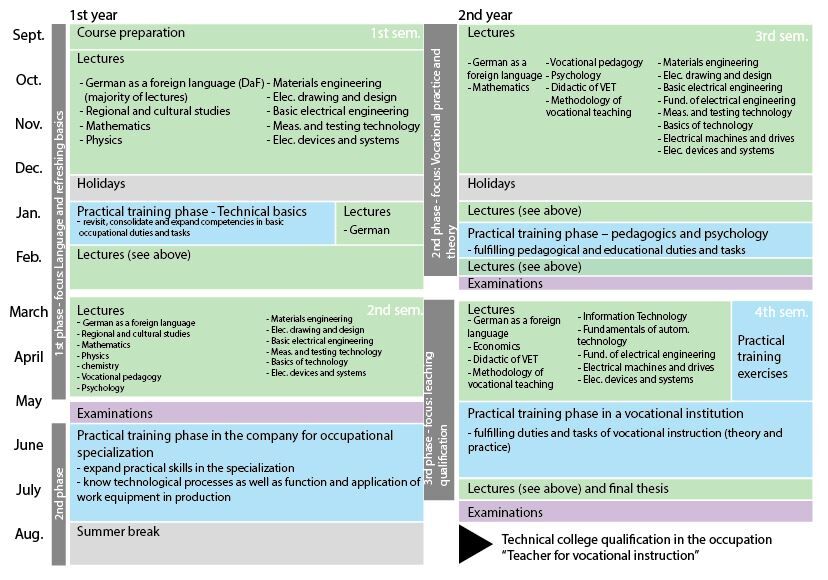
The technical college training programme “teachers for vocational instruction” was introduced on 1 September 1986 in the GDR (cf. Ministerrat der Deutschen Demokratischen Republik 1986, and Beckman 2015 1). In the GDR, technical college training was a distinct education level located in between skilled worker training and university education. Those completing technical college were employed in industry and business as technicians, engineers and economists (cf. HANDE 1996).
The aim of the training programme was to train “citizens from young nation states” to become “integrated teachers of theory and practice” (cf. BArch DQ 4/5397). Within their occupational specialization, such as engineering or electrical engineering, these teachers were to have the ability to “plan, prepare, conduct high quality teaching and draw the appropriate conclusions to inform subsequent training and education work in the context of initial and continuing TVET” (BArch DQ 4/5397). Taken together, students should therefore be qualified for employment at initial and continuing TVET institutions in their native countries.
Around 500 “teachers for vocational instruction” were trained from 1982 to 1989 (cf. BArch DQ 4/3152 and DQ 4/3153) in the GDR. Students came mainly from Laos, Angola, Nicaragua and Zambia. They completed a programme lasting two years to become integrated teachers (cf. fig.). In order to meet entry requirements, they had to have a general education qualification recognized in their own country. And, they needed as much hands on work experience as possible in their respective occupational specialization and/or a GDR vocational training qualification in this field. Focus at the start of the programme was on learning the German language. Vocational theory and practice were refreshed also. Training of both was intensified in the second phase. Here, the emphasis was on practical training, which to some extent was completed in companies under actual production conditions. In the third and final phase, students acquired the competencies for imparting vocational theory and practise. This was achieved by means of intensive pedagogical training both in theory and practice. The entire training period was accompanied by German language training, with a strong focus on technical language of the occupational field concerned. The final examination was conducted by staff of the college as well as companies resulting in a qualification at technical college level which was formally recognized in the GDR. Consequently, the qualification made it possible, for instance, to study at a university in the GDR to gain a diploma as engineering-pedagogic (Diplom Ingenieurpädagoge). The total cost was around 180,000 marks per Person (German language education, initial training, accommodation, grants, insurance, cultural assistance, etc.) and was borne mainly by the GDR and, in individual cases, by the sending countries (cf. BArch DQ 4/5377).
Initial steps – development and testing
The training programme was developed by the Institut für Berufspädagigk (IBP) [Institute for Vocational Pedagogy] in Magdeburg. The IBP had been formed by the Staatssekretariat für Berufsbildung (SB) [State Secretariat for Vocational Training] in 1981 and subordinated to the SB department “Training of Foreigners”. One of the main tasks of the IBP was to “train and develop cadres from developing countries to become teachers for vocational instruction” (BArch DQ 4/5441). In 1981 the IBP began the development and testing of training. The ensuing experiences were integrated into the training programme promulgated in 1986.
Learning took place at two learning venues – the technical college and the companies. Instruction and exercises in vocational theory and pedagogics were conducted at the technical college of IBP. The teachers at the technical college were diploma engineering pedagogics. These “engineering teachers for instruction in vocational theory” came from university and taught in technical colleges of the GDR. They typically trained future engineering pedagogics (Ingenieurpädagogen), who, in turn, where teachers for vocational practise, mainly working in GDR companies as in-company trainers. Teachers at the technical college were therefore teaching relatively practise-oriented and had close contacts with companies. Companies such as VEB Entstaubungstechnik “Edgar André” [“Edgar André” Dedusting Technology, state-owned enterprise] provided the IBP with training places and training staff for practical training phases in the company.
Despite these comprehensive provisions, a number of difficulties were encountered during the testing of the training (cf. BArch DQ 4/5691). The level of coordination and resources needed was greater than anticipated. The training personnel in the companies and in the technical college had trouble coping with the work involved in training foreign students. Competencies and capacities were lacking. This was also because students brought with them very different pre-requisites. In particular, they often lacked the basic language skills and the necessary basic hands-on work experience. This was due to the entry requirements, which were defined very generally and did not necessarily include work experience. Furthermore, the IBP was not able to conduct the selection of students on-site in the sending countries. Instead, this was done by other GDR stakeholders or the respective foreign government.
As a result of the experiences of the initial testing period, the IBP extended the language and practical training phases and from 1986 onwards incorporated the GDR vocational training qualification as one possible entry requirement. The intention was to obtain more students with the necessary language skills and occupational competencies at a more consistent entry level.
Training integrated teachers in the context of GDR training assistance
Integrated teachers were trained within the framework of GDR training assistance, one of the key components of “sozialistische Bruderhilfe” [“socialist fraternal aid”]. As multipliers in their native countries, integrated teachers were expected to contribute to the development of a skilled work force. In this respect they were only one part of many GDR activities relating to initial and continuing education of multipliers for developing countries. For example, a large number of skilled workers from Vietnam and Laos were trained to become engineering pedagogics within different institutions in the GDR as part of technical college education. At times in the 1980s up to 5,000 people were residing in the GDR for the purposes of initial and continuing TVET (cf. BArch DQ 4/3153 und 3152). In addition to the training of foreigners in the GDR, GDR training assistance also included support in partner countries. This, among other things, comprised the establishment of TVET institutes as well as the initial and continuing education of skilled workers.
Education and training was the most extensive activity of GDR development assistance. This assistance, however, was not solely a selfless act. It was also a political tool within the East West conflict. The intention was to draw developing countries to the Eastern Bloc and to obtain their international recognition of the GDR as a sovereign state. Furthermore, economic interests played an important part. First, GDR companies operating in developing countries needed skilled workers. Second, the intention was to export GDR technology to partner countries and for this technology to be used and maintained there. Third, TVET export was a declared aim of the GDR. The role of the IBP was therefore to conduct their training activities also based on contracts relating to machinery and equipment export as well as TVET export. In fact, in order to be able to commercially offer training of integrated teachers to Arab states, Marxism-Leninism was officially left out of this officially recognized training programme, making it the only training programme in the GDR without this subject. One country to fund the programme at the IBP was Angola.
GDR training assistance was implemented by various stakeholders. At government level, the SB was responsible for training foreigners in the GDR. In addition to this, a range of different ministries were active abroad (e.g. the ministries for People's Education, for Technical College and University Education, for Construction/Building and for Foreign Trade); the Stelle für internationale Kooperation der Außenhandelsbetriebe der DDR (AHB Intercoop) [Office for International Cooperation of Foreign Trade Companies in the GDR] and the Freie Deutsche Jugend (FDJ) [Friendship Brigades of the socialist youth movement] were also involved in training assistance. A complex network of objectives and stakeholders existed, which at times even competed with one another (cf. SOMMER 1992). This lack of central coordination is one reason why it is hard, today, to reconstruct the impact of GDR training of foreign workers had abroad.
Lessons to be learned – inspiration for vocational education and training cooperation today
The integrated teachers went back to their home countries after their studies. Some graduates from Laos work there today in government in the field of TVET. Little, however, is known about the overall impact of integrated teachers on the development of their countries. Training assistance in the GDR came to an end with the reunification. Some things were continued within the framework of German development cooperation. The IBP, for instance, was integrated into the Deutsche Stiftung für Entwicklungspolitik German (DSE) [Foundation for International Development] (cf. STOLTE 2000). Experienced practitioners today still contribute knowledge, competence and networks to Germany’s international vocational education and training cooperation. Much, however, has been forgotten. The achievements of GDR training assistance have barely been subjected to systematic review, even less frequently are they used strategically. At the same time, GDR training assistance underlines the fact that education and training, and, above all, TVET, are among the most important of Germany's resources for international cooperation. Even if having “collected some dust”, the integrated teacher is an element of this resource.
And, the integrated teacher is still in demand today. For example in Vietnam and in China, where “integrated teachers” or “teachers with double qualifications” are firmly established concepts. There, teachers are needed who master both, the delivery of vocational practice as well as of vocational theory. Due to their comprehensive occupational competence, integrated teachers may be employed beyond the teaching position – in the management of TVET institutes, in companies or even in government.
The approach is therefore highly useful for cooperating with these countries in the areas of initial and continuing education and training of TVET personnel. Its key principle is that of integrating vocational practice and theory. A principle, which also proves to be “transferable”, delivering, for instance, an important impetus to the development of an occupational standard for TVET teachers in the partner country. Furthermore, on the basis of such a standard, suitable ways for the initial and continuing education and training of TVET teachers may be developed. Germany already supports this as part of development cooperation. This is done, on the one hand, through practical training of teachers at TVET institutes and, on the other hand, through development of concepts for initial education of TVET teachers (cf. GIZ 2012).
Even if the GDR training programme may not serve as a blueprint, it certainly offers valuable ideas. Training programmes for TVET teachers should, for example, provide training phases in the company. Furthermore, the opportunity to enter the programme should be extended to skilled workers. This way, more individuals with work experience may be attracted to TVET.
The integrated teacher approach also provides important insights for the design of training programmes in Germany for multipliers from developing and emerging countries. Abroad, there is great demand for this. However, established procedures and programmes are still lacking. The integrated teacher approach shows what is needed as a minimum: political will, resources and institutions, extensive phases of development and testing, intensive language training, clearly defined entry requirements and implementation of the programme in Germany interlinked with stakeholders and institutions in the native country of the students. This is worth the effort. Today, countless “ambassadors for Germany” once trained in the GDR contribute significantly to the transfer of know-how and the positive image of Germany abroad.
Literature
BArch DQ 4 (Staatsekretariat für Berufsbildung) /3152 und 4/3153. Übersicht über den Umfang und den Aufenthalt von Ausländern zur beruflichen Aus- und Weiterbildung in Einrichtungen der Berufsbildung der DDR [Overview of the number and residency of foreign workers involved in initial and continuing vocational education and training in vocational education and training institutions in the GDR]
BArch DQ 4/5348. Problem der weiteren Entwicklung des Berufsbildungsexports – Entwurf eines Diskussionspapiers [Problem of the continuing development of the export of vocational education and training – draft discussion paper]
BArch DQ 4/5363. Erfahrungen und Probleme aus der beruflichen Aus- und Weiterbildung ausländischer Bürger in der DDR [Experiences and problems relating to initial and continuing vocational education and training of foreign citizens in the GDR]
BArch DQ 4/5377. Abkommen zwischen der Regierung der DDR und der Regierung der Republik Sambia über die Zusammenarbeit auf dem Gebiet der Berufsbildung in den Jahren 1981-1990 [Arrangement between the governments of the GDR and the Republic of Zambia regarding collaboration in the area of vocational education and training from 1981-1990]
BArch DQ 4/5441. Lehrinhalte für das Studium “Lehrkraft für den beruflichen Unterricht” [Teaching content from the course of study "Teacher of vocational education"] 1981,1958-1986
BArch DQ 4/5397. Informationsmaterial über die Aus- und Weiterbildung von Ausländern [Information regarding the initial and continuing education and training of foreign workers], 1981-1983, p. 3-5
BArch DQ 4/5691. Auswertung der Arbeit mit Studienplänen und Lehrprogrammen am IBP Magdeburg [Evaluation of work with courses of study and teaching programmes at the IBP Magdeburg], 1983
GIZ GMBH: TVET Quality Breakthrough – Regional TVET Conference 2012 in Viet Nam – Documentation. Hanoi/Vietnam 2012, p. 12
HANDE, W.: Sozialisationserfahrungen von Ingenieuren und Fachschülern. In: Aspekte der Beruflichen Bildung in der ehemaligen DDR. Anregungen, Chancen und Widersprüche in einer gesamtdeutschen Weiterbildungsdiskussion. [ Experiences with the socialisation of engineers and technical college students. In: Aspects of vocational education and training in the former GDR. Proposals, opportunities and contradictions in a discussion of continuing education and training concerning Germany as a whole]. New York/München/Berlin 1996, p. 111-162
MINISTERRAT DER DEUTSCHEN DEMOKRATISCHEN REPUBLIK: Studienplan für die Grundstudienrichtung Lehrkraft für den beruflichen Unterricht zur Ausbildung an Fachschulen der DDR [Study plan for the basic discipline of Teachers of Vocational Eduction for Training at Technical College in the GDR], 01.09.1986
SOMMER, H.: Zu Schwerpunkten und Problemen bisheriger Entwicklungszusammenarbeit DDR-VDR Laos auf dem Gebiet der beruflichen Bildung. [On the emphasis and problems of the GDR-VDR Laos development collaboration to date in the area of vocational education and training. In: ZBW 88 (1992) ,3, pp. 193-206
STOLTE, H.: Weiterführung entwicklungspolitischer Aus- und Fortbildungsprojekte der ehemaligen DDR durch die Deutsche Stiftung für internationale Entwicklung nach der deutschen Wiedervereinigung. [Continuation of development policy based projects relating to initial and advanced education and training in the former GDR post reunification by the German Foundation for Development Policy] In: BMZ; DSE; STIFTUNG NORD-SÜD-BRÜCKEN (Hrsg.): Noch die internationale Solidarität? Ansichten und Informationen zur Vereinigung der deutsch-deutschen Entwicklungspolitik. [Does international solidarity still exist? Views and information regarding the unification of German-German development policy]. Berlin 2000, pp. 69-77
PHILIPP PHAN LASSIG
Coordination Development Cooperation in VET, German Office for International Cooperation in VET (GOVET) at BIBB
Translation from the German original (published in BWP 5/2015): Martin Lee, Global SprachTeam, Berlin and Philipp Phan Lassig, BIBB, Bonn
-
1
The following remarks are based on an interview conducted on 25 May 2015 with Dr. BERNHARD BECKMANN, the former head of the Institut für Berufspädagogik (IBP) [Institute for Vocational Pedagogy] and the current director of the Europäisches Bildungswerk für Beruf und Gesellschaft (EBG) [European Association for Vocational and Social Education].