22,000 further education providers ensure country-wide coverage
Stefan Koscheck, Hana Ohly
The address base of the annual wbmonitor online surveys of continuing education and training providers has been updated in order to successfully continue the surveying. About 8,000 new provider addresses were added to the address pool as a result of this endeavour, which took almost two years to complete. This updated database is used in this article to illustrate the supply of the population with continuing education and training providers, taking the number of providers and the provider density at the district level as key indicators.
Dynamic developments in the continuing education and training sector
A list of all providers of vocational and general continuing education and training was created for the first time in 2007 (cf. DIETRICH/SCHADE/BEHRENSDORF 2008). Since then this list has served as the address base for the wbmonitor online surveys conducted annually in May by the BIBB and the German Institute for Adult Education - Leibniz Centre for Lifelong Learning (DIE) 1.
In correspondence with the location-based concept of wbmonitor, branch offices and subsidiary locations are listed as separate providers. Due to the closure of establishments and locations, mergers etc., the original number of about 18,000 addresses decreased by more than 4,000. In order to continue to project the survey results onto the whole continuing education and training landscape, it became necessary to update the address base. Starting in 2011, provider addresses were acquired from various data sources and compared with the existing provider inventory for this purpose. In addition, branches/subsidiaries of head offices already included in the address inventory were recorded. The 22,500 new addresses gathered in this process were checked regarding their belonging to the wbmonitor target group by way of brief telephone surveys.
In the end, approximately 8,000 (35%) continuing education and training providers could be confirmed. wbmonitor thus disposes of a directory of about 22,000 validated addresses of continuing education and training providers that is unique in Germany.
Continuing education and training providers are concentrated in the big cities
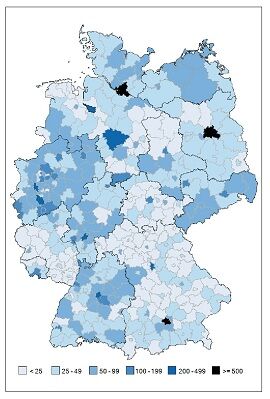
Figure 1 shows the distribution of continuing education and training providers at the level of urban and rural districts. It clearly illustrates the large number of providers in the big cities. A total of approximately 3,000 continuing education and training providers are located in Berlin, Hamburg, Munich and Cologne, and in Berlin alone there are more than 1,000 providers and locations. Other districts with a large number of providers (200 to less than 500 continuing education and training providers) are the urban districts of Bremen, Düsseldorf, Frankfurt am Main, Stuttgart and Nuremberg, as well as the Hanover Region 2.
Overall there is a very strong statistic connection between the adult population in a rural/urban district and the number of continuing education and training providers (with a correlation coefficient of 0.92). In North Rhine-Westphalia, the most populous federal state and a territorial state with a high population density, the majority of rural and urban districts have 50 or more continuing education and training providers. The situation in Bavaria is totally different: most districts have fewer than 25 providers in the federal state with the second-largest population. Thus at first glance, the supply situation for the Bavarian population with regard to continuing education and training opportunities appears to be below average in large areas of the state. This impression, however, is caused by the large number of small districts in Bavaria: Bavaria consists of 96 rural and urban districts, almost twice as many as in North Rhine-Westphalia (53 districts) despite its smaller population. A similar correlation between a small-area district structure and a small number of providers per district is present in Rhineland-Palatinate and Thuringia. On the other hand, districts in Northern and Eastern Germany have a larger number of providers in most cases, since these districts are larger in area and urban districts are rare.
Highest provider density in medium-sized cities
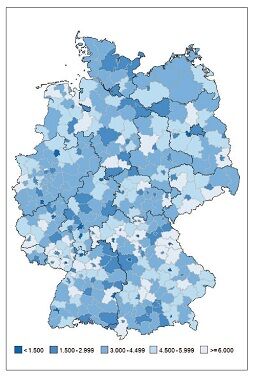
This North-South or West-South divide is put into perspective when we look at the provider density, i.e. the number of adult inhabitants per provider in a rural or urban district (cf. Fig. 2). Serious differences between the federal states as seen in Figure 1 are no longer discernible. Topping the list in terms of provider density (with less than 1,500 adult inhabitants per provider) are exclusively urban districts, frequently those of medium size, which obviously also supply the surrounding rural districts with their often very low provider density. The urban districts with the highest provider density are Ansbach (940 adult inhabitants per provider), Landau in der Pfalz and Koblenz (1,100 each). The large cities with the highest absolute number of providers, on the other hand, have a slightly lower provider density between 1,500 and 2,999 adults per provider (with the exception of Frankfurt am Main). It also becomes clear from Figure 2 that a country-wide supply of continuing education and training providers to the entire population is ensured if the urban/rural district differentiation is taken into account.
Outlook
The updated provider inventory lays the foundation for successfully conducting the wbmonitor surveys in the coming years. This year, in addition to the wbmonitor survey, the BIBB in cooperation with the DIE and the Duisburg-Essen University will also interview the staff of the continuing education and training providers: The objective of the BMBF( Federal Ministry of Education and Research) funded research project "wb-personalmonitor" is to gather current and representative data about the forms of employment, activities and working conditions of the persons employed in continuing education and training.
Literature
DIETRICH, S.; SCHADE H.J.; BEHRENSDORF, B.: Ergebnisbericht Projekt Weiterbildungskataster. Bonn 2008 - URL: www.die-bonn.de/doks/dietrich0803.pdf (as of 24 February 2014)
STEFAN KOSCHECK
Research associate in the “Qualifications, Occupational Integration and Employment” Division at BIBB
HANA OHLY
Research associate in the “Qualifications, Occupational Integration and Employment” Division at BIBB
Translation from the German original (published in BWP 2/2014): Paul David Doherty, Global SprachTeam, Berlin
-
1
More information on wbmonitor and the definitions used can be found at www.wbmonitor.de (as of 7 January 2014)
-
2
The Hanover district and the district-free city of Hanover were merged into the Hanover Region in 2001.