Successful at the second attempt - resits of final training examinations
Margit Ebbinghaus
Not all young people taking the final examination in the occupation in which they have trained are immediately successful. Such candidates have the opportunity to repeat the final examination. It is worth taking advantage of this second chance, as the present article shows on the basis of selected data from the Vocational Education and Training Statistics.
Determining the success rate
In the dual vocational education and training system, the acquisition of a formal vocational qualification depends on passing the final training examination. Most trainees succeed at the first attempt. Those who are not immediately successful have the opportunity to repeat the final examination on a maximum of two occasions (first resit and second resit).
Around 35,000 of the total of 495,200 final training examinations conducted in 2012 were resits. 29,200 of these were first resits. This information can be gleaned from the Vocational Education and Training Statistics produced by the Federal Statistical Office and the Statistical Offices of the Federal States (referred to in abbreviated form as the Vocational Education and Training Statistics), which have recorded all resits conducted in a calendar year at an individual level since 2010. This enables the success rate for first resits (EQWP1) to be calculated as follows.

Proportion of first resits varies
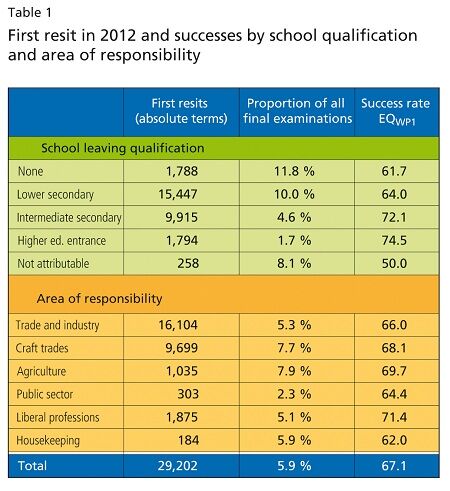
Viewed in absolute terms, the number of trainees without a school leaving qualification and the number of trainees in possession of a higher education entrance qualification resitting an examination they had not passed for the first time were approximately the same in 2012 (cf. Table 1). Significant differences are, however, revealed if we view the situation relatively. In this case, the amount of first resits as a proportion of all final examinations 1 conducted amongst trainees with a higher education entrance qualification was just under two percent, significantly below the proportion for the dual system overall, which was just under six percent in 2012. By way of contrast, trainees without a school leaving qualification were significantly more likely to undertake a first resit of the final examination than was the case for the dual system as a whole, the proportion here being just under twelve percent (cf. Table 1). These differences reflect the unequal success rates of trainees with different levels of prior school learning in initial examinations (cf. BIBB 2013, pp. 194 ff.).
If we consider first resits of final examinations differentiated according to areas of responsibility, the following picture is revealed for the year 2012. In absolute terms, first resits were most likely to occur in the area of trade and industry and least likely in housekeeping (cf. Table 1). Relatively speaking, however, only slight differences exist between these two areas of responsibility. In this case, there is a difference of only 0.6 percentage points in the amount of first resits as a proportion of all final examinations conducted in trade and industry and housekeeping. At the same time, final training examinations not passed were approximately equally as likely to be repeated for a first time in both areas as in the dual system as a whole. The proportion of first resits was above average in the areas of agriculture and the craft trades and comparatively low in the public sector.
Two in three first resits result in success
Two thirds of the first resits conducted in 2012 were passed, thus resulting in the acquisition of the formal vocational qualification which candidates had failed to obtain at the first attempt. This picture remains in place if differentiation by gender is made, but not if prior school learning is taken into account. In the latter case, it is revealed that, in the same way as was the case with initial examinations, the school qualification plays a part in examination success. Just under 62 percent of candidates without a school leaving qualification resitting the examination for the first time succeeded in obtaining a formal vocational qualification, whereas the equivalent figure for those with a higher education entrance qualification was almost 75 percent (see Table 1).
The success rate for first resits also varies according to area of responsibility (cf. Table 1). The differences are between 1.6 and 9.4 percentage points. Part of the reason for this is the fact that trainees with certain prior school learning are represented to differing extents in the individual areas of responsibility. Trainees resitting the final examination in the area of the liberal professions were most likely to achieve a pass at the second attempt. Agricultural occupations, however, in which first resits make up the largest proportion within the examination system in comparative terms, also have an above-average success rate of just under 70 percent (cf. Table 1). The opposite is the case in public sector occupations, where the success rate is amongst the lowest despite the fact that the sector accounts for one of the lowest proportions of first resits in the examination system (cf. Table 1).
Differences at occupational level
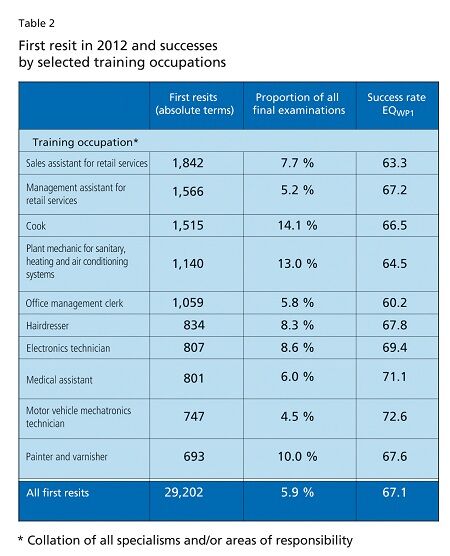
The differences in the success rate for first resits exhibited for the areas of responsibility continue at the level of individual training occupation. In the ten training occupations in which the most final training examinations were repeated for the first time in 2012 (in absolute terms), success rates vary between 60 percent for office management clerks and just under 73 percent for motor vehicle mechatronics technicians (cf. Table 2). In the latter occupation, first resits also make up quite a small proportion of the examination system on account of the high success rates achieved in initial examinations. This means that in overall terms a very high proportion of trainees in the occupation of motor vehicle mechatronics technician achieve their formal vocational qualification within two attempts.
However, even in occupations in which first resits are a relatively strong factor due to the fact that the first attempt is comparatively likely to end in failure, candidates who present themselves for resit frequently succeed. Therefore, if the final examination is not passed at the first attempt, a second try is definitely worthwhile.
Literature
BIBB (Ed.): Datenreport zum Berufsbildungsbericht 2013 [Data Report to accompany the 2013 Report on Vocational Education and Training]. Bonn 2013
- URL: http://datenreport.bibb.de/html/dr2013.html (status: 20.03.2014)
MARGIT EBBINGHAUS
Research associate in the “Vocational Training Supply and Demand/Training Participation” Division at BIBB
Translation from the German original (published BWP 3/2014): Martin Stuart Kelsey, Global Sprachteam Berlin
-
1
"All final examinations" refers to the total amount of initial examinations, first resits and second resits.