More chances of participation – assisted training as an instrument for the fostering of inclusive vocational education and training
Ralf Nuglisch
Assisted training involves regular vocational education and training backed up by extensive preparatory and support provision on the part of Young People’s Vocational Support Services. This enables even disadvantaged young people to undergo normal company-based vocational education and training. This article presents the opportunities offered by assisted training and outlines the experiences gained from implementation in Baden-Württemberg.
Access to the regular system and full participation in company training activities
The aim of assisted training is to allow more young people faced with serious impediments to training to be able to complete regular company-based vocational education and training. In order to achieve this, assisted training supplements regular VET with services which secure success from social, professional and organisational points of view. Both the (potential) trainees and those responsible for their training in the companies and at vocational schools receive support in working together to prepare and structure their training relationship. Within the scope of assisted training, areas of education and training potential are tapped into, used and expanded within the regular system. This delineates it from support concepts which provide assistance to so-called disadvantaged young people via specific measures outside the employment system.
Assisted training should, therefore, be viewed as an intensive form of support for regular company-based training rather than as an alternative to it. Responsibility for training remains with the companies and the young people. The training contract is concluded between the company and the trainees, and the companies pay the normal training allowances.
Assisted training is a new intervention stage between existing training support measures and vocational education and training in extra-company institutions and facilitates access to regular VET within the normal system to more young people. The preparatory phase of assisted training can thus be aligned between introductory training (EQ/EQ plus) and the vocational preparation schemes (BvB).
In the case of assisted training, young people perceive themselves to be fully valued members of the company from the outset. Companies can use assisted training to extend their training commitment more easily to young people who were previously excluded. This enables the fostering of factors which are important to the success of vocational education and training on the part of the young people and the companies, such as motivation, commitment, obligation and a sense of responsibility.
The success of assisted training depends upon its market effect
Dual training is regulated via supply and demand. To this extent, the acceptance and the inclusive potential of assisted training depend on how it is able to establish itself on the training market. Demographic change and changes in educational behaviour are placing increased demands on companies with regard to the search for trainees. For this reason, both branches and companies are showing themselves to be increasingly open towards training young people who from their point of view exhibit a more difficult initial position. A sense of societal responsibility on the part of companies is also leading to greater openness vis-à-vis groups of persons viewed as being weaker. This initially presents positive starting conditions for greater inclusion and for the establishment of assisted training on the training market. The introduction of assisted training will, however, only succeed on a permanent basis and to a significant extent if it delivers added value for all those involved.
Experiences with assisted training in Baden-Württemberg show that this is possible. Assisted training in Baden-Württemberg is being implemented within the scope of state-wide pilot projects. The “carpo” project, in which around 1,700 young people have now participated, has been running since the autumn of 2008.
Key conceptual benchmarks – experience with implementation in Baden-Württemberg
Assisted training is directed at all young people with impediments to placement and particular support requirements who have not thus far been able to commence or successfully complete vocational education and training. In order to pursue company-based VET successfully, participants require more intensive support than that provided by training support measures. They do not, however, need the support framework provided by extra-company vocational education and training. This openness of the target group corresponds with the objective of approaching the integration of young people in a way that is aligned towards potential and competence and is thus also open in terms of the result.
Assisted training makes services available reliably and continuously and in a manner that is appropriate to the situation. For this purpose, a broad conceptual basis is required which makes it possible to react flexibly to individual life situations, support requirements and training impairments with provision that is adequate in each case and to pursue a suitable setting for support and assistance on an individual case basis (cf. Figure). The services are available to the young people and the companies throughout the whole of the preparatory stage and throughout training.
At the beginning of the process, it is frequently necessary to overcome the social and communicative hurdles of the young people and the companies. These are one of the main reasons why training contracts do not come into being. A relationship of trusts needs to be established between the young people, the companies and the provider of young people’s vocational support services. Both sides need to be able to rely on the act that they have a kind of “trouble shooter” at their side who is available to help them in all matters relating to training and who takes an active part in working towards success.
It is of essential significance that young people are able to start by developing for themselves a sustainable vocational biography option which they can continue to develop on the training market. For this purpose, the range of provision of assisted training usually encompasses a six-month preparatory phase (including competence assessment, vocational orientation, application training, support with everyday problems, sorting out childcare and financial security, a company internship, preparation for the training situation), precisely tailored placement in the company providing training and support until conclusion of training (e. g. everyday support, clarification and guidance in school-based and company-based matters, conflict mediation). Companies are provided with detailed information prior to commencement of training, and a suitable applicant is placed with them. Practical placements are completed with possible companies before training begins.
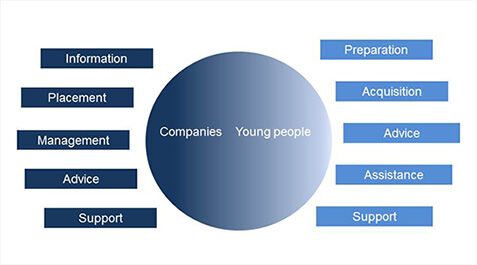
During training, feedback meetings take place with the relevant stakeholders on a regular basis. The provider will also take over parts of training management if required. The contents and intensity of support are aligned to the individual requirements situation of the trainees and the companies.
High-quality implementation of the demanding task of delivering support from a single source is provided by a specialist with a higher education qualification in social studies. Insofar as necessary, the services of a specialist in subject-specific learning support can also be called upon.
Cooperative financing from the federal state, the European Social Fund, the Federal Employment Agency and the provider of basic social security benefits facilitates individual training support for the young people. It integrates all relevant stakeholders in a binding and responsible manner and implies support structures which are able to take account of the inclusive work principle of assisted training. This cooperative financing model secures funding support for young people in a wide range of (pre)vocational training courses and life situations.
Further perspectives for assisted training
The instrument of assisted training is a component of the Alliance for Initial and Continuing Training and has been included by the Federal Employment Agency in the “Company-based training has priority” initiative. The aim now is to expand funding provision for labour promotion and basic social security nationwide on the basis of a newly created statutory foundation.
Assisted training has the potential to align vocational education and training more closely to the principles of heterogeneity and inclusion. In order to ensure its success, it will be necessary to structure future support principles in an open and flexible way so that it is possible to deliver individual and comprehensive assistance within the scope of regular training contracts.
For further information, please visit: www.carpo-esf.de
RALF NUGLISCH
Head of the “Work and Training” Section at the PARITÄTISCHE Social Welfare Federation Baden-Württemberg
Translation from the German original (published in BWP 2/2015): Martin Stuart Kelsey, Global Sprachteam Berlin