Volunteering as a mainstay of self-governance in the craft trades sector – areas of potential and development requirements
Verena Berten
Volunteer involvement forms the human resources foundation for self-governance in the craft trades and thus ensures the practical relevance and legitimacy of vocational education and training in the sector. This article explains the function performed by voluntary participation in self-governance within the craft trades while also highlighting the increasing pressure to which this structure is being exposed as a result of changes to underlying motives and to general prevailing conditions. It concludes by presenting results from expert workshops which indicate the approaches which may be suitable for securing the future viability of this system.
Self-governance in the craft trades sector – principle and added value
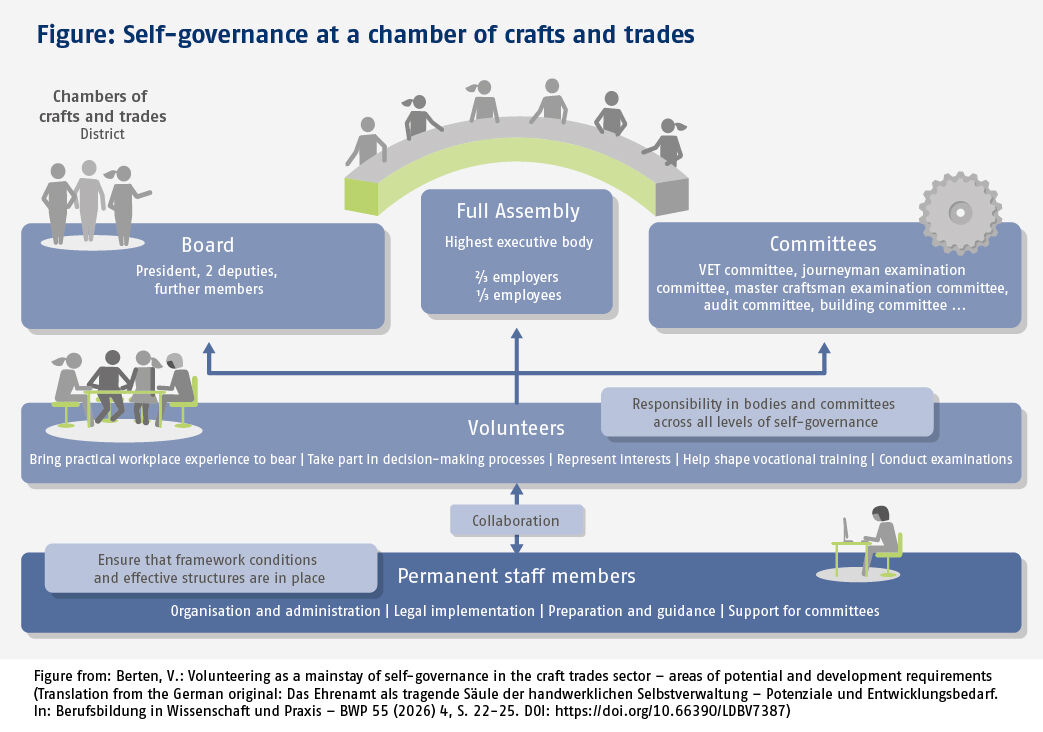
Self-governance is the fundamental organisational principle of the craft trades sector. It has its roots in the idea that public tasks should be performed by those with the greatest specialist expertise and with direct practical experience. The structures of craft trades organisations in Germany are largely stipulated by the Crafts and Trades Regulation Code, which serves as the statutory basis in this regard. The chambers of crafts and trades form the heart of the self-governance system. Their members comprise craft trade firms and companies carrying on trades that are considered to be similar to craft trades. Each company joins the chamber in its own particular chamber district. The role of the chambers of crafts and trades is to represent the interests of the craft trades sector. Their statutory remit further includes management of the Register of Crafts and Trades[1] and further wide-ranging tasks in vocational education and training. They regulate and monitor vocational education and training, enact examination regulations and establish examination boards (§ 91 Crafts and Trades Regulation Code, HwO).
Various institutions are jointly involved in the carrying out of these tasks (§ 92 HwO). The General Assembly (Full Assembly) is the main executive body of the chambers of crafts and trades. Its members, one third of whom are employee representatives, are elected for a term of five years (§§ 93–103 HwO). The General Assembly elects the Board. This comprises “the chair (President), two deputy chairs (Vice Presidents) – one of whom must be a journeyman or another employee who has completed vocational education and training – and a further number of members” (§ 108 Paragraph 2 HwO). The General Assembly is also empowered to set up committees for specific tasks. The VET committee is of particular significance for vocational education and training. Self-governance thus gives rise to various forms of volunteer involvement. These range from strategic and (education and training) policy decisions to direct participation in the examination system. There are 53 chambers of crafts and trades across Germany, all of which have their own Articles of Association. The guilds form a further layer of self-governance in the craft trades alongside the chambers. Guilds consist of self-employed workers carrying out the same trade within the same district who come together to promote their common interests (§ 52 HwO). They also have volunteer-run bodies in place in the form of the Guild Assembly, the Board and committees. Unlike the members of chambers of crafts and trades, guild members are all business owners. They pool their vested interests at further regional and supra-regional levels via district craft trade associations and federal state guild associations.
The various bodies and opportunities for participation in self-governance in the craft trades are summarised in the figure below.
The system is characterised by collaboration between permanent staff members and volunteers. Permanent staff members are persons who carry out their duties at craft trade organisations within the scope of a paid employment relationship. They ensure that organisational, legal and managerial processes run smoothly. Volunteers, on the other hand, use their direct operational experience to inform decision-making processes and to shape the substantive alignment of self-governance.
The added value this delivers is especially apparent in the area of vocational education and training. Whereas permanent staff members are in charge of the organisational framework and take care of matters such as examination registrations and the provision of venues, volunteers are involved in the vocational training committees where training and examination structures are designed and developed further. Their knowledge of operational practice directly informs decisions and ensures that institutional regulations remain aligned to the actual requirements of the world of work.
Self-governance in the craft trades underscores the fundamental significance of volunteer involvement. It would not be possible for the member-led decision-making process to be maintained in its current form without the willingness of business owners and employees to take on responsibilities within the governing bodies and committees. Although the latest data from the Volunteering Survey indicates that voluntary work is performed by 36.7 percent of the population aged 14 and over in Germany (cf. Fritzsche et al. 2025), craft trades organisations complain of difficulties in filling volunteer jobs (cf. Schumacher/ Nicolaus 2024; Kosney 2024; Berten 2021).
Against this background, this article will now examine the challenges and development needs faced by voluntary involvement in the craft trades, as well as the resulting requirements regarding sustainable organisation of self-governance within the sector.
Volunteering in the craft trades sector – motivations and obstacles
Initial indications regarding possible motivations and obstacles for volunteers were provided by a research project entitled “Isn’t it simply a matter of honour? The future of volunteering in rural areas”, which was carried out by the Hildesheim-South Lower Saxony Chamber of Crafts and Trades in 2020/21. This study used guided interviews to quiz eight volunteers and seven permanent staff members who worked closely with volunteers (cf. Berten 2021). The evaluation of the results showed that the decision to take on a voluntary role has its basis in a combination of different motives. The key motivations highlighted by the interviewees were the opportunity to play an active role in shaping the future of the craft trades sector and to assume responsibility for their profession. In the field of vocational education and training in particular, volunteering is seen as a way of helping to maintain professional standards and of supporting the next generation of skilled workers. In addition to this, the interviewees felt that voluntary work offers significant prospects for personal and professional development and for networking (cf. ibid. 2021).
At the same time, they made it clear that these areas of potential are not very visible to the outside world and also pointed out that long-term time commitments may pose a particular obstacle. They felt that the resources required to fulfil a voluntary function over a period of several years were often not available. This depended on a person’s age and individual life circumstances, but was particularly true for young people (cf. Berten 2021; Simonson et al. 2022). Although participation in volunteering is generally high among 30 to 49 year-olds (40.4% in 2024; cf. Fritzsche et al. 2025), this is also the age group in which the weekly time budget remains the lowest (cf. ibid. p. 22). There is comparatively little time left for voluntary work during this “rush hour of life”, i.e. the phase when work and family commitments coincide most intensely.
In the craft trades sector, there is the additional factor that structural changes are altering the general conditions for self-governance. The company landscape is altering. Although the craft trades sector was characterised for a long time by a high proportion of micro-enterprises and sole traders (up to 81.6 per cent in 2008), the share of larger firms (with more than 50 employees) has been growing over the past ten years.[1] This reduces the pool of human resources from which volunteers can be recruited for self-governance of the craft trades. 62 percent of guilds reported declining or sharply declining member numbers in the period from 2012 to 2022 (cf. Sack/Fuchs 2025). Acquiring the services of volunteers is increasingly becoming a challenge.
Perspectives and areas of potential change – four action areas for the future of volunteering in the craft trades sector
In 2025 and 2026, the Academy for Volunteers in the Skilled Crafts in Baden-Württemberg staged a series of workshops called “Let’s talk about volunteering”. The key issue addressed was how the structures and framework conditions of self-governance in the craft trades sector can be developed in a sustainable manner. A total of four networking sessions featuring a participatory format were held at four different venues in four different chamber districts. Evaluation research was conducted by the Institute for Management in the Skilled Crafts at the German Craft Trades Institute. The 58 participants comprised volunteers, permanent staff members at craft trade organisations and individual tradesmen and women. The aim was to highlight different perspectives of the pressing challenge of attracting young people to voluntary work and to work together to develop approaches for shaping the future of volunteering.
During the first two sessions, the participants used a world café process to debate the challenges facing volunteers and permanent staff members. They also talked about the necessary support structures and future cooperation scenarios. The results were documented and prioritised and subsequently discussed. The follow-up question addressed was: what fundamental structural changes would be required if existing approaches (such as increased endeavours to engage with the next generation of skilled workers and expanded training provision) proved to be insufficient? During the two further workshops, provocative propositions were discussed via a scenario-based positional dialogue. Participants defined their position by means of a five-point scale and were then required to justify their view. The documented results of all four workshop sessions were collated and pooled by topic.The discussions of the networking gave rise to four action areas which encroach to varying degrees upon existing structures of self-governance within the craft trades sector:
Make volunteering more attractive and stronger in the long term
This first action area mainly comprises known measures which the participants believe should be pursued more robustly and more strategically. These include reaching out to potential volunteers at an early stage and on an ongoing basis, raising awareness of the opportunities and benefits of volunteering, and fostering a modern culture of recognition and support. The recruitment of young volunteers should be viewed as a permanent task rather than as something which is only tackled when new vacancies arise. So-called volunteering ambassadors could assist in this regard by passing on their own experiences and by making personal contact with interested parties. Training courses and digital support options such as online meetings or using AI to generate minutes of meetings may also help to empower volunteers in the long term and to ease their workload.
Open up access points and reduce barriers to entry
A second action area concerns access to volunteering itself. The results suggest that potential volunteers should be given an in-depth insight into the duties, procedures and requirements involved before they enter into a binding commitment to assume a post. Existing routes into volunteering should therefore be called into question if it is only possible to become familiar with volunteer tasks after an election has already taken place or a role has been formally taken on.
Job shadowing was discussed as one possible approach. Interested parties could accompany experienced volunteers as the latter perform their duties and thus have the opportunity to observe meetings and committee work and to ask questions. This would offer a realistic insight into the institutions of self-governance in the craft trades and would allow them to compare their own expectations with the actual requirements. Such a scheme may help to reduce uncertainty and enable people to make an informed decision about taking on a voluntary role.
Make forms of participation more flexible and adapt them to the changing realities of life
The results point to a need for more fundamental change that extends beyond making recruitment easier and lowering the barrier to entry. If long-term and time-consuming commitments become increasingly difficult to reconcile with professional and personal demands (cf. Fritzsche et al. 2025; Simonson et al. 2022; Destatis 2022), then this raises the question of whether voluntary participation must continue to be predominantly tied to wide-ranging roles and fixed terms of office. For this reason, one key possible approach would be to break tasks down into smaller parts and to distribute responsibility more widely among several people.
Conceivable examples include performance of functions on the basis of division of labour, the allocation of tasks to more than one volunteer, and project-based and time-limited forms of participation. Tasks and responsibilities must be described transparently and also need to be clearly delineated if these types of involvement are to work effectively. Suitable points of contact and supportive guidance from the permanent staff would also be necessary in order to allow volunteers to familiarise themselves with tasks and processes quickly, even if their involvement takes place on an ad hoc basis. This shifts the focus away from the conventional long-term single-person roles towards more flexible forms of shared responsibility.
Continue to develop general institutional and legal framework conditions
The broadest perspective concerns the issue of whether existing institutional and legal frameworks will continue to provide a suitable environment for voluntary participation in the future. The structure and working methods of committees and the guidelines on which they are based must also be reviewed in the long term if there are changes to volunteer willingness and to opportunities for voluntary commitment. This may, for example, relate to the size and composition of various bodies or to the legal prerequisites regarding new forms of shared and flexible participation. The institutional and legal framework would possibly need to be revised in the long term if existing regulations restrict such changes.
Adapting without compromising core structures
The results reveal a broad consensus that changes are needed for the long-term safeguarding of volunteering as the main human resources base for self-governance in the craft trades. However, the approaches under discussion differ significantly in terms of the extent of their intervention. They range from the optimisation of existing measures to the opening up of access, and also extend to include the introduction of more flexible forms of participation and the review of institutional and legal frameworks. It is worth noting that the existing basic structures of self-governance were not fundamentally called into question. However, the more the changes under discussion encroached upon these structures, the less specific the ideas regarding their implementation became. The considerations put forward now need to be explored in greater depth.
It also remains to be seen which of the approaches are actually viable and effective. Prototype testing of selected models could provide insights into feasibility and acceptance, although a wide range of influencing factors means that their impact on willingness to engage in volunteering is likely to be only partially measurable in isolation. The results thus provide initial prospects for future development while also highlighting the need for further piloting and research.
-
1
An official directory of all companies within the chamber district which are conducting a licensable trade.
-
2
Cf. figures on company development in the craft trades sector, 1998-2025 from the GERMAN CONFEDERATION OF SKILLED CRAFTS www.zdh.de/daten-und-fakten/betriebe/beschaeftigte/umsaetze
Literature
Berten, V.: Das ist doch Ehrensache! Ehrenamt der Zukunft im ländlichen Raum. Karlsruhe 2021
Destatis: Zeitverwendungserhebung (ZVE) 2022 (revised version dated 6 June 2025). Wiesbaden 2025
Fritzsche, A.; Leven, I.; Rysina, A.; Schneekloth, U.; Wolfert, S.: Freiwilliges Engagement in Deutschland. Zentrale Ergebnisse des Sechsten Deutschen Freiwilligensurveys (FWS 2024). Berlin 2025
Kosney, P.: Ehrenamt in der funktionalen Selbstverwaltung. Grundlagen, Rechte und Pflichten unter besonderer Berücksichtigung des Prüfungswesens im Handwerk. Baden-Baden 2024
Sack, D.; Fuchs, S.: Die Innungen in den Arbeits- und Tarifbeziehungen des Handwerks. Ergebnisse des Forschungsprojektes „Innungen, Tarifbindung und Mitbestimmung im Wandel“. Düsseldorf 2025
Schumacher, M.; Nicolaus, L.: Frauen in der Handwerksorganisation. Zu den rechtlichen Mitwirkungsmöglichkeiten von in Leitungspositionen tätigen Frauen, die nicht Betriebsinhaberin sind, in Handwerkskammern, Innungen und Kreishandwerkerschaften de lege lata und de lege ferenda. München 2024
Simonson, J.; Kelle, N.; Kausmann, C.; Tesch-Römer, C. (Eds.): Freiwilliges Engagement in Deutschland. Der Deutsche Freiwilligensurvey 2019. Berlin 2022
Further links
The figure from this article is available for download: www.bwp-zeitschrift.de/g12544
(All links: status 14/10/2026)
Verena Berten
Head of Continuing Professional Development, Institut für Betriebsführung im DHI e. V., Karlsruhe
Translation from the German original (published in BWP 4/2026): Martin Kelsey, GST GlobalSprachTeam ‒ Sassenberg e. K., Berlin