Measuring the social competences of qualified medical assistants
Development of a method under the CoSMed project
Agnes Dietzen, Moana Monnier, Tanja Tschöpe
Specifically in personal services occupations where the primary emphasis is on dealing with people, social competences have a major influence on successful work performance. In health and nursing occupations this not only applies to coordination within the team but also, more importantly, to interactions with patients whose experiences and responses are often coloured by anxieties, worry or pain. "Always be kind" is one of the requirements frequently mentioned in expert interviews. But what does this simple adage really mean? The article describes how the CoSMed project sets about answering this question in order to make the social competences of qualified Medical Assistants measurable.
Social competence - a key component of the occupational profile
"When will I finally be seen?", "how long will I take to recover?" - questions like this are part and parcel of working life for staff qualified in the recognised occupation of Medical Assistant (German: Medizinische/r Fachangestellte/r). They must quickly appraise a sick person's situation and emotional state, calm down agitated patients and stabilise them in difficult situations, and carry out certain procedures that patients find unpleasant. At the same time, the occupation calls for good coordination within the practice team.
So alongside healthcare and business competences, social competences are fundamental to the occupational profile of the Medical Assistant. Germany's training regulation for the recognised occupation, dating from April 26 2006, enumerates various tasks in patient care and consultation which especially underscore the importance of social competences when working in this occupation.
The introduction of the concept of occupational competence as a normative basis for personality development and occupational proficiency has helped, overall, to make social competences a more emphatic focus of interest in vocational education and training (VET). According to the broad educational vision that underpins the VET concept, human and social competences need to be taught, supported and, where possible, assessed alongside occupation-specific competences (cf. KMK 2007).
Considering the huge significance of social competences in the health and nursing occupations in particular, comparatively low-key attempts have been made to do any targeted teaching, support and measurement of these skills. One explanation may be that these are often seen as personal qualities that people "just need to arrive with". Alternatively it is hypothesised that they are acquired through primary socialisation processes and continuously developed in working life, mainly through informal and experience-led learning in the process of carrying out the occupational role. As a subject of curriculum-led learning, however, they play more of a subsidiary role. Another factor is that in the past, nursing, care and dealing with people needing help was generally a sector to which society paid little attention, and hence the requisite skills were not adequately perceived, much less professionalised.
No wonder, then, that it is an area of practice in which Medical Assistants are found to have particular shortcomings. In a representative survey involving 1,350 doctors all over Germany (cf. Zentralinstitut für die kassenärztliche Versorgung in der Bundesrepublik Deutschland 2002), 66 per cent of respondents rated the psychosocial competences of Medical Assistants as in need of improvement (as opposed to only 43-49 per cent for other occupation-specific competences in the field of medical care). Respondents consider that improvements are particularly required in interpersonal conversation and in dealing with difficult patients.
Stumbling blocks in concretising and measuring social competences
To this day, the "major stumbling blocks" described by SEYFRIED (1995) still impede the route towards measuring social competences. The first such stumbling block is the unclear nature of the conceptual construct of "social competence". The multitude of different attempted definitions and systematisations is based largely on plausibility assumptions. As a rule these are not empirically derived (cf. KANNING 2003, p. 157). Accordingly, the term can be used as an all-embracing construct that permits wide-ranging interpretations, and can be concretised in diverse and to some extent arbitrary ways (cf. EULER/BAUER-KLEBL 2008, p. 16).
KANNING (2005, p. 4) defines socially competent behaviour as a person's behaviour in a specific situation which contributes to achieving their own goals whilst maintaining social acceptance for the behaviour.This very open-ended definition, selected just as an example, is in complete contrast to detailed lists of competences, which specify all the components that go together to make up social competences. Depending on the background, these include concepts like abilities in communication, teamwork, handling conflict, handling criticism, assertiveness, empathy, self-confidence, tact, responsibility and many other concepts (cf. KANNING 2005). So socially competent behaviour can be understood in very different ways, since tasks, responsibilities and role definitions - depending on the context - can be completely different. What is taken to be assertive in one field can come across as uncooperative or even overstepping boundaries in another area. At the same time individual facets of social competence can be incidental to some contexts or occupations whereas they are central to others. In order to support the recognition, fostering and measurement of social competences, an occupation-specific approach is therefore indispensable.
A second stumbling block is the unsatisfactory repertoire of methods for measuring occupational social competences. In past years occupational competence diagnostics have achieved some degree of progress in the field of occupation-specific competences. For example, in the industrial-technical and in the commercial sectors, simulation-style test procedures have been developed which enable first insights into the structure and the level-progression of technical competences in selected occupations (cf. NICKOLAUS 2011). For the area of social competences, there is a complete lack of such work as yet. Some attempts are under way to record general social competence using the existing procedures for recording social competences (cf. the overview in KANNING 2005; NANGLE et al. 2010) . Their meaningfulness for individual occupations is limited, however. Further doubt is cast on validity by the method of data-access, being via self- assessment responses or third-party assessments. Some theoretically founded procedures concentrate on individual facets of social competence. Practitioners of aptitude diagnostics also make use of simulation-style tests in which people are required to describe their hypothetical behaviour in certain typical situations pertaining to that occupation (known as situational judgement tests, cf. inter alia WEEKLEY/PLOYHART 2006). These are mainly used at higher hierarchical levels and are not transferable due to their highly customised nature. For the sphere of VET in the health and nursing sector, no procedures of this kind exist.
Development and validation of a test procedure in the CoSMed project
Through the complex interplay of social competences with healthcare-medical as well as administrative- business competences in the working life of a Medical Assistant, this occupation provides the opportunity for interdisciplinary competence research from educational, psychological and sociological perspectives. By adopting this interdisciplinary approach, the CoSMed project hopes to contribute to further developing the repertoire of methods for occupation-specific measurement of social competences.
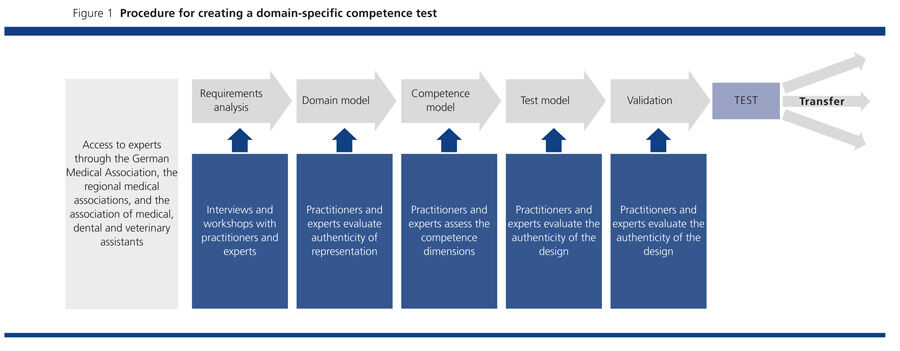
Procedure for creating a domain-specific competence test
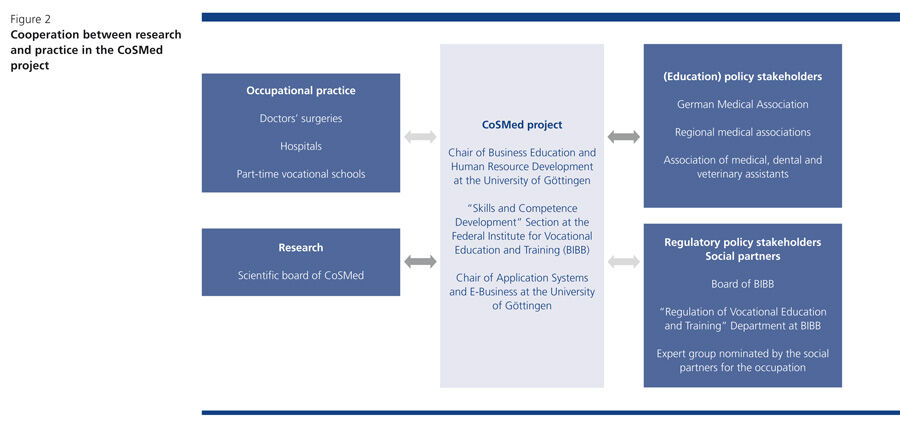
Cooperation between research and practice in the CoSMed project
The CoSMed project
The CoSMed (Competence Diagnostics: Simulations in Medical Settings) project is a consortium project in which the University of Göttingen (Chair of Business Education and Human Resource Development) and BIBB, the Federal Institute for Vocational Education and Training BIBB ("Skills and Competence Development" Section) are developing technology-based instruments for measuring the occupational competences of Medical Assistants.
The tests, which are being piloted in the course of the project on large samples of around 2000 trainees, will make it possible to report on the performance of trainees at the end of their initial vocational training. The work being done at BIBB focuses on social competences while the University of Göttingen is concentrating on competences in the medical-health and business-administrative domains. Technical implementation of the project is being supported by the Chair of Application Systems and E-Business of the University of Göttingen.
The project as a whole is funded by the Federal Ministry of Education and Research under the ASCOT research initiative for technology-based assessment of skills and competences in VET (cf. www.ascot-vet.net). It was launched in December 2011 for a three-year term.
Requirements analysis
The starting point for developing the test under the CoSMed project was the analysis of requirements (cf. process chart outlined in Figure 1). For the analysis of social competences, all incidents involving social contacts were taken under scrutiny. As well as extensive analysis of literature and documentation, interviews and workshops were conducted with Medical Assistants, doctors and other experts in this occupational field (e.g. representatives of chambers and professional associations) focusing on the tasks and framework conditions of the particular workplace. Especially success-critical situations were identified with the help of the "critical incident method" (cf. FLANAGAN 1954), and both positive and negative courses of action were explored.
Development of a domain model
All information obtained was aggregated in a domain model so as to completely represent the contents of the occupation, the framework conditions, normal duties and activities to be carried out (cf. KLIEME et al. 2003). In this process it became clear that the majority of normal duties and activities take place in interaction with three groups of people: patients, doctors and colleagues. The domain model for the Medical Assistant thus underscores the closely interlocking nature of medical-health, administrative-business and social competence requirements. The activities involving patient contact can be differentiated according to the interfaces of telephone calls, the reception desk and the treatment room, while interactions within the team involve additional locations like the laboratory and the break room. All interfaces can have typical task situations assigned to them, such as receiving complaints about delays at the reception desk, calming the patient who is waiting for an examination in the treatment room, or negotiating holiday dates with a colleague in the break room.
From domain model to competence model
In the next step, the current project phase, the competence model is derived from the domain model. This involves a psychological process of translating requirements and activities into the competences required to accomplish them. To establish foundations for the competence model, the CoSMed project pursues a combined empirical and theory-based approach, which considers the results of the requirements analysis against the background of psychological, linguistic and sociological theories.
The project has so far identified the following competences as necessary for meeting the social requirements of the work: Medical Assistants must be in a position to put themselves in the other person's place without losing sight of their own interests, to interact harmoniously by choosing readily understandable forms of communication, and to manage their own emotions constructively. These competences are the subject-matter of theoretical concepts on the coordination of perspectives, of linguistic approaches and communication models, and of emotional regulation theories. The firm theoretical foundations of the CoSMed project serve two purposes. On the one hand, they should preclude any mistaken assessment of behaviours that are commonplace in practice as necessarily positive. For example, it is conceivable that to regulate their own emotions many Medical Assistants absorb trouble instead of processing it appropriately. Line managers and other people might possibly rate this behaviour as desirable. Empirical findings suggest, however, that this behaviour causes negative stress in the short term and raises the risk of burnout in the long term (cf. HACKER 2009). On the other hand, coping theories highlight alternative coping strategies that are seldom mentioned in practice but are more effective nevertheless (cf. JOHN/GROSS 2004). Furthermore, theories help to mark out the developmental stages of the relevant competences, which in turn are important for modelling them in test items as well as fostering them in training.
Test design and validation
The next step of test design involves choosing, from among the identified occupational task situations, all those in which the measure of social competences can be assessed especially well. These situations are reconstructed in short film sequences, using actors. The test format consists of questions on every film sequence along with four multiple-choice answers. Respondents choose a response which shows how they would behave in the given situation.
The question is deliberately addressed to the identified dimensions of social competences: empathy, managing one's own emotions, verbal expression skills and communication strategies. The situational judgement tests described above provide the methodological foundation. While the multiple-choice responses are mostly obtained empirically, theoretical considerations nevertheless have an important role to play in CoSMed. They provide the background for a theoretically well-founded assessment of the alternative responses.
The finished test must be validated by experts from research and practice to ensure that it is factually correct and faithful to reality, and to confirm the psychological relationships between the competence and the requirement. Trials of the test then examine whether the designed questions on the individual competences do actually measure these unequivocally and specifically, and whether the competences can be differentiated clearly from each other.
Only when this pilot stage yields satisfactory results is the test used on a larger sample. Subsequently it is possible to draw preliminary conclusions on the social competences of Medical Assistants at the end of their initial vocational training period.
Research - practice - communication
A linchpin of the entire CoSMed consortium project is its close cooperation with partners from workplace practice. Project work in all phases of model and test development is carried out in cooperation and communication with experts from national and regional medical associations, the German association of medical, dental and veterinary assistants (Verband medizinischer Fachberufe) and a series of practitioner representatives from schools, doctors' surgeries and clinics (cf. Figure 2, p. 27).
The assessments from practice help in the selection of empirically-based competence dimensions, and ensure that the typical work and business processes represented in the test assignments are as authentic as possible. The participating associations also help to secure field access in order to trial the developed test instruments and to carry out the test study.
Transfer and applied use of results
Collaboration between research and practice creates a solid basis for the applied use of the results. It establishes the right prerequisites for translating the test procedures into existing examination practice at a later date. It also makes it possible to explore transfer opportunities into other occupations within the health and nursing occupational field, or into continuing vocational education measures, at an early stage. Close cooperation with the VET regulation section at BIBB also means that preparations can be made for practical transfer of the results into the regulatory process, e.g. for the redrafting of the training regulation and the examination procedure along competence-based lines. Aside from these options for practical application, the project results also make a contribution to scholarship. It remains as unclear as ever which are the components that make up social competences for individual occupations, and how these interact. Another equally open question concerns the relationship between social competences and technical or personal competences. For example, do technical and social competences develop in parallel or are some trainees strong technically but weak socially, or vice versa? Insights on these questions enable novel kinds of insight into the interaction of the different facets of all-round occupational competence.
Questions of this nature are highly significant for instruments like the German national qualifications framework (DQR). This specifies that the grading of social competence levels is done on the basis of a uniform structure for all occupations, which concentrates heavily on team and leadership skills (cf. Arbeitskreis DQR 2011). It is not yet been clarified whether this general approach is viable for all occupations. By comparing the task areas and requirement profiles for different occupations, it is possible to examine where exactly similarities and transfer opportunities exist. Occupation-specific analyses, as conducted under the CoSMed project, thus support educational and regulatory policy to base their schematic concepts on consistent competence descriptions.
Literature
ARBEITSKREIS DQR: Deutscher Qualifikationsrahmen für lebenslanges Lernen. Passed 22 March 2011 (current as of 08.10.2012)
EULER, D.; BAUER-KLEBL, A.: Bestimmung und Präzisierung von Sozialkompetenzen. Theoretische Fundierung und Anwendung für die Curriculumsentwicklung. In: ZBW 104 (2008) 1, pp. 16-47
FLANAGAN, J.C.: The Critical Incident Technique. In: Psychological Bulletin 51 (1954) 4, pp. 327-358
HACKER, W.: Arbeitsgegenstand Mensch: Psychologie dialogisch-interaktiver Erwerbsarbeit. Lengerich 2009
JOHN, O. P; GROSS, J. J.: Healthy and unhealthy emotion regulation: Personality processes, individual differences and life span development. In: Journal of Personality 72 (2004) 6 pp. 1301-1334.
KANNING, U. P.: Diagnostik sozialer Kompetenzen. Göttingen 2003
KANNING, U. P.: Soziale Kompetenzen. Entstehung, Diagnose und Förderung. Göttingen 2005
KLIEME, E. u.a.: Zur Entwicklung nationaler Bildungsstandards. Eine Expertise. Berlin 2003 KMK: Handreichung für die Erarbeitung von Rahmenlehrplänen der Kultusministerkonferenz für den berufsbezogenen Unterricht in der Berufsschule und ihre Abstimmungen mit den Ausbildungsordnungen des Bundes für anerkannte Ausbildungsberufe. Bonn 2007
NANGLE, D. W. et al.: Practitioner's Guide to empirically based Measures of Social Skills. New York 2010
NICKOLAUS, R.: Die Erfassung fachlicher Kompetenz und ihrer Entwicklungen in der beruflichen Bildung - Forschungsstand und Perspektiven. In: ZLATKIN-TROITSCHANSKAIA, O. (ed.): Stationen empirischer Bildungsforschung: Traditionslinien und Perspektiven. Wiesbaden 2011, pp. 331-351
SEYFRIED, B. (ed.): "Stolperstein" Sozialkompetenz. Was macht es so
schwierig sie zu erfassen, zu fördern und zu beurteilen? Bielefeld 1995 Verordnung über die Berufsausbildung zum Medizinischen Fachangestellten/ zur Medizinischen Fachangestellten vom 26. April 2006. In: BGBl I No. 22 of 5 May, 2006, pp. 1098-1108 (current as of 08.10.2012)
WEEKLEY, J. A.; PLOYHART, R. E. (eds): Situational Judgment Tests - Theory, Measurement, and Applications. Mahwah 2006
ZENTRALINSTITUT FÜR DIE KASSENÄRZTLICHE VERSORGUNG IN DER BUNDESREPUBLIK DEUTSCHLAND: Qualifikationsanforderungen an ArzthelferInnen. Arbeitgeberbefragung zur zukünftigen ArzthelferInnenausbildung. Abschlussbericht. Cologne 2002
Literature
AGNES DIETZEN
Dr., Head of the “Skills and Competences Development” Division at BIBB
MOANA MONNIER
Deputy of the “Skills and Competences Development” Division at BIBB
TANJA TSCHÖPE
Research associate in the “Skills and Competences Development” Division at BIBB
Translation from the German original (published in BWP 6/2012): Deborah Shannon, Academic Text & Translation, Berlin