Many young people end up in the transition area - despite their good education backgrounds
Regina Dionisius; Amelier Illiger; Friedel Schier
Despite the changing situation in the training place market there are still many young people entering measures in the transition area. The educational background of these young people is assumed to be the reason. However, one quarter of the beginners in the transition area have an intermediate school or higher school leaving certificate.
Comparing entrances into training and into the transition area
The integrated training reporting (iABE) points out which training and qualification pathways are followed by young people after completing lower secondary school. For this purpose a system of (educational) sectors and accounts was developed that mirrors these pathways in a clear-cut way. The highest general education certificate is recorded in the iABE using the "school education background" feature.
In order to compare the educational sectors relevant to initial VET, the aggregated 2011 data on beginners from the "integration into vocational training (transition area)" and "VET" sectors are contrasted: Apart from the education background, nationality and gender are indicated as examples in order to point out any target group differences and disadvantages (see EULER 2012).
The majority of the young people in the transition area had a school leaving certificate: About 53% of the beginners had completed lower secondary school and about 26 per cent even had an intermediate or higher school leaving certificate. Approximately 19% did not finish lower secondary school (see Table 1).
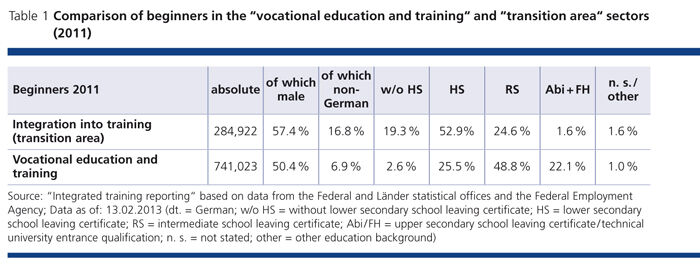
In the "VET" sector, more than one quarter (26%) of the beginners had a lower secondary school and almost half of them (49%) an intermediate school leaving certificate. Well over 22% had acquired general university or technical college entrance qualifications. The proportion of training beginners without lower secondary school leaving certificates is considerably lower here than in the transition area (less than 3%).
Other differences are: The share of young men (57.4%) and the share of young people without German citizenship (16.8%) are considerably higher in the transition area than among those starting initial VET.
The education background of beginners in the transition area
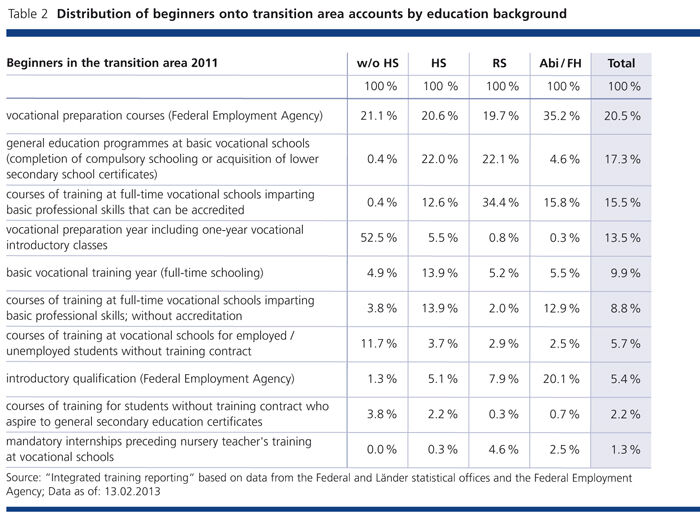
The integrated training reporting in the "integration into vocational training (transition area)" sector covers ten so-called education accounts, i.e. measures and school programmes for young people after completion of their general education which do not lead to a vocational certification (see Federal and Länder Statistical Offices 2012). They differ in their prerequisites, content and goals. It is possible to distinguish three functions of the transition area (see BEICHT 2010):
- Acquisition of traineeship entry maturity: School leavers without school leaving certificate undergo training preparation to acquire their certificate and traineeship entry maturity.
- Acquisition of higher educational qualifications: Young people attempt to acquire an intermediate education certificate to improve their career choice options ("qualification upgraders").
- Bridging the lack of training: Young people without success in finding a training place enter into a bridging measure ("market disadvantaged")
These functions of the transition area, however, cannot be statistically registered in a direct way. The school education background can be used as a supplementary indicator to establish the proportion of young people in "waiting loops". Table 2 shows how young people are distributed over the different courses of education depending on their education backgrounds.
If the school education background is taken as an indicator for (lack of) traineeship entry maturity or for market disadvantages, the data allow the following conclusions:
- Young people with university entrance qualifications are certainly among those experiencing a waiting loop since they can no longer upgrade their school qualifications (market disadvantaged). Similar considerations apply to the majority of the young people with intermediate school leaving certificates. Strikingly large subgroups of these well qualified persons are encountered in the vocational preparation measures of the Federal Employment Agency (BA) which are available nationwide. This includes many young people who have not developed a perspective at the beginning of the training year or who are looking for an alternative at the end of the year. Young people completing an internship before starting their training to become nursery teachers must not be counted among the market disadvantaged, since the internship is often a prerequisite for the nursery teacher's training.
- If we look at the group of young people without lower secondary school leaving certificates, or in other words, those we would most likely expect in the transition area, it turns out that 53% of them start a "vocational preparation year including one-year vocational introductory classes". It can be assumed that most of these young people primarily want to improve their "traineeship entry maturity" with a school leaving certificate. The state-specific vocational school programmes offered thus complete the preceding general school education at the lower secondary school level.
- To what extent young people intend to upgrade their qualification is not clearly assignable. A look at the education background, however, shows that almost one third of the young people completing a "general education programme for the completion of compulsory schooling or acquisition of lower secondary school certificates" already possess an intermediate school leaving certificate at the beginning of the programme. This contradicts the concept of qualification upgrading and obviously indicates a waiting loop.
Consequences
A comprehensive appraisal of entries into the transition area needs to take into account that each Land has a different situation and thus provides specific measures and programmes: In SchleswigHolstein, for example, intermediate education certificates are often awarded only in the transition area. In BadenWürttemberg some courses of education in the transition area are accredited as the first year of dual VET.
Still it is obvious that too many young people are placed in the transition area although they already have the general education background required for initial VET.
Literature
BEICHT, U.: Bedeutung und Wirksamkeit von Bildungsgängen des Übergangssystems (Analysen auf Basis der BIBBÜbergangsstudie 2006). In: BIBB (eds.): Datenreport zum Berufsbildungsbericht 2010: Informationen und Analysen zur Entwicklung der beruflichen Bildung. Bonn 2010, pp. 90-96
EULER, D.: Rückblick - Einblick - Ausblick: Das Übergangssystem im Übergang zum Inklusionsprinzip? In: ZBW 108 (2012) 3, pp. 321-328
FEDERAL AND LÄNDER STATISTICAL OFFICES: Indikatoren der integrierten Ausbildungsberichterstattung für Deutschland. Ein Vergleich der Bundesländer. Wiesbaden 2012
For further information on the integrated training reporting: iABE-Startseite - as of: 04.02.2013
REGINA DIONISIUS
Dr., Research associate in the “Vocational Training Supply and Demand/Training Participation” Division at BIBB
AMELIE ILLIGER
Research associate in the “Vocational Training Supply and Demand/Training Participation” Division at BIBB
FRIEDEL SCHIER
Research associate in the “Vocational Training Supply and Demand/Training Participation” Division at BIBB
Translation from the German original (published in BWP 2/2013): Paul David Doherty, Global Sprachteam Berlin