Young people in training - occupational preferences and further career plans
Michael Friedrich
Regular BIBB school leaver surveys provide information on the plans that young people have after general schooling and the occupational pathways upon which they embark. This article uses the 2012 results as a basis for presenting how young people became aware of their training place, how many offers they received and which career plans they are forming for the future.
Dual Vocational Education and Training - Preferences and reality
Affinity with the dual system of vocational education and training remains high. In the spring of 2012, almost half (47%) of young people leaving a general school, vocational school or full-time vocational school in the summer of the same year were interested in company-based training in the training year 2012/2013. 60 percent of these school leavers actually went on to commence dual training in the autumn of 2012. 56 percent concluded a training
contract with a company, four percent with an inter-company or extra-company institution. Three in four young people (75%) who were unable to realise their wish of entering dual training remain interested in pursuing training.
16 percent of these young people are still interested in entering training in 2012 and 39 percent are still interested in a training place for next year. 20 percent are seeking a training place for a later point in time. Results differentiated according to personal characteristics on the young people who have commenced training and on those who have failed to secure a training place and a presentation of developments over the course of time since 2004 are included in the Data Report to accompany the 2013 Report on Vocational Education and Training.
How did the young people become aware of the training place?
The answers given by the young people to this question were subsequently summarised in three categories.
- Social networks (e.g. parents, relatives, friends and acquaintances)
- Publicly accessible information and services (e.g.
a training place information exchange and the advisory services provided by the Federal Employment Agency, training place advertisements placed by companies in the print media or on the Internet) - Own activities (e.g. practical placements at companies and making their own enquiries of companies)
Publicly accessible information and services were the most popular category stated (32%), followed by own activities, mostly in the form of a practical placement (30%). Social networks, mostly friends and acquaintances, were stated by one in four young people (25%). There were a further four percent who became aware of their training place via various routes (summarised under "Other") and nine percent who provided more than one response, thus meaning that they could not clearly be allocated to one of the categories named (cf. Table 1).
Differences in access pathways become clear when the school leaving qualification of the young people is taken into account. Young people with a higher education entrance qualification are more likely to use publicly accessible information such as via the Internet (45%) and social connections (29%), whereas practical placements and making own enquiries of companies played only a lesser role (12%). By way of contrast, the latter route was the most important amongst young people with the lower or intermediate secondary school leaving certificate (34%). Only just under one in four (24%) of this group was able to use social connections, and less than a third (29% and 28% respectively) found their training place via publicly available information sources.
BIBB school leaver survey 2012
In the autumn of 2012, Forsa (Berlin) interviewed around 1,500 school leavers on behalf of BIBB on their current situation and (retrospectively) on their occupational plans from the spring. The survey included young people from general schools (lower secondary school, intermediate secondary school, integrated comprehensive school, upper secondary school), from vocational schools (specialised grammar school, specialised upper secondary school) and from non-fully qualifying education and training courses at vocational schools (prevocational training year, basic vocational training year and full-time vocational school not leading to a vocational qualification). The representative survey was conducted between September and the end of November 2012 via computer-aided telephone interviews. Comparable studies were carried out in 2004, 2005, 2006, 2008 and 2010 (for the method used cf. FRIEDRICH 2009).
Training in the preferred occupation and number of training place offers received
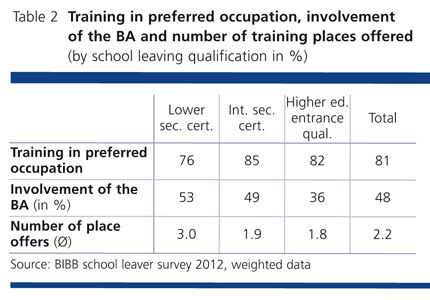
81 percent of the young people stated that they hadtr found a training place in their preferred occupation (cf. Table 2). In the case of 16 percent of young people, the training occupation corresponds at least in part with the preferred occupation. The training occupation did not match the preferred occupation for only four percent of the young people. It therefore also comes as no surprise that only three percent of young people currently completing training are looking for another training place.
This good result occurs because young people frequently received more than one offer of a training place and were therefore able to make a choice. Young people were offered an average of 2.2 places. One in two of the young people commencing training had the prospect of more than one training place.
A more precise consideration of the results reveals that young people with the lower secondary school leaving certificate (Ø 3 places) had significantly more prospective training places than young people with a higher education entrance qualification (Ø 1.8 places) and young people with the intermediate secondary school leaving certificate (Ø 1.9 places). This is presumably linked to the fact that young people with a lower secondary school leaving certificate are more likely (53%) to register with the Federal Employment Agency (BA) as a training place applicant than young people with an intermediate secondary school leaving certificate (49%) or young people with a higher education entrance qualification (36%). Young people who also sought to obtain a training place via the BA were offered an average of 2.6 company-based training places. The average for those not registered with the BA was two places. The assumption is that these training places included a relatively large number of positions that are unattractive for young people with a good lower secondary school leaving certificate or higher school leaving qualification (such as salesperson specialising in foodstuffs, restaurant specialist, or cook).
This good result occurs because young people frequently received more than one offer of a training place and were therefore able to make a choice. Young people were offered an average of 2.2 places. One in two of the young people commencing training had the prospect of more than one training place.
A more precise consideration of the results reveals that young people with the lower secondary school leaving certificate (Ø 3 places) had significantly more prospective training places than young people with a higher education entrance qualification (Ø 1.8 places) and young people with the intermediate secondary school leaving certificate (Ø 1.9 places). This is presumably linked to the fact that young people with a lower secondary school leaving certificate are more likely (53%) to register with the Federal Employment Agency (BA) as a training place applicant than young people with an intermediate secondary school leaving certificate (49%) or young people with a higher education entrance qualification (36%). Young people who also sought to obtain a training place via the BA were offered an average of 2.6 company-based training places. The average for those not registered with the BA was two places. The assumption is that these training places included a relatively large number of positions that are unattractive for young people with a good lower secondary school leaving certificate or higher school leaving qualification (such as salesperson specialising in foodstuffs, restaurant specialist, or cook).
Career plans
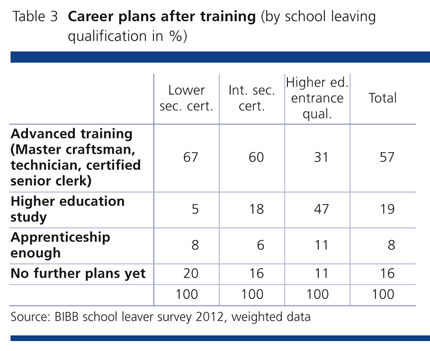
Opportunities for advancement within the vocational education and training system and permeability to academic education play an important role for the young people and are perceived by them right at the beginning of training. Most of the young people (76%) would like to pursue further education or training upon conclusion of their initial training. The majority goal for young people with a lower or intermediate secondary school leaving certificate (67% and 60% respectively) is a course of advanced training leading to a qualification as master craftsman, technician or certified senior clerk. Young people with a higher education entrance qualification tend to prefer (47%) to study for a degree upon completion of training. Only one in three (31%) of young people in this category wished to pursue advanced training (cf. Table 3).
Solving Matching Problems
Although the positive training places market trend of the last few years "began to falter" in 2012 (cf. ULRICH et al. 2012), young people's training opportunities have, in overall terms, developed positively over the course of time. The results of the BIBB school leaver surveys confirm this trend. One pleasing aspect is that young people with a lower secondary school leaving certificate can benefit from this development alongside young people with intermediate and higher school leaving qualifications. Young people with a lower or intermediate secondary school leaving qualification in particular show a high degree of educational aspiration and endeavour to pursue further training within the VET system. This target group is therefore of interest to companies seeking to cover their future requirements for young and qualified skilled workers.
Matching problems between supply and demand also need to be resolved in order to secure the supply of young skilled workers. As part of this process, the integration of young people with lower levels of school performance and of young people who are socially disadvantaged will gain in significance.
Literature
FRIEDRICH, M.: Berufliche Pläne und realisierte Bildungs- und Berufswege nach Verlassen der Schule. Ergebnisse der BIBB-Schulabgängerbefragungen 2004 bis 2006 [Career plans and educational and career pathways realised after leaving school. Results of the BIBB school leaver surveys 2004 to 2006] Bielefeld 2009
FRIEDRICH, M.: Berufliche Wünsche und beruflicher Verbleib von Schulabgängern und Schulab-gängerinnen [Career wishes and occupational destination of school leavers]. In: BIBB (Ed.): Datenreport zum Berufsbildungsbericht 2013 [Data Report to accompany the 2013 Report on Vocational Education and Training], Chapter A3.1. Bonn 2013 - URL: http://datenreport.bibb.de (Stand: 17.06.2013)
ULRICH, J. G. et al.: Die Entwicklung des Ausbildungsmarktes im Jahr 2012. Entspannung auf dem Ausbildungsmarkt gerät ins Stocken [Development of the training market in the year 2012. Easing of the situation on the training market begins to falter] BIBB-Erhebung über neu abgeschlossene Ausbildungs¬verträge zum 30. September[BIBB Survey of newly concluded training contracts as of 30 September], Bonn 2012 - URL: www.bibb.de/dokumente/pdf/a21_beitrag_naa-2012.pdf (accessed: 17.06.2013)
MICHAEL FRIEDRICH,
Research associate in the "Vocational Training Supply and Demand/Training Participation" Division at BIBB
Translation from the German original (published in BWP 4/2013): Martin Stuart Kelsey, Global Sprachteam Berlin