Withdrawals of training applicants
Reasons companies suspect to be behind this
Margit Ebbinghaus, Silke Hüls, Regina Dionisius
Filling training places presents challenges for many companies. This problem area is further exacerbated when applicants or even prospective trainees withdraw from the process. A survey of 377 companies providing training using the Reference Company System (RBS) investigates how frequently and when such withdrawals occur and looks at the reasons which companies suspect may be behind this. Reflection against the motives of young people shows that the assumptions of the companies are not incorrect, but that they underestimate a relevant aspect of the recruitment process.
Applicant withdrawals – a factor in the filling of training places that has received little attention thus far
For many companies, providing their own vocational education and training is a key building block in terms of securing a supply of skilled workers. Successfully filling the training places on offer has, however, proved to be a major challenge for years. Although the situation on the training market improved slightly in favour of the supply side in the 2025 reporting year, 54,400 places – or 10.6 percent of company training provision – still remained vacant (cf. Christ et al. 2025). The IAB Establishment Panel, which takes account of training places registered with the Federal Employment Agency (BA) as well as including non-registered training places and partial training contracts outside the scope of the Vocational Training Act (BBiG) and the Crafts and Trades Regulation Code (HwO), even recorded a vacancy rate of just over 30 percent for the year 2024 (cf. Fitzenberger/Leber/Schwengler 2025).
The most frequently discussed explanations for unfilled training places relate to a basic shortage of applications or to insufficient suitability of applicants from a company point of view. However, even when a company receives (suitable) applications, there is no guarantee that the training place can actually be filled. There are increasing reports that trainees whose participation has already been planned fail to turn up on the first day of training. This phenomenon, often referred to as ghosting, represents a particular form of applicant withdrawals. But how frequently are companies really affected by withdrawals?
Applicant withdrawals have only been investigated in a fragmentary fashion in the empirical research conducted thus far. In a few individual company surveys, for example, the fact that applicants change their minds is cited as a reason for unfilled training places (cf. Ebbinghaus/Leber/Schwengler 2025). Some survey studies on ghosting also exist. In these cases, the likelihood that young people simply cease contact or do not take up the training place is examined from a company perspective or from the point of view of the young applicants (cf. inter alia Ullrich/Böcker 2024). Nevertheless, there is not enough empirical evidence to obtain a differentiated picture of the various forms of applicant withdrawals and of the occurrence of these during the individual phases of the recruitment process (e.g. at the very outset of the selection procedure). The same applies to the reasons which cause applicant withdrawals.
Presumed causes as an important prerequisite for targeted measures
Although numerous HR advice sites contain recommendations for the prevention of applicant withdrawals, whether companies actually take appropriate measures probably largely depends on what reasons they themselves believe lie behind the phenomenon. This is something of which we have very little knowledge at present. It thus remains unclear not only which intervention measures companies may be open to, but also the extent to which such measures tackle the real causes of applicant withdrawals. Our article seeks to address this gap. We will begin by addressing the question of the points of time in the recruitment process at which companies are affected by applicant withdrawals. We will then consider the reasons which companies believe to be behind such withdrawals. Finally, the reasons presumed by the companies will be reflected against the – small number of – empirical findings which indicate the reasons given by young people for withdrawing from the application process of their own accord.
Reference company system (RBS)
The RBS is an Access Panel instigated by BIBB which comprises companies of different sizes and sectors across all regions of Germany. These firms have agreed to be contacted once or twice a year for brief surveys on current topics of relevance to vocational education and training. As well as being willing to participate in this way, companies must be actively involved in providing training in order to be accepted onto the panel. They are, however, not excluded if they subsequently cease to offer training. This means that the panel now contains some companies which no longer provide training.
Although the panel is structurally mixed, it does not constitute a representative company sample. To this extent, RBS surveys only serve to indicate trends. Nevertheless, these have proved to be relatively accurate.
A company survey promises answers
Questions are processed on the basis of a survey of around 1,270 companies on the topic of “Withdrawals of training applicants”. The survey was conducted in the autumn of 2025 using the reference company system (RBS) (cf. Information Box). A total of 401 panel companies took part. This figure included 377 companies providing training, the distribution of which was 34 percent smaller companies (1–19 employees), 35 percent medium-sized companies (20–199 employees) and 31 percent larger companies (200 or more employees). The information they provided forms the basis of the following remarks.
Withdrawals the rule rather than the exception
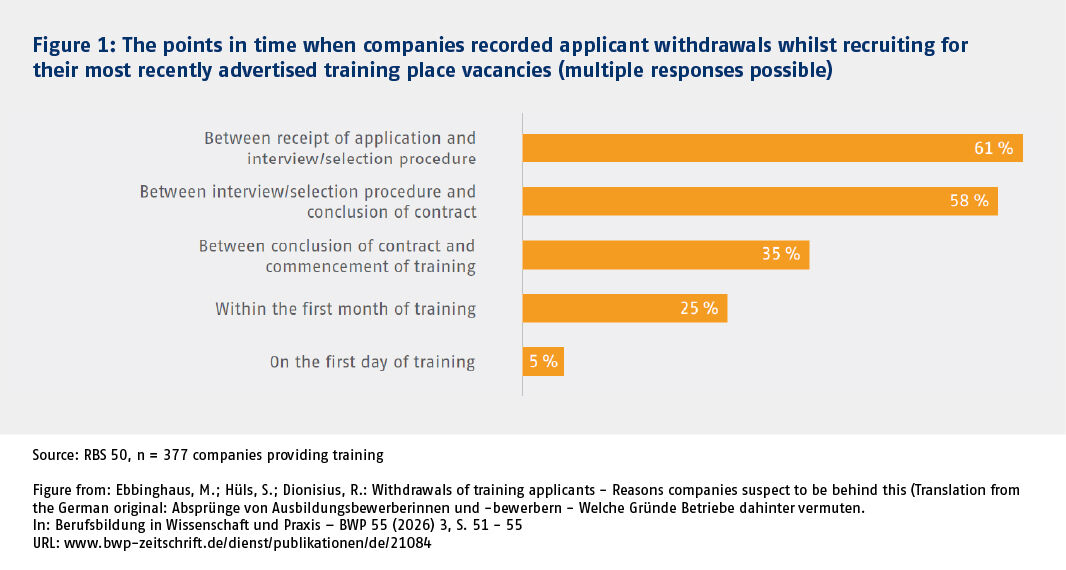
The majority of the RBS companies surveyed (85 %) most recently offered places for the 2025/2026 training year. Almost all of the others had done so for the previous year. In the course of filling these places, four in five companies (80 %) ultimately experienced the loss of applicants they had initially acquired. It should be borne in mind that companies usually only note the withdrawal of applicants in whom they have a greater interest. In some cases, withdrawals even meant that training places could not be filled. This was the case for one in five (20 %) of the companies surveyed.
The most frequent response of the companies was that applicants exited the process even before an interview was conducted. Just over six in ten of the surveyed companies providing training reported experiences of this kind (cf. Figure 1). Withdrawals become less common as the time of planned commencement of training approaches. One likely reason for this is that the group of applicants who could still withdraw becomes smaller after each selection stage. Nevertheless, even the time when the contract is concluded does not mark a cut-off point at which withdrawals stop. On the contrary, just over a third of companies were confronted with a situation where young people who have entered into a contract and therefore might be viewed with some certainty as prospective trainees withdrew from the process prior to the start of training. However, only a relatively small number of companies state that young people failed to turn up on their first day of training. The type of withdrawal known as ghosting, which is currently a particular point of interest in the media, appears to be less widespread than public reporting would sometimes have us believe. However, withdrawals increase once more directly after commencement of training. A majority of the surveyed companies providing training stated that this was not the first time they had found, when filling their most recent vacancies, that young people had applied but then lost interest in the training place. Only one in ten companies had not previously experienced this, and the same proportion had never faced applicant withdrawals at all. All other companies were familiar with the phenomenon because it had happened to them in previous years.
Companies presume that offers from competitors are the main reason for withdrawals
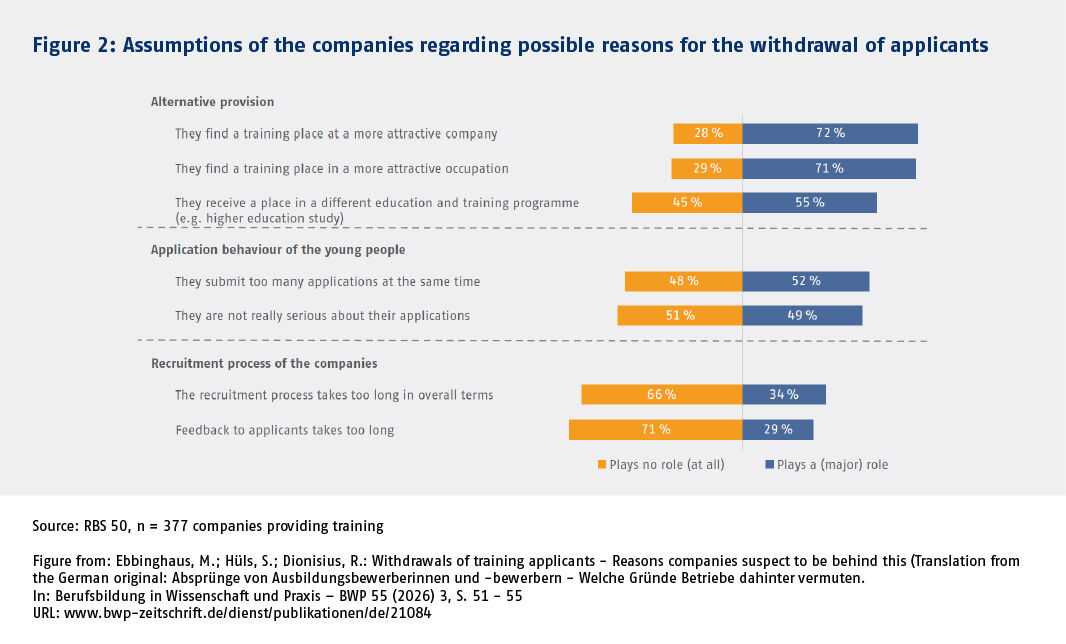
What causes young people to no longer pursue an application that has been submitted for a certain training place? The companies surveyed were presented with seven possible causes and were asked to indicate to what extent they believed each played a role. The companies were also able to comment on the issue of withdrawals in an open text box. Some of these statements are addressed below.
According to the assessments of the causes surveyed, the main assumption of the RBS companies providing training is that attractive competing offers encourage young people to withdraw (cf. Figure 2). However, they do not believe that competing provision from outside vocational education and training (e.g. a higher education study place) is as much of a cause. The proportions of companies which believe this to be likely or unlikely are similar (55 % and 45 % respectively). Competing provision from inside vocational education is of greater relevance in the companies’ view. This may equally involve training offers from more attractive companies or training places in more attractive occupations. From the companies’ perspective, what makes one company “more attractive” to young people does not always appear to be linked to the company’s (training) conditions, and indeed several companies made comments similar to this one: “The most frequent reason stated for a withdrawal in our case [...] was the response that ‘I have found a training place nearer to where I live.’” Proximity to place of residence was a decisive factor, even if companies were much smaller and offered “worse” conditions and poorer training opportunities. And an “attractive” occupation also sometimes simply seems to mean “a different occupation”. This is strongly suggested by comments such as: “They are unsure whether they want to become a florist, media designer or sculptor. So, they apply everywhere, only to realise that they do not fancy being a construction worker after all.”
The companies have mixed assumptions regarding the role played by the application behaviour of young people. Half of the companies are convinced that applicant withdrawals are (also) due to young people applying for too many training places at the same time. The other half of the companies, however, do not view this as a (key) cause. A comparable statement may be made regarding the assumption that withdrawals are caused by the lack of seriousness of a submitted application. One company agreed with this assumption by commenting that “commitment on the part of applicants is declining”.
Whereas a majority of the companies thus associate applicant withdrawals with reasons which lie outside their own firm, potential internal reasons are – not completely unexpectedly – viewed as a cause by a significantly lower number of companies. Questions were specifically posed about two aspects of the time structure of the application process. One of these concerned the overall duration of the application or recruitment process, and the other related to the period of time within which applicants receive feedback (for example regarding receipt of application or the impression made during the interview). Just under or just over a third of companies were prepared to admit that withdrawals might occur in one or two cases if things took too long. Such a view was, however, rejected by the majority. One respondent summed up the general attitude among many companies regarding attribution of cause by saying: “The companies are not the problem. The problem is the applicants [...].”
Categorisation of the survey results
Are the presumptions of the companies correct, or do they deviate from young people’s actual motives for withdrawing? In simplified terms, the answer is yes and yes.
Various findings substantiate the view that (attractive) alternative opportunities, which companies regard as particularly significant, do indeed play a role in withdrawals of applications which have been submitted. Studies by Greilinger/Graser (2023) and Ebbinghaus et al. (2025) show that, for young people, the desire or the opportunity to switch to a better training contract is a decisive factor in continuing to look for alternatives after signing a training contract or in dissolving the contract before commencement of training. In some cases, the young people were already aware when concluding the original training contract that they were merely making a “second choice”. This view was based on characteristics relating to the occupation, to the company or to the general prevailing conditions (e.g. the training allowance). As mentioned by the company cited above, company characteristics stated commonly included location and accessibility (cf. Greilinger/Graser 2023; Ebbinghaus et al. 2025).
The extent to which young people’s application behaviour leads to actual rather than to presumed withdrawals from the recruitment process is more easily inferred from circumstantial evidence than deduced from empirical findings. According to the “2025 Trainee Recruiting Trends” study, more than 40 percent of training applicants surveyed had received two or more training offers (cf. Ullrich/Böcker 2025). This clearly implies that a not inconsiderable proportion of young people apply to several companies in parallel. Although it is not possible to deduce from this whether they are submitting too many applications at the same time, the comments of the companies surveyed suggest that applications may not always be well targeted. This is at least the conclusion indicated by recent studies, which have identified a growing concern among young people that they might make the wrong decision (cf. McDonald‘s 2025; Bertelsmann Foundation 2025). A resultant broad spread may well impair the seriousness of individual applications. The fact that serious intention is sometimes directly lacking is underlined by the reason given by a few young people who continue looking after concluding a contract: “to see how far I can get elsewhere” (cf. Ebbinghaus et al. 2025). To this degree, the assumptions made by the companies are also not without substance. At the same time, applying to several companies simultaneously is a sensible strategy in terms of safeguarding against potential rejections and finding the most suitable training place.
Nevertheless, many companies underestimate the significance of the duration of application processes for young people. There is even some evidence to suggest that this is the most relevant factor behind applicant withdrawals. The most frequent reason for breaking off contact with companies cited by pupils responding to the “Training 2024” study was that a response was received too late (cf. Trendence Institut 2024). Similarly, the “2024 Trainee Recruiting Trends” study identified protracted decision-making by companies as the main reason why applicants withdrew from the recruitment process (cf. Ullrich/Böcker 2024). By way of contrast, large proportions of young people expect feedback within a week.
Making better use of areas of structural leeway
The findings reported indicate that companies still have opportunities to counter withdrawals by training applicants by adjusting the timing of their recruitment processes, given that a significant proportion of the RBS companies surveyed underestimate the relevance of this. However, it must be assumed that these are not the only options available to companies seeking to retain applicants they have already acquired. Structuring training provision in an attractive way is also likely to be a worthwhile approach.
The survey carried out with the RBS was only able to shed light on a small range of possible reasons which may be behind the withdrawal phenomenon. Furthermore, given the small and non-representative sample size, the findings should be interpreted merely as an indication that companies may have a somewhat narrow view of the reasons that lead young people to not follow through with an application for a training place once this has been submitted. Nevertheless, the findings suggest that applicant withdrawals are a key factor in the complex web of causes behind the difficulty, or even impossibility, of filling training places. This is an issue that requires greater attention than it has received to date, from the perspective of both applicants and the companies providing training.
Literature
Greilinger, A.; Graser, K.: Ghosting. Ausbildungsvertrag unterschrieben – alles fix? Empirische Erkenntnisse zu Kündigungen vor bzw. dem Nichterscheinen bei Ausbildungsbeginn. In: Beruf und Bildung 6 (2023) November/Dezember, pp. 369–375
(All links: status 15/07/2026)
Margit Ebbinghaus
Dr. Research fellow at BIBB
Silke Hüls
Research fellow at BIBB
Regina Dionisius
Dr. Research fellow at BIBB
Translation from the German original (published in BWP 3/2026): Martin Kelsey, GST GlobalSprachTeam ‒ Sassenberg e. K., Berlin