Buoyant sentiment among German exporters of vocational education and training
Monika Muylkens
Vocational education and training "made in Germany" is booming. Since 2007 iMOVE has been surveying 100 German initial and continuing vocational education and training providers about their current activities and future plans in foreign markets. Selected results of the iMOVE TrendBarometer are presented in the article.
The export of vocational education and training services is frequently accompanying other exports and is not systematically recorded - in no small part because the multitude of providers and the variety of their offerings make it a field that is very complex to analyse. There is, however, great interest in compiling an overview of this growing economic sector in the form of indicative figures. These could be useful to German training providers as a basis for defining their strategic outlook and making investment decisions. State agencies would have the benefit of some evidence-based reference points on how they can continue to promote German education export in the field of initial and continuing vocational education and training. For instance, such information could give the Federal Institute for Vocational Education and Training (BIBB) pointers on how the services provided by iMOVE (cf. information box) could be further improved to meet the sector's needs.
The iMOVE trendbarometer
The iMOVE TrendBarometer, which has been published since 2007, cannot fundamentally alter the inadequacy of the current data on vocational education and training export. Nevertheless, it yields preliminary insights into the prevailing sentiment among German companies offering vocational education and training services abroad, and reflects the sector's situation and own self-assessment. For the current TrendBarometer, iMOVE interviewed 100 individuals in leading roles in German education and training companies which are already actively exporting vocational training. The export of vocational training is defined as:
- Export of initial and continuing vocational education and training in the broadest sense: Not just knowledge transfer, but also consultancy services relevant to education and the sale of teaching and learning resources
- "Incoming" (e.g. face-to-face seminars in Germany) and "outgoing" (e. g. consultancy to a foreign vocational training establishment) in situ or online.
A few findings from the quantitative and qualitative evaluations are presented below.
iMOVE
The acronym stands for International Marketing of Vocational Education and is an initiative of the Federal Ministry of Education and Research (BMBF) for the internationalisation of German initial and continuing vocational education and training services. The initiative is based at BIBB.
Since 2001, iMOVE has been supporting German continuing vocational education providers with an extensive range of services to support access to international markets.
iMOVE seeks to inform interested parties around the world about German competence in the field of vocational training and continuing education, along with "made in Germany" qualifying opportunities. Further information: www.imove-germany.de
Number of exporters more than doubled since 2010
The survey shows that the export of vocational training is an important business segment for German providers. Survey respondents estimate that almost one in four German providers now exports education services, which is more than double the figure reported in the 2010 survey. A further reference point for the sector's economic relevance is given by the respondents' statements on their annual turnover. Although only 72 of them gave responses, their annual turnovers in the export of vocational training amount to 550 million euros in the year 2011. In the 100 training providers surveyed, around 5,650 persons in total - around 16 per cent of their entire staff - were working on the export of vocational training.
Whereas 27 per cent of respondents expect a turnover of below one billion euros in 2012, 13 per cent consider a turnover of one to two billion euros realistic. One in ten respondents considers two to five billion euros a likely volume of turnover in the sector, while seven per cent of the providers questioned believe in an export volume of five to ten billion euros, with six per cent looking to a figure of ten billion euros or more. The volume of turnover in the sector will grow, according to the majority of respondents' predictions, by at least nine per cent by 2015. Seven out of ten training providers believe that both their German and their export business will develop positively in the next three years. The same number of respondents think that their business abroad will post even better progress than their German business during the same period. Never has there been such a positive sentiment about education exports as opposed to the German education and training market since the survey was launched in 2007.
German education exports by international comparison
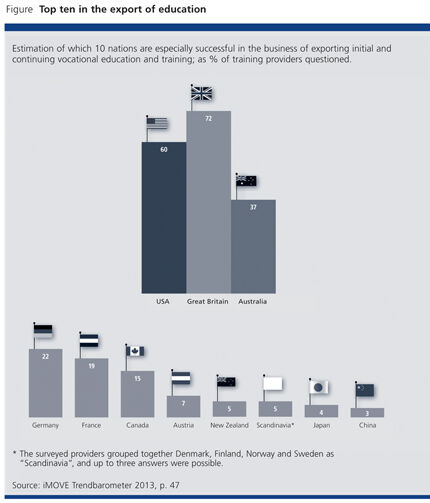
90 per cent of the surveyed training providers rate the export competitiveness of German training as "moderate to high", with almost half of them giving an unqualified "high" rating for competitiveness. The providers surveyed currently view the German export of initial and continuing vocational education and training as ranking in fifth place compared to providers from other nations. They estimate that German exports in the vocational training sector could even climb to fourth place by 2015. In the training providers' view, particularly successful competitors are those from Great Britain, the USA and Australia. When asked about the reasons for success, many respondents answered that English language skills, the familiarity of the education systems, and state support by the respective governments gave these competitors decisive advantages. At the same time, the prevailing positive German image in target markets was helpful for the export of German education services (cf. figure).
Success factors and barriers
iMOVE questioned the training providers on the essential success factors for their own business abroad. A factor they see as especially important is the commitment of management (96%). Management should be willing to set internal incentives within the company and to make adequate resources available for foreign business both in the short and medium term. Factors of almost equal importance to respondents were sound information about the target market, and foreign language and intercultural skills within their own company (94% each) as well as good contacts in the target market (93%), followed by cooperation with local partners (90%). Somewhat less important to those surveyed is their own internationalisation strategy (76%). A corporate presence in the target market is a determinant of success for close to six in ten providers (57%). More than half of those surveyed see the state support from Germany (54%) as a factor for the success of their foreign business.
In education export, it can often take several years to line up business successfully. Accordingly seven out of ten providers state that long lead times are a barrier in education export. The lack of contacts in the target market is a barrier for 66 per cent of the training providers surveyed. German training providers feel that both barriers within their own companies and limited capacities or competences are almost as obstructive (65%) as, for example, visa or customs regulations (63%). Providers exporting education and training are also held back by limited revenue-earning opportunities in the target market. Four out of ten providers (42%) find competition from other providers almost equally as challenging as the lack of information about the target market (41%). A generally poor regard for vocational education in the target market is a barrier for one-third of the respondents (32%). At the same time, comments from individual providers indicate that this very factor can bring German providers into the business.
At www.imove-germany.de the latest TrendBarometer report ("Trendbarometer Exportbranche Aus- und Weiterbildung 2013", in German) is available free of charge to order or download. German training providers may draw different conclusions from the information in the TrendBarometer. One thing is quite clear, however: the respondents currently assess the situation and prospects for their sector very positively, in its own right and by international comparison. Apart from that, the study shows that state support for the export of vocational training - not only financial but also specialist content support as well as marketing activities in the target markets - is what the sector wants. The Federal Ministry of Education and Research (BMBF) supports German education export in various ways including the funding guideline on "Education Export" and by means of iMOVE. On the basis of the findings of the Trend Barometer survey, iMOVE will continue to develop its own service offering.
MONIKA MUYLKENS
Research associate in the "iMOVE: Training - Made in Germany" Division at BIBB
Translation from the German original (published in BWP 6/2013): Deborah Shannon, Academic Text & Translation, Berlin