Growing problems in matching supply and demand in the training place market
Stephanie Matthes, Joachim Gerd Ulrich
From 2007 to 2011 in Germany, the proportion of unsuccessful applicants for apprenticeship places fell markedly. In 2012 this trend reversed, however, and the situation worsened once again in 2013. It is striking that not only is the proportion of unsuccessful applicants back on the upturn but, at the same time, companies are increasingly struggling to fill their places. The article describes the situation and inquires into the causes.
The ratio between supply and demand
In the majority of cases, companies and young people manage to become linked up in their respective capacities as training place providers and training place seekers. Nevertheless, some market participants are unable to realise their training wishes. If the proportion of VET places which are unsuccessfully offered is relatively high whilst the ratio of unsuccessful applicants remains low, a recruitment problem exists on the training market. If only small numbers of VET places remain unfilled but many young people are unsuccessful in their applications, then there is an integration problem. In cases where there are unfilled VET places and large numbers of unsuccessful applicants, a matching problem is experienced (cf. Table 1).
Recruitment problems
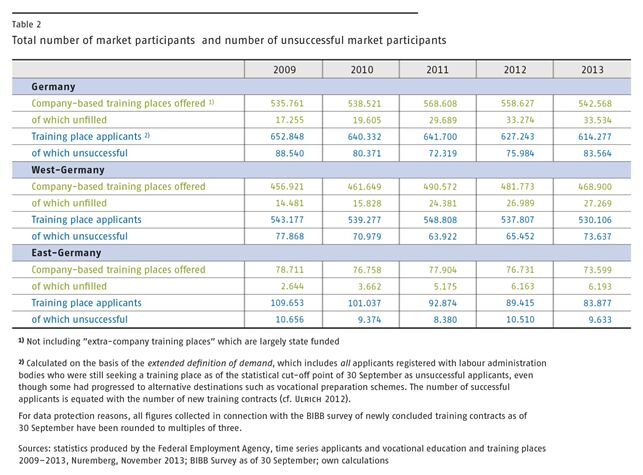
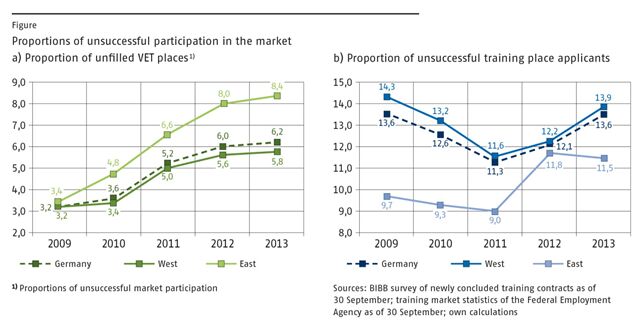
Recruitment problems have been continuously increasing nationwide over the past five years. Whereas in 2009 only 17,300 unfilled VET places were officially recorded at the statistical cut-off point of 30 September (cf. Federal Employment Agency 2013), the corresponding figure for 2013 was almost twice as high at 33,500. A unique phenomenon has been occurring since 2012, which has seen the number of unfilled places rise despite the fact that training supply has been falling in overall terms (cf. Table 2). This resulted in an increase in the relative proportion of unfilled VET places to 6.2 percent by 2013. Recruitment problems have worsened more in East Germany than in West Germany. In the East, the rate in 2013 was almost two and a half times that of 2009 (cf. Figure a, p. 7).
Integration problems
As a result of a growing supply of company-based training until 2011 and a lower level of demand on the part of young people, the number of unsuccessful VET place applicants fell between 2009 (88,500) and 2011 (72,300). From 2012, however, integration problems increased once more. Although there was a decrease in the number of people seeking a training place (from 641,700 in 2011 to 614,300 in 2013), the number of unsuccessful applicants rose from 73,300 in 2011 to 83,600 in 2013. The relative proportion of those still seeking a VET place went up from 11.3 percent to 13.6 percent (cf. Figure b, p. 7).
Matching problems
The growth in both recruitment and integration problems in 2012 and 2013 brought an increase in matching problems in its wake. The Federal Government has rightly identified such problems as one of its major challenges (cf. BMBF 2013, S. 24). The larger these problems become, the harder it becomes for an arithmetical balance between supply and demand to meet the needs of trade and industry for skilled workers and the need of young people for integration into vocational training. The fear is that companies who continue for a long period of time to offer training places which remain unfilled will at some point withdraw from the training market in disappointment. On the other hand, young people will need to expect heavily delayed transitions to vocational education and training, and the risk increases that some will remain without training permanently.
Table 1: Types of problems on the training market
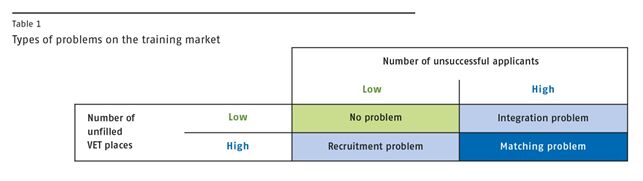
Table 2: Total number of market participants and number of unsuccessful market participants
Causes
The primary causes of the growing recruitment difficulties lie in demographic developments. The number of young people in Germany is undergoing a chronic shrinkage, resulting in a reduction of the number of young people interested in pursuing training. This especially applies to occupations which do not have such a good image. Even less able school leavers, who would have turned to such occupations if market conditions were difficult, are reverting their attention to occupations which they believe to be more attractive. Certain craft trade occupations, occupations in the hotel and restaurant sector and cleaning occupations are particular victims of this phenomenon.
One of the reasons why integration problems have once again been increasing for young people since 2012 is the fact that company-based supply of VET places is falling (cf. Table 2). Regression analyses (cf. Ulrich et al. 2013) show that a reduction in additional supply in the form of "extra-company training places", which are predominantly publicly funded, is also playing a role. Whereas there were 45,800 such training places in 2009 and still 30,500 places in 2011, the figure for 2013 was only 21,700. There were two essential reasons for this decrease. Firstly, the expectation was that the supply situation with respect to company-based apprentices would continue to improve. Secondly, the aim was to prevent company-based training places from remaining unfilled because of extra-company supply. This training policy approach functioned perfectly well until 2011 due to the fact that company-based training supply was expanding. From 2012, however, this supply fell once more. This resulted in a deterioration of the percentage ratio between company-based/extra-company places and the number of training applicants (2011: 93.4 %, 2013: 91.9 %).
There are, however, also statistical reasons for the increasing proportion of unsuccessful applicants. Many applicants break off contact with the advisory and placement services without such bodies finding out what has happened to them. We know from representative surveys that large numbers of such persons find themselves in precarious life situations. If the problematic proportion of applicants whose whereabouts are unknown is successfully decreased, the young people concerned are allocated to the category of unsuccessful applicants. The relevant ratio then rises. The State of the City of Hamburg is an example in this regard. In 2009, the whereabouts of 26.7% of all registered applicants was unknown. Targeted measures enabled this proportion to be reduced to its present level of only 12.1 percent (cf. Federal Employment Agency 2013). At the same time, however, the proportion of unsuccessful applicants (which is now increasingly visible) rose from 5.9 percent to 15.2 percent (cf. Ulrich et al. 2013).
Figure: Proportions of unsuccessful participation in the market
Literature
Bundesagentur für Arbeit [Federal Employment Agency]: Arbeitsmarkt in Zahlen. Zeitreihe Bewerber und Berufsausbildungsstellen [Labour market in figures. Time series applicants and vocational education and training places]. Nuremberg 2013
BMBF [Federal Ministry of Education and Research]: Report on Vocational Education and Training 2013. Bonn/Berlin 2013
Ulrich, J. G.: Indikatoren zu den Verhältnissen auf dem Ausbildungsmarkt [Indicators for ratios on the training places market]. In: Dionisius, R.; Lissek, N.; Schier, F. (Eds.): Beteiligung an beruflicher Bildung - Indikatoren und Quoten im Überblick [Participation in vocational education and training - a summary of indicators and rates]. Bonn 2012, pp. 48-65
Ulrich, J. G. et al.: Die Entwicklung des Ausbildungsmarktes im Jahr 2013 [The development of the training market in the year 2013]. Bonn 2013
STEPHANIE MATTHES
Research associate in the “Vocational Training Supply and Demand / Training Participation” Division at BIBB
JOACHIM GERD ULRICH
Dr., Research associate in the “Vocational Training Supply and Demand / Training Participation” Division at BIBB
Translation from the German original (published BWP 1/2014): Martin Stuart Kelsey, Global Sprachteam Berlin