Dual role of the transitional sector in the integration of refugees
Regina Dionisius, Amelie Illiger
With the beginning of increased immigration of refugees to Germany in 2015, the number of beginners with foreign nationality in the transitional sector also rose substantially. This article addresses the question of what roles the transitional sector plays in the integration of refugees and which transitional measures are particularly important for immigrants.
The transitional sector and its roles
The integrated training reporting (cf. Information Box) records young people participating in measures where they can obtain partial vocational qualifications that do not result in a vocational qualification in the sector “integration into vocational education and training (VET)” (transitional sector). These measures differ in their prerequisites, content and goals. According to Beicht (2010), it is possible to distinguish three roles of the transitional sector, which have the objective of integrating young people into vocational education and training:
- Acquisition of traineeship entry maturity: School leavers without a school leaving certificate undergo training preparation to acquire their certificate and traineeship entry maturity.
- Acquisition of higher educational qualifications: Young people attempt to acquire an intermediate education certificate to improve their career choice options (“qualification upgraders”).
- Bridging the lack of training: Young people who have been unsuccessful in finding a training place enter into a bridging measure (“market disadvantaged”).
However, the available education opportunities do not always clearly serve one of these roles specifically. Many measures in the transitional sector are designed to take on multiple roles.
iABE – Integrated training reporting
Since the 2005 reporting year, the integrated training reporting has reported on the education and training stations of young people after after completing lower secondary school. Various official statistics are linked for this (“integrated”).
Although the integrated training reporting does not provide any information on refugees – because it can only distinguish between “German nationality” and “foreign nationality” –, the combination of the characteristics of foreigners, previous school education of foreigners, and special analyses of the “programmes for learning German” provides clear indications of where refugees end up.
Young people with foreign nationality in the transitional sector
The data of the integrated training reporting shows that since the start of the increased migration of refugees, more and more young people with foreign nationality have been funnelled into special programmes within the transitional sector that focus on learning German. The majority of these young people are refugees. The transitional sector plays a particular role here. The objective for the young people in these programmes is to gain the maturity to enter a traineeship by learning the language and/or to obtain basic occupational skills to improve their chances on the apprenticeship market. Accordingly, in addition to its three traditional roles, the transitional sector can now also be awarded a special, temporary (fourth) mixed role, namely the integration of young refugees into the education system and society.
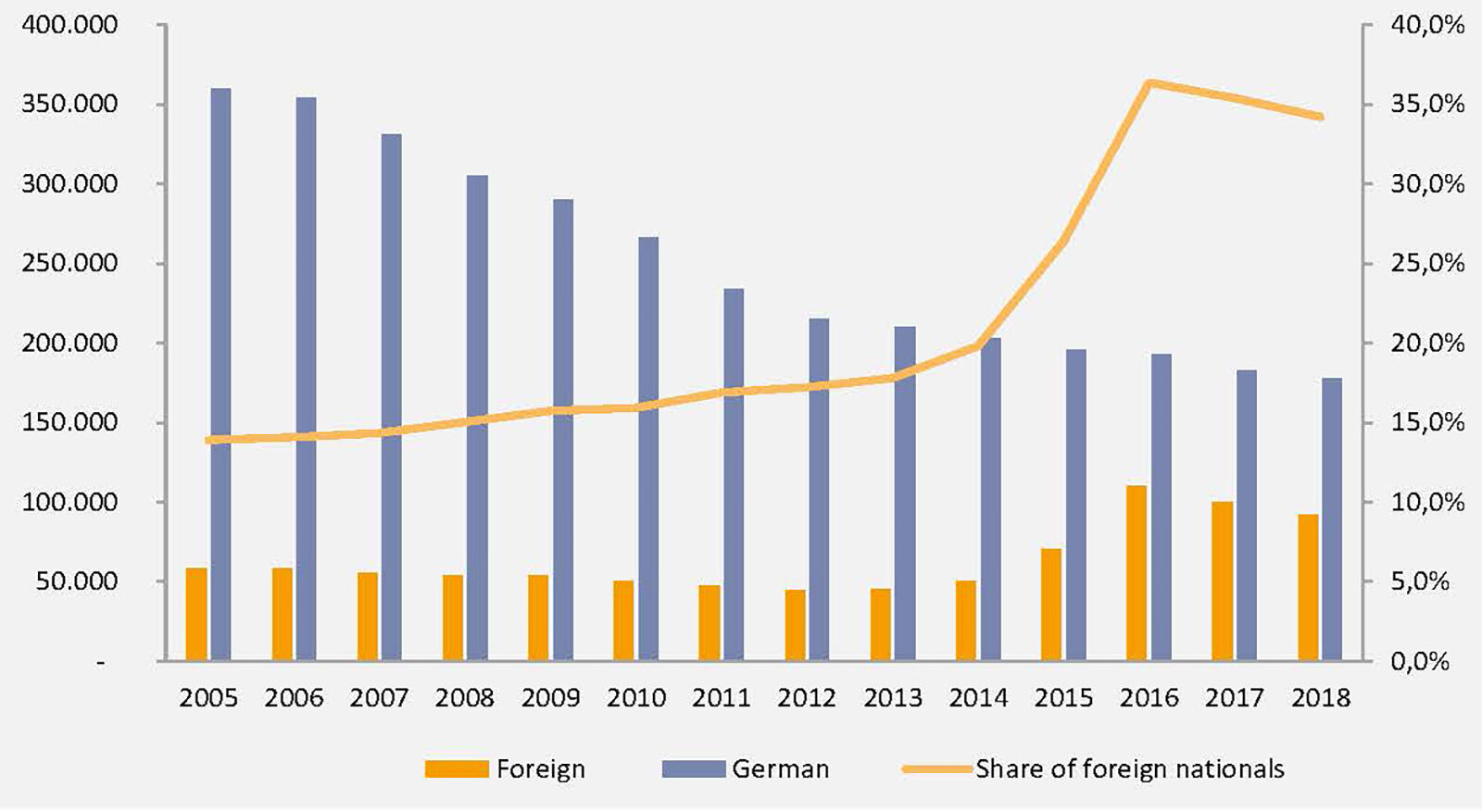
The Figure illustrates the development of beginners in the transitional sector. According to this, the number of foreign beginners in the transitional sector has risen substantially (+120 % from 2014 to 2016). Although the absolute numbers of foreign beginners were decreasing again in 2018 compared with 2016 (-16 %) and the percentage of foreigners has also declined slightly, the level still remains comparatively high, as the number of German young people has also reduced over the same period.
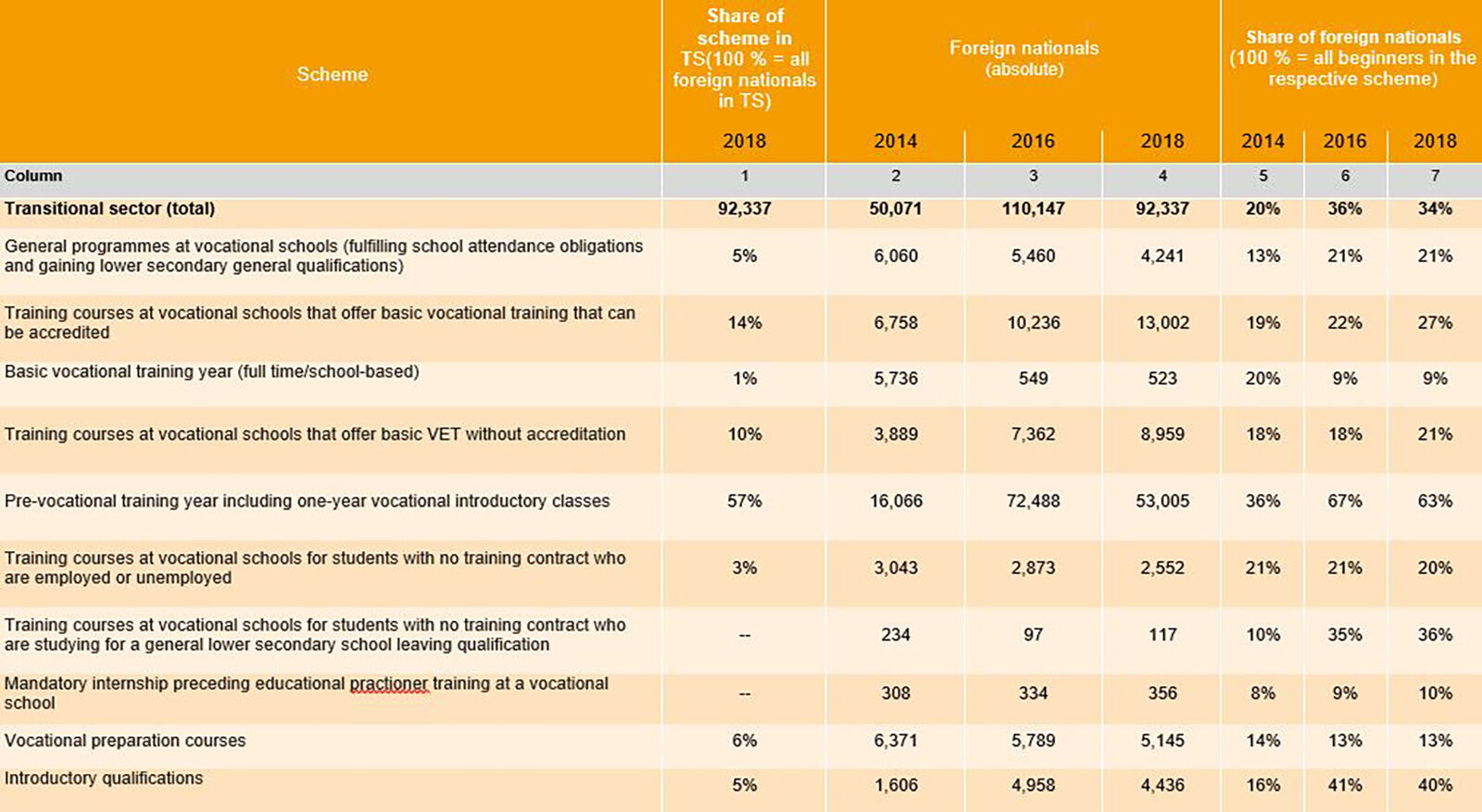
If we look at the development of foreign beginners in training measures (schemes), there are clear contrasts (cf. Table). Column 1 shows the distribution of foreign beginners across the transition schemes. The “pre-vocational training year including one-year vocational introductory classes” scheme is most important for the integration of foreign beginners. 53,005 individuals – more than half (57 %) of all foreign nationals – have recently started such a measure. The rapidly changing share of foreign nationals (columns 5 and 6) also emphasises the particular significance of these measures for this target group (from 36 % in 2014 to 67 % in 2016). In 2018, the share declined slightly to 63 per cent. A comparatively high number of young foreigners (14 %) also end up in “training courses at vocational schools that offer basic vocational training that can be accredited”. However, here the proportion of foreign nationals is increasing at a more moderate rate (+8 percentage points between 2014 and 2018). “Training courses at vocational schools that offer basic VET without accreditation” are also significant for this target group with ten percentage.
In relation to the development of the number of beginners between 2014 and 2018 (columns 2-4), the “Pre-vocational training year including vocational introductory classes” scheme catches the eye once again. In this category, the number of foreign beginners more than quadrupled between 2014 and 2016. Although the numbers have been decreasing since then, they are still significantly higher than the level in 2014. This can be explained above all by the fact that, in most federal states, pupils with insufficient German skills are taught in special pre-vocational one-year classes at vocational schools. These have different “labels” depending on the federal state. For example, Lower Saxony has “SPRINT classes” while Saxony-Anhalt refers to them as “language support classes or literacy classes (BVJ-S)”.
The introductory qualifications (EQ) are also striking. In many federal states, this measure has been expanded to provide specific offers for refugees. For example, Saxony-Anhalt offers the “Introductory qualification Plus (EQ++) with supplementary language teaching”. In Brandenburg, “EQ Welcome” is aimed at young refugees. Throughout Germany, the numbers of individuals in EQ measures almost tripled between 2014 and 2018, but have also been decreasing since 2016. In the same time period, the proportion of foreign nationals increased considerably, from 16 per cent in 2014 to 40 per cent in 2018.
Given the significance and development of the two schemes that provide basic VET with or without accreditation, it is clear that foreign youths do not enter the transitional sector solely with the objective of learning the language, but also participate in measures that prepare them for VET and provide partial qualifications. However, the range of offers taken up by this group is less broad than that by German young people, particularly as a result of the lack of language skills (cf. Statistisches Bundesamt 2019).
Structural integration into education and work
As a result of the obligatory participation in training measures for language learning and basic VET in particular, the transitional sector plays a fundamental institutional role in the “structural integration” (also cf. Esser 2009) of refugees.
The VET statistics also demonstrates that participation in transitional sector measures also improves the refugees’ chances of finding an apprenticeship place. More and more young people who are “citizens of one of the most common asylum countries of origin” (mostly refugees) and previously participated in a transitional sector measure end up in dual VET (BIBB Trainee Data System DAZUBI 2019). The Bundesagentur für Arbeit (BA) [Federal Employment Agency]/BIBB migration study also shows that participation in an EQ measure significantly increases VET opportunities (also cf. Matthes et al 2018). The transitional sector therefore also creates the basis for more long-lasting and deeper structural integration of refugees into work and society.
Although the number of foreign nationals in the transitional sector has been declining again since 2016, this sector is expected to continue playing an important dual role for the integration of refugees for a while to come. In addition to the short-term structural integration through temporary measures with a mixed role (language learning and/or basic occupational skills), the transitional sector fosters the integration into VET by providing prospects for those involved.
Literature
BEICHT, U.: Bedeutung und Wirksamkeit von Bildungsgängen des Übergangssystems (Analysen auf Basis der BIBB-Übergangsstudie 2006). In: BIBB (Ed.): Datenreport zum Berufsbildungsbericht 2010: Informationen und Analysen zur Entwicklung der beruflichen Bildung. Bonn 2010, pp. 90-96
DAZUBI: „Datenbank Auszubildende“ des BIBB auf Basis der Berufsbildungsstatistik der statistischen Ämter des Bundes und der Länder (Erhebung 31.12.), Berichtsjahre 2015 -2017. Bonn 2019
ESSER, H.: Pluralisierung oder Assimilation? Effekte der multiplen Inklusion auf die Integration von Migranten. In: Zeitschrift für Soziologie 38 (2009) 5, pp. 358–378
MATTHES, S. et al.: Junge Geflüchtete auf dem Weg in Ausbildung. Ergebnisse der BA/BIBB-Migrationsstudie 2016. Bonn 2018 – URL: www.bibb.de/veroeffentlichungen/de/publication/show/8620 (retrieved: 27.05.2019)
STATISTISCHES BUNDESAMT: Integrierte Ausbildungsberichterstattung 2017 und Schnellmeldung 2018 – Anfänger, Teilnehmer und Absolventen im Ausbildungsgeschehen nach Sektoren/Konten und Ländern. Wiesbaden 2019
REGINA DIONISIUS
Dr., Research Associate in the “Vocational Training Supply and Demand, Training Participation” Division at BIBB
AMELIE ILLIGER
Research Associate in the “Vocational Training Supply and Demand, Training Participation” Division at BIBB
Translation from the German original (published in BWP 4/2019): Beverly Rudd, Exact! Sprachenservice, Mannheim